





The Benefits of Music Education: An Evidence Round-Up for Parents
Every parent wants to give their child the best possible start in life. You sign up for reading programmes, explore sensory play, and debate the merits of various enrichment classes. But one thing the research consistently points to — across neuroscience, psychology, and education — is the remarkable power of music education for children. Not just for raising future musicians, but for building smarter, more emotionally resilient, and better-prepared little learners.
Yet despite the growing body of evidence, many parents still view music classes as a “nice extra” rather than a developmental essential. This article changes that. We’ve rounded up the key findings from peer-reviewed studies and child development research to show exactly what music education does for young minds — particularly in the crucial window from birth to age five. Whether your child is still a baby or heading into preschool, this evidence may well reshape how you think about their early learning journey.
Why Music Education Matters More Than You Think
Music has accompanied human development since before recorded history, but it is only in recent decades that science has begun to reveal just how profoundly it shapes the developing brain. Music is crucial for babies in every developmental sense — with regards to communication and language, emotional and social well-being, and even motor skills. It is only relatively recently that science has begun to elaborate in more detail the true extent of its significance. The findings, taken together, make a compelling case that music is far more than entertainment. It is one of the most effective developmental tools available to parents and educators alike.
Research has found that music education improves skills like planning and following instructions, builds stronger neuroplasticity, and provides a quantifiably significant incentive for children at risk for dropping out to remain in school. The breadth of these effects — spanning cognition, language, movement, emotion, and academic performance — explains why leading educators and neuroscientists describe music as one of the most powerful early childhood interventions we have.
Benefit 1: Music Accelerates Brain Development
Of all the findings in music education research, perhaps the most striking involves the brain itself. Music instruction appears to accelerate brain development in young children, particularly in the areas of the brain responsible for processing sound, language development, speech perception, and reading skills, according to initial results of a five-year study by USC neuroscientists. This is not a marginal effect — it represents a meaningful acceleration in the very neural structures children need for lifelong learning.
“There’s some good neuroscience research that children involved in music have larger growth of neural activity than people not in music training,” said Eric Rasmussen, chair of the Early Childhood Music Department at Johns Hopkins University’s Peabody Preparatory. The explanation lies in how music uniquely engages the brain. Music simultaneously stimulates multiple areas of the brain, demanding integration of sound, memory, movement, and emotion all at once. Studies have even found that musicians exhibit larger brain volume in certain regions associated with auditory processing and executive functions when compared to non-musicians.
The hypothesis that music education affects cognitive abilities and brain plasticity, with potential transferability to other domains, has been the focus of several studies published over the last decade. While some studies suggest that abilities related to executive functions are enhanced by musical training, inhibitory control — one of the central dimensions of executive functions — appears consistently to benefit from music education, especially among preschoolers. For parents of young children, this means that structured music participation during the preschool years can directly shape the executive function skills — focus, self-control, and planning — that underpin success in school and beyond.
Benefit 2: Music Builds Language and Literacy Skills
The connection between music and language is one of the most extensively studied areas in early childhood research, and the findings are consistently positive. Emerging evidence suggests the areas of the brain controlling both musical ability and language comprehension are more related than previously thought. Music education requires students to recognise and repeat pitch, tone, or enunciation of words. Especially in young children, music directly benefits the ability to learn words, speak them correctly, and process the many new sounds they hear from others.
A study conducted at Northwestern University revealed that music training improves the neural processing of speech, leading to enhanced language skills in children. This finding underscores the broader cognitive benefits of music education, as language proficiency is crucial for academic success across various subjects. For babies and toddlers specifically, the evidence is equally compelling. Research showed that the home musical environment significantly predicted gesture development, and for infants below 12 months, both parental singing and overall home musical environment significantly predicted word comprehension. These findings represent the first demonstration that an enriched musical environment in infancy can promote the development of communication skills.
Listening to music and moving to the beat helps young babies learn to recognise patterns in music and language. Singing songs with rhymes, numbers, and patterns supports older infants and toddlers’ cognitive development, including memory, sequencing, and storytelling. This is precisely the approach taken in programmes like Tenderfeet at The Music Scientist, where even the youngest learners benefit from music-rich sensory experiences designed to lay the groundwork for language and communication. For toddlers taking their next steps, the Happyfeet programme builds on this foundation by pairing movement and melody with early vocabulary and listening skills.
Benefit 3: Music Strengthens Motor Skills
Motor development and music are more intertwined than many parents realise. Music improves babies’ and toddlers’ motor skills. Music stimulates a baby’s sensory experience and provides opportunities to practise motor skills, by moving to the beat, for example. This happens because rhythm is inherently physical — children who hear a beat naturally want to move their bodies in response, and that movement is developmental work in action.
Incorporating movement into early childhood education supports the development of both fine and gross motor skills. Through dance, play, and physical activities, children improve their body awareness and coordination. When children engage in activities like dancing, hopping, or clapping, they are refining their motor skills. Gross motor skills are enhanced through larger movements like jumping or running, while fine motor skills are developed through smaller actions such as finger plays or playing simple musical instruments. These activities are essential for developing coordination and control, which are crucial for everyday tasks and future academic skills like writing.
Movement supports early maths and brain development by turning abstract concepts into embodied experiences that strengthen spatial reasoning, counting, and numerical patterning. When children step through counting songs or trace shapes while singing, they map numeric sequences onto body-based routines, creating robust sensorimotor associations that bolster number sense. The Groovers programme at The Music Scientist is built around exactly this insight, combining music and dance to build coordination, body awareness, and spatial understanding in toddlers. Older children exploring the Scouts programme take it further, embedding science and general knowledge themes into catchy, movement-rich musical experiences.
Benefit 4: Music Supports Social and Emotional Development
Beyond the cognitive and physical, music plays a profound role in how children learn to understand and manage their emotions and connect with others. Research has shown that music can have a significant impact on a child’s motor and cognitive skills, as well as their social-emotional development. The latter is particularly important for helping children understand and manage emotions, build confidence, and form meaningful relationships. This emotional dimension of music education is especially significant in the early years, when children are still developing the internal tools they need to navigate big feelings.
Studies show that children as young as 3 can notice emotions in music and can even recognise “happy” and “sad” in musical excerpts that are just 0.5 seconds long. This sensitivity to emotional cues in music can be nurtured and channelled. A landmark study of toddlers in Finnish early childhood settings found that children in groups where music and singing were emphasised exhibited more sustained intense activity, less low or interrupted involvement, more positive emotions, increased social adaptation, and increased social engagement. The evidence from group settings is equally clear. A study from the Bernard van Leer Foundation found that singing interventions in early infancy may reduce parental anxiety, improve mood, encourage emotional development, and improve bonding and attachment between parent and child.
A systematic review of the research suggests several beneficial effects of music on children’s development, such as greater emotional intelligence, academic performance, and prosocial skills. For parents, these findings point to something that intuitively makes sense: music shared between a caregiver and child is not just enjoyable. When a parent sings or moves in time to music with a baby, both brains release oxytocin, a bonding hormone that offers a sense of peace and well-being. From lullabies in infancy to group sing-alongs in toddlerhood, every musical moment is also an emotional one.
Benefit 5: Music Primes Children for School Success
One of the most practically important benefits of music education for parents preparing young children for formal schooling is its direct link to academic performance and school readiness. “Study after study proves that regardless of socioeconomic background, music-making students do better in school than those who have no music involvement.” The mechanisms behind this are multiple and well-documented.
Children exposed to music education often show improved language development and memory, and they tend to have better attention spans and mathematical capabilities. These are precisely the building blocks of school readiness. Attention, memory, the ability to follow instructions, and early numeracy all correlate strongly with how well a child adapts to formal learning environments. Skill tests performed on 5,154 fifth-graders found that children who were learning to play an instrument received higher marks than classmates who were not. Children who were learning longer had higher scores.
For families specifically focused on preparing their children for Singapore’s preschool and primary school environment, this evidence is particularly relevant. The Music Scientist’s SMART-START English and SMART-START Chinese preschool readiness programmes are designed around exactly this evidence — using originally composed music integrated with general knowledge themes to build the cognitive foundations children need for a seamless transition into formal education. Music is not a supplement to school preparation here; it is the engine of it.
Why Starting Early Makes All the Difference
A recurring theme in the research is that earlier music exposure yields stronger and more lasting benefits. Researchers found that students who started music education before age 8 were more hopeful about the future, and younger students who received musical training scored higher in key measures of positive youth development. The window from birth to approximately age five represents the period of greatest neural plasticity — when the brain is most receptive to shaping through rich, stimulating experiences.
Brain research has shown the essential role played by stimulating experiences during the first years of life in developing both multiple neural connections and networks and cognitive abilities. Exposure to visual, sound, and tactile stimuli contributes to the development of motor, emotional, behavioural, cognitive, and social skills. Early experiences are crucial to the development of the architecture of a young brain, and in particular, music has a fundamental role in this process. This is why the age range of 4 to 47 months — the focus of The Music Scientist’s programmes — represents such a critical and opportunity-rich period for music-based learning.
Young children learn best through repetition, sensory experience, and responsive relationships. Music brings all three together. A familiar song gives a child something predictable to anticipate. A steady beat invites movement and coordination. And singing face to face with a caregiver builds the trust and connection that underpins all healthy development. The earlier these experiences begin, the deeper their roots — and the further they reach.
Giving Your Child the Musical Advantage
The evidence is clear, consistent, and compelling. Music education is not a luxury enrichment activity reserved for musically gifted children. It is one of the most evidence-backed investments a parent can make in their young child’s cognitive development, language skills, motor coordination, emotional intelligence, and school readiness. And the earlier it begins, the greater the returns.
For babies and toddlers, music is not just about learning songs — it is about building brains. Every rhythm clapped, every melody sung, every instrument explored is laying down neural pathways that will serve your child across every domain of learning and life. The research is unanimous on this: music-engaged children develop faster, more broadly, and more confidently than those without it.
At The Music Scientist, every programme is built around this body of evidence — combining music, movement, and sensory play to nurture the whole child at every developmental milestone, from infancy through the preschool years. Whether your child is just finding their feet or getting ready for their first day of school, there is a music-powered pathway designed for them.
Ready to Give Your Child the Musical Head Start They Deserve?
Explore The Music Scientist’s developmentally-designed programmes for babies, toddlers, and preschoolers — and see how music can transform your child’s early learning journey.
Ask any preschool teacher what the secret is to a smooth, joyful classroom morning, and the answer is almost always the same: a good song. Circle time songs do so much more than fill space between activities. They signal transitions, anchor routines, build language, spark curiosity, and give young children the one thing they need most to feel safe and ready to learn — predictability wrapped in melody.
But not all circle time playlists are created equal. Most lists simply bundle songs together by theme without considering when in the day they actually belong. A greeting song used as a clean-up cue loses its power. A high-energy movement song right before story time can undo twenty minutes of settling. The magic happens when the right song meets the right moment in the routine.
At The Music Scientist, music is never background noise — it is the medium through which young children aged 4 to 47 months learn to think, move, communicate, and grow. Drawing on that developmentally grounded approach, we have put together 30 circle time songs sorted by routine stage, from the moment children arrive to the final goodbye. Each song is matched to the part of the day where it will have the greatest impact, along with a clear explanation of the developmental skill it is building.
Whether you are a preschool teacher building your first circle time plan or a parent curious about what makes these songs so powerful, this guide gives you both the playlist and the understanding behind it.
What Is Circle Time in Preschool?
Circle time is a structured, teacher-led group activity that typically takes place at the start of the preschool day, though it can also occur during transitions or at closing time. Children gather together — usually on a mat or carpet — to participate in shared routines that include songs, greetings, stories, movement, and simple learning activities like calendar review and weather observation. The format is deliberately circular because the shape itself communicates equality: every child can see every other child, making eye contact natural and listening feel mutual.
The purpose of circle time goes well beyond the activities themselves. It builds a sense of classroom community, establishes consistent expectations, and provides the predictable structure that young children need to feel emotionally secure. When circle time is rich with music, these benefits multiply. Songs give children a clear, pleasurable signal for what comes next, reducing anxiety around transitions and allowing cognitive energy to flow into learning instead of adjustment.
Why Circle Time Songs Matter More Than You Think
There is genuine science behind why music is such a powerful vehicle for early learning. Research shows that early musical training is especially effective between the ages of 2 and 5, a window during which the brain exhibits heightened plasticity and rapidly forming neural connections. Music-making activities during this period engage the motor, visual, and auditory cortices simultaneously, fostering holistic brain development in ways that few other activities can match.
For preschoolers specifically, circle time songs support development across multiple domains at once. Singing introduces new vocabulary, sharpens pronunciation, and builds the phonological awareness that underpins early literacy. The repetition and pattern recognition embedded in songs strengthen memory and sequencing skills. Group singing teaches children to listen, take turns, and cooperate — essential social-emotional competencies that will serve them long after preschool ends. And for children who thrive on kinesthetic or musical learning styles, songs are often the most natural entry point into new concepts.
At The Music Scientist, this is exactly the philosophy behind programs like Groovers and Scouts — using originally composed music integrated with real learning themes so that knowledge, rhythm, and memory become inseparable. The 30 songs below are chosen with that same principle in mind: each one earns its place in the routine not just because it is enjoyable, but because it actively develops something.
30 Circle Time Songs Sorted by Routine
1. Arrival and Greeting Songs (Songs 1–5)
The arrival moment is one of the most emotionally loaded parts of a preschooler’s day. Children are separating from caregivers, entering a social environment, and regulating a cascade of feelings — all before they have even sat down. A warm, familiar greeting song acts as an emotional anchor, telling a child’s nervous system: this place is safe, I know what happens here, I belong. These songs also begin the work of name recognition, social bonding, and turn-taking from the very first minute.
- 1. Hello Song (The Singing Walrus) — A gentle, name-personalised greeting that signals the start of circle time and builds each child’s sense of belonging within the group.
- 2. Good Morning, Friends — Sung to a simple tune, this song invites every child to greet their neighbours, building eye contact and early social reciprocity.
- 3. The More We Get Together — A beloved classic that reinforces community and friendship through a swaying, repetitive melody ideal for easing separation anxiety.
- 4. Where Is (Child’s Name)? — Adapted from “Where Is Thumbkin?”, this personalised greeting song doubles as an attendance check, making each child feel individually seen and welcomed.
- 5. Come and Sit with Me — A simple, inviting song that helps children transition from free play or drop-off into the circle, using a calm, predictable melody to guide their focus inward.
2. Morning Opening and Attendance Songs (Songs 6–9)
Once children have settled, the morning opening songs shift the group’s collective energy toward shared learning. This is also when attendance routines happen, and singing a child’s name is one of the most powerful ways to build name recognition and literacy awareness in the whole group. Children who hear their name in a song develop a positive association with their own identity as a learner — a subtle but meaningful confidence builder.
- 6. Who Is Here Today? — An attendance song where each child’s name is called and the group responds, reinforcing listening, name familiarity, and simple social interaction.
- 7. Rise and Shine — A lively, upbeat morning song that elevates energy intentionally, helping children shift from quiet arrival mode into alert, ready-to-learn mode.
- 8. One Little, Two Little (Children in Our Class) — A counting-based attendance song that simultaneously reinforces number concepts and helps children track the size of their group.
- 9. Good Morning to You (Sung to “Happy Birthday”) — Simple, familiar, and universally loved. Its melodic familiarity reduces cognitive load, allowing children to focus entirely on the social ritual of greeting.
3. Calendar and Weather Songs (Songs 10–13)
Calendar and weather activities are cornerstones of the preschool circle time routine, and music transforms what could be rote recitation into genuine understanding. When children sing the days of the week or describe today’s weather in a song, they are encoding sequential information into long-term memory far more effectively than when they simply recite it. These songs build temporal awareness — the understanding of time, sequence, and prediction — which is foundational for mathematical reasoning and self-regulation alike.
- 10. The Days of the Week Song (The Singing Walrus) — A catchy, rhythmically clear song that helps children internalize the seven-day sequence through repetition and a memorable melody.
- 11. Seven Days in a Week (The Kiboomers) — A slightly different take on the same concept, useful for reinforcing days-of-the-week learning with a fresh tune that keeps the concept feeling new.
- 12. What’s the Weather Like Today? — Children identify the day’s weather conditions and describe them through song, building both observational skills and descriptive vocabulary.
- 13. Today, Yesterday, and Tomorrow (StoryBots) — Introduces more nuanced temporal concepts — past, present, and future — through a colourful, animated melody that makes abstract time feel concrete and relatable.
4. Learning Content Songs: Numbers, Letters, Colors, and Shapes (Songs 14–20)
This is the heart of the educational circle time session, where songs become the curriculum. The most effective learning content songs do not simply list information — they use melody, rhyme, and rhythm to create memory hooks that children can retrieve long after the session has ended. Research on music and cognition consistently shows that information set to music is recalled more easily and accurately than the same information presented verbally or visually alone. For preschoolers targeting multiple intelligences — logical, musical, verbal, and kinesthetic — these songs are doing the heavy lifting of early academic preparation.
- 14. Five Little Monkeys — Combines counting and simple subtraction with an irresistibly silly narrative, making mathematical thinking feel like play.
- 15. One, Two, Buckle My Shoe — A classic counting rhyme that also introduces rhyming patterns, laying essential phonological groundwork for reading readiness.
- 16. The Ants Go Marching — Sequential counting from one to ten embedded in a marching narrative that invites physical engagement, reinforcing number order through movement.
- 17. The Alphabet Song — Arguably the most impactful song in early literacy, this melody maps all 26 letters onto a memorable tune, giving children their first scaffold for letter recognition.
- 18. The Rainbow Song (Super Simple Songs) — Teaches colour names in a logical, visually rich sequence (red, orange, yellow, green, blue, violet) using a melody that makes the order easy to remember.
- 19. I Can Sing a Rainbow (The Kiboomers) — A slightly slower, more lyrical colour song that encourages gesturing and visual imagination alongside singing, supporting multi-sensory colour learning.
- 20. Shapes Song (The Kiboomers) — Introduces circle, square, triangle, and rectangle through a catchy tune with descriptive lyrics, helping children connect shape names to their visual properties.
Songs in this category connect beautifully with programs like SMART-START English and SMART-START Chinese, which use music specifically to prepare children for the literacy and numeracy demands of formal schooling.
5. Movement and Brain Break Songs (Songs 21–24)
Preschoolers are not designed to sit still for long stretches, and neuroscience confirms this: physical movement increases blood flow to the brain and activates the neural pathways associated with attention and memory consolidation. A well-placed movement song mid-way through circle time does not interrupt learning — it supercharges what comes next. Finger plays develop fine motor control and hand-eye coordination. Action songs build gross motor skills, body awareness, and spatial reasoning. The key is using movement intentionally, not just as an energy release.
- 21. Head, Shoulders, Knees and Toes — One of the most developmentally efficient songs in early childhood education, simultaneously building body part recognition, gross motor coordination, listening skills, and increasing tempo as a challenge device.
- 22. The Itsy Bitsy Spider — A perfect finger play that develops fine motor dexterity, hand-eye coordination, and narrative sequencing through a short, repeatable story arc.
- 23. If You’re Happy and You Know It — Introduces emotional vocabulary and physical expression together, asking children to identify a feeling and respond with a corresponding action, supporting social-emotional learning.
- 24. Freeze Dance Song (Scratch Garden) — Children dance freely and then stop on cue, building impulse control, listening skills, and self-regulation in a high-energy, thoroughly enjoyable format.
This kind of music-and-movement integration is central to programmes like Happyfeet for toddlers and Tenderfeet for infants, where sensory play and musical movement are combined to support developmental milestones from the earliest months.
6. Transition and Clean-Up Songs (Songs 25–27)
Transitions are consistently among the most challenging moments in the preschool day. Young children struggle with abrupt shifts because their executive function — the part of the brain that manages flexibility and impulse control — is still very much under construction. Transition songs work because they give children advance warning in a form they enjoy, making the change feel like something that is happening with them rather than to them. They also provide a built-in timer, which teaches children early time-management awareness.
- 25. Clean Up Song (ELF Learning) — A simple, upbeat signal that it is time to tidy up. Consistency is key: using the same song every time creates an automatic behavioural cue that reduces resistance and speeds up the transition.
- 26. This Is the Way (Super Simple Songs) — Highly adaptable to any routine step — washing hands, packing bags, lining up — by simply changing the lyrics to match the action, making it a versatile classroom management tool.
- 27. Time to Sit Down — A calm, directive song that helps children move from active play back into a focused seated position, using a gentle melody to lower arousal rather than escalate it.
7. Closing and Goodbye Songs (Songs 28–30)
How a session ends matters just as much as how it begins. A closing song signals the psychological completion of the learning block, giving children’s brains a moment to consolidate what they have experienced. It also eases the emotional challenge of saying goodbye — to friends, to teachers, and to the safety of the classroom routine. Children who leave circle time with a positive, musical send-off carry that warmth into the next part of their day, whether that is lunch, nap time, or home.
- 28. Goodbye Friends (The Singing Walrus / Maple Leaf Learning) — A warm, gentle farewell song that reinforces the concept of closure while making separation feel manageable and emotionally safe.
- 29. See You Later, Alligator — A call-and-response goodbye song filled with rhyming animal pairs, keeping the farewell playful and upbeat while reinforcing phonological awareness through rhyme.
- 30. The More We Get Together (Goodbye Verse) — Bookending the session by returning to a familiar opening song creates a sense of wholeness and routine, reinforcing children’s trust in predictable structure and communal belonging.
How to Build a Song-Centered Circle Time Routine
The most effective circle time routines share three qualities: they are consistent, they are developmentally sequenced, and they are flexible enough to grow with the children. Start by anchoring the session with fixed songs — a greeting song that never changes, and a goodbye song that always closes. These constants are the emotional scaffolding of the routine. Children who know what the first and last songs will be walk into and out of circle time with confidence, regardless of what happens in between.
Within that frame, sequence your content songs to follow the natural arc of a child’s attention and energy. Opening with warm, social greeting songs, moving through calendar and learning content at peak attention (usually mid-session), inserting a movement song when you sense focus beginning to drift, and then closing with calm transition and goodbye songs mirrors the natural rhythm of a young child’s cognitive stamina. Think of circle time as a musical story with a clear beginning, middle, and end — and choose songs that serve each chapter.
It also helps to align circle time songs with the learning themes your classroom is exploring that week. If the theme is animals, lean into songs like Old MacDonald Had a Farm or Five Little Ducks during the learning content segment. If you are exploring emotions, If You’re Happy and You Know It takes on deeper meaning. This thematic coherence reinforces learning across multiple contexts, one of the most powerful strategies in early childhood education.
Tips for Keeping Preschoolers Engaged During Circle Time
Even the best playlist needs a skilled, enthusiastic delivery to reach its full potential. Young children are exquisitely sensitive to the energy of the adults around them. When a teacher sings with genuine joy and full-body commitment — big gestures, clear facial expressions, authentic enthusiasm — children mirror that energy and invest themselves more deeply in the experience. There is no “performance” too large for a preschool classroom.
Here are a few practical strategies that work especially well during circle time songs:
- Use props and visuals. Puppets, picture cards, scarves, and simple instruments give children something to focus on and interact with, deepening engagement especially for visual and kinesthetic learners.
- Vary the tempo and volume deliberately. Singing a familiar song in a whisper, or suddenly speeding it up, recaptures wandering attention immediately and adds an element of playful surprise.
- Invite participation gradually. Let children observe a new song before expecting them to join in. Most children will begin participating naturally within a few repetitions once they feel the rhythm is safe and familiar.
- Create space for child-led moments. Ask a child to choose the next song, lead an action, or add a new verse. This builds agency, confidence, and investment in the shared routine.
- Keep it short. A well-paced circle time for 3- to 4-year-olds typically runs 15 to 20 minutes. It is far better to end while children are still engaged than to push past that window and lose the magic.
Take Circle Time Further with The Music Scientist
Circle time songs are a wonderful introduction to the power of music in early learning — but they are just the beginning of what music can do for a young child’s development. At The Music Scientist, every programme is built on the understanding that music is not an enrichment add-on but a core developmental medium, one that targets logical, musical, kinesthetic, and verbal intelligences simultaneously through original compositions and themed general knowledge content.
For the youngest learners, Tenderfeet brings sensory-rich music experiences to babies and infants, laying neural foundations from the earliest months. Toddlers in Happyfeet and Groovers build movement vocabulary, motor skills, and language through music and dance. Older preschoolers in Scouts explore science concepts through catchy, curriculum-aligned melodies. And for children approaching the transition into formal schooling, SMART-START English and SMART-START Chinese use music to ensure that readiness in literacy, numeracy, and self-regulation arrives before the first day of Primary One.
The Routine Is the Song
The 30 circle time songs in this list are more than a playlist — they are a framework for the kind of predictable, joyful, developmentally rich daily routine that helps young children flourish. When every transition has a song, when every morning begins and ends with a familiar melody, children are not just having fun. They are building language, memory, focus, emotional regulation, social skills, and a love of learning — all at once, without even realising it.
That is the quiet power of music in early childhood. Choose the right song for the right moment, deliver it with warmth and consistency, and the results will speak for themselves — in calmer mornings, in children who cannot wait to get to the carpet, and in the skills they carry proudly into every next stage of learning.
Want to See the Science of Music in Action?
The Music Scientist’s programmes bring the same developmental thinking behind these circle time songs into fully structured, expert-designed music enrichment classes for babies, toddlers, and preschoolers aged 4 to 47 months. Whether your child is just beginning to respond to rhythm or is ready to prepare for primary school, there is a programme designed exactly for where they are right now.
There is something wonderfully disarming about a toddler’s face the moment a song becomes a game. Finger plays — those short, sung or chanted rhymes paired with hand and finger movements — have captivated young children for generations, and modern developmental research now explains exactly why. Far from being just a cute distraction, finger plays are one of the most efficient, zero-cost tools a parent or educator can use to simultaneously build fine motor skills, language, memory, counting ability, and social confidence in children as young as six months old.
This guide gives you 20 of the best finger plays for toddlers, complete with full lyrics and clear, step-by-step actions so you can start right away. Each play is grouped by the primary developmental skill it targets, and we have included the science behind why each category matters. Whether you are a parent looking for screen-free entertainment at home, a preschool teacher building your repertoire, or a caregiver wanting to turn ordinary moments into learning opportunities, this resource has everything you need.
What Are Finger Plays?
A finger play is a short song, chant, or rhyme in which hand and finger movements are used to act out the words. The movements can range from large, sweeping gestures like waving both arms, to precise, small actions like isolating a single finger to represent a character. The defining feature is the pairing of movement with language: every line of the rhyme corresponds to a physical action, creating a multi-channel learning experience that engages the body and the mind at the same time.
Finger plays are different from simple action songs in that they typically demand more deliberate finger control rather than just whole-body movement. This specificity is what makes them so powerful for toddlers aged roughly 12 to 48 months, a period when hand and finger dexterity is developing rapidly. They require no materials, no setup, and no special space — making them ideal for use at home, in the car, at the dinner table, or in a classroom setting.
Why Finger Plays Matter: The Developmental Science
Finger plays work because they engage multiple developmental pathways simultaneously, reinforcing learning in a way that any single-channel activity simply cannot replicate. When a toddler hears a rhyme, copies a hand movement, watches a caregiver’s face, and anticipates the next line, they are activating auditory, visual, tactile, and kinesthetic processing all at once. This multisensory engagement is precisely what early childhood education researchers point to when explaining why these activities are so effective at building skills.
Fine motor development is one of the most direct and well-documented benefits. The small, isolated finger movements required in finger plays are the same muscles a child will later use for writing, drawing, and self-care tasks like buttoning clothes. Without plenty of practice building these muscles during the toddler years, children can struggle with pencil grip and hand control when they begin formal schooling. A simple daily habit of finger rhymes therefore quietly lays a foundational skill that pays dividends years later.
Language and early literacy are equally well-supported. The rhythmic patterns of rhyming songs help children hear the small sounds that make up words, a skill known as phonemic awareness, which is one of the strongest predictors of reading success. Repetition of the same lyrics across multiple sessions also builds vocabulary, as children begin to associate words with actions and mental images. For bilingual families — a common scenario here in Singapore — singing the same finger play in two languages strengthens vocabulary across both and helps children map actions to words in each language.
Cognitive development, including memory, attention, and sequencing, is also strongly supported. Memorizing a finger play requires a child to hold a sequence of movements and words in working memory, then reproduce them in the correct order. Over time this strengthens the neural pathways involved in planning, focus, and procedural memory. Even the delightful repetition that can make parents a little weary is precisely what makes these activities so effective: repetition builds mastery, and mastery builds confidence.
Social and emotional development round out the picture. Finger plays are naturally turn-taking activities. When performed in a group, they build awareness of others, practice of joint attention, and the quiet confidence that comes from doing something successfully alongside peers. For shy or anxious toddlers especially, the structured predictability of a familiar rhyme offers a low-pressure way to participate and belong.
How to Get Started with Finger Plays
Starting is simpler than it sounds. Choose one or two of the rhymes below, learn them yourself first, then introduce them slowly, doing the actions alongside your child and leaving space for them to copy you. There is no need for perfection — a toddler who is waving vaguely in the right direction while grinning is getting every benefit the activity offers. Keep sessions short: aim for one to three minutes per rhyme for toddlers, and repeat your favorites several times a day rather than doing a single long session. Consistency and repetition are far more valuable than variety.
As your child grows more confident with the actions, you can introduce variations — speeding up, slowing down, whispering the words, or pausing expectantly to let them fill in the missing word. These micro-challenges develop listening skills, anticipation, and expressive language in a playful way that feels more like a game than a lesson.
Fine Motor and Hand Coordination Finger Plays
The following six finger plays specifically target fine motor skill development — the ability to make small, controlled movements with the fingers and hands. These are especially valuable for toddlers approaching preschool age, as they lay the groundwork for writing and drawing. At Happyfeet, our enrichment classes for 18-month-olds and toddlers incorporate activities like these to build hand strength and dexterity through music and play.
1. Where Is Thumbkin?
Skill focus: Finger isolation, sequencing, naming
Lyrics and actions:
- Where is Thumbkin? Where is Thumbkin? — (hide both hands behind your back)
- Here I am! Here I am! — (bring out left thumb, then right thumb)
- How are you today, sir? Very well, I thank you! — (wiggle each thumb toward the other in turn)
- Run away, run away! — (tuck each hand back behind your back)
- Repeat for Pointer, Tall Man, Ring Man, and Pinky.
This classic builds individual finger isolation — the ability to move one finger independently of the others — which is a key pre-writing milestone. Children love the anticipation of each finger “appearing,” making it naturally engaging.
2. Open, Shut Them
Skill focus: Bilateral hand coordination, following directions
Lyrics and actions:
- Open, shut them, open, shut them — (open and close both hands with each word)
- Give a little clap, clap, clap! — (clap three times)
- Open, shut them, open, shut them — (repeat hand opening/closing)
- Put them in your lap, lap, lap! — (place hands in lap)
- Creep them, creep them, creep them, creep them — (walk fingers slowly up chest)
- Right up to your chin, chin, chin! — (tap chin)
- Open up your little mouth — (open mouth wide, pause with anticipation)
- But do not let them in! — (quickly bring hands back down)
The surprise ending — where fingers almost go into the mouth but don’t — delights toddlers every time and keeps them engaged through multiple repetitions. The alternating open-close movements build bilateral coordination that is foundational for all hand-based tasks.
3. Itsy Bitsy Spider
Skill focus: Fine motor coordination, storytelling through action
Lyrics and actions:
- The itsy bitsy spider went up the water spout — (touch right thumb to left index finger, alternating to “climb” hands upward)
- Down came the rain and washed the spider out — (wiggle fingers downward like falling rain, sweep arms out wide)
- Out came the sun and dried up all the rain — (form a large circle with both arms overhead)
- And the itsy bitsy spider went up the spout again — (repeat climbing motion)
The spider climbing action is a wonderful finger isolation and alternating-hand coordination challenge. The narrative arc of the rhyme (struggle, setback, perseverance) also makes it a gentle early lesson in resilience, which is why it has remained a favourite for generations.
4. Pat-a-Cake
Skill focus: Bilateral coordination, crossing midline, social engagement
Lyrics and actions:
- Pat-a-cake, pat-a-cake, baker’s man — (clap hands together on each beat)
- Bake me a cake as fast as you can — (speed up clapping)
- Pat it — (pat hands on thighs)
- And roll it — (roll forearms over each other)
- And mark it with a B — (draw a B shape in the air with one finger)
- And put it in the oven for baby and me! — (push hands forward as if sliding a tray into an oven)
The finger isolation required to draw the letter “B” in the air makes this a surprisingly demanding fine motor task for toddlers, and the partner-play element encourages eye contact, turn-taking, and joyful social connection.
5. Here Is the Beehive
Skill focus: Finger isolation from a fist, counting introduction
Lyrics and actions:
- Here is the beehive — (make a fist with one hand)
- Where are the bees? — (look at the fist quizzically)
- Hiding inside where nobody sees — (peer into the fist)
- Watch and you’ll see them come out of the hive — (prepare to release fingers one at a time)
- One, two, three, four, five — (extend each finger from the fist, one per count)
- Buzzzzz! — (wiggle all five fingers rapidly)
Releasing fingers one at a time from a clenched fist is a genuinely challenging fine motor task for young toddlers and provides excellent targeted practice. The suspense built before the bees “come out” makes repetition feel exciting rather than routine.
6. This Little Piggy
Skill focus: Toe or finger identification, naming, anticipation
Lyrics and actions:
- This little piggy went to market — (wiggle thumb or big toe)
- This little piggy stayed home — (wiggle index finger or second toe)
- This little piggy had roast beef — (wiggle middle finger or middle toe)
- This little piggy had none — (wiggle ring finger or fourth toe)
- And this little piggy went wee wee wee all the way home! — (wiggle pinky finger or little toe, then tickle up the arm or leg)
Traditionally played on toes, this works equally well on fingers. The one-to-one correspondence of each “piggy” to a digit makes it a natural precursor to understanding number and quantity, while the tickling finale is guaranteed to produce delighted giggles — and requests to do it again.
Counting and Early Numeracy Finger Plays
Counting finger plays are among the most powerful early numeracy tools available, because they pair abstract number concepts with physical, concrete representations — fingers children can see and feel. Counting up and counting back down both feature in these rhymes, giving children early intuitions about addition and subtraction long before formal instruction begins. Our Groovers music and dance programme for toddlers integrates counting songs and rhythmic movement to build these foundational numeracy skills in a joyful, musical context.
7. Five Little Ducks
Skill focus: Countdown, subtraction concept, cause and effect
Lyrics and actions:
- Five little ducks went out one day — (hold up five fingers)
- Over the hill and far away — (move hand over an imaginary hill)
- Mother duck said, quack quack quack quack — (make a beak with one hand, opening and closing it)
- But only four little ducks came back — (bring back four fingers)
- Continue reducing by one with each verse until none come back.
- Sad mother duck said quack quack quack — (make a sad face)
- And all five little ducks came back! — (hold up five fingers triumphantly)
8. Five Little Monkeys Jumping on the Bed
Skill focus: Countdown, number recognition, individual finger movement
Lyrics and actions:
- Five little monkeys jumping on the bed — (hold up five fingers, bounce them)
- One fell off and bumped his head — (fold one finger down, place hand on head)
- Mama called the doctor and the doctor said — (mime calling and answering a phone)
- “No more monkeys jumping on the bed!” — (wag finger in a scolding gesture)
- Repeat with four, three, two, one.
9. One, Two, Buckle My Shoe
Skill focus: Number sequence, rhyme pattern, vocabulary
Lyrics and actions:
- One, two, buckle my shoe — (hold up one finger, then two; mime buckling a shoe)
- Three, four, knock on the door — (hold up three, then four fingers; mime knocking)
- Five, six, pick up sticks — (hold up five, then six fingers; mime picking up sticks)
- Seven, eight, lay them straight — (hold up seven, then eight fingers; lay hands flat and parallel)
- Nine, ten, a big fat hen! — (hold up nine, then ten fingers; tuck arms like wings and cluck)
10. Five Green and Speckled Frogs
Skill focus: Countdown, descriptive language, imagination
Lyrics and actions:
- Five green and speckled frogs sat on a speckled log — (hold up five fingers, rest arm flat like a log)
- Eating the most delicious bugs, yum yum! — (rub tummy)
- One jumped into the pool where it was nice and cool — (fold one finger down, dip it)
- Then there were four green speckled frogs — (hold up four fingers)
- Continue until no frogs remain on the log.
11. Ten in the Bed
Skill focus: Countdown from ten, memory, number recognition
Lyrics and actions:
- There were ten in the bed and the little one said — (hold up ten fingers)
- “Roll over, roll over!” — (roll fists over each other in a circle)
- They all rolled over and one fell out — (fold one finger down, drop hand)
- Continue reducing by one with each verse until one remains.
- There was one in the bed and the little one said — (hold up one finger)
- “Goodnight!” — (put palms together at cheek and close eyes)
Language and Vocabulary Finger Plays
These finger plays are especially valuable for building oral language skills, phonemic awareness, and early literacy foundations. The rhyming patterns help children hear and predict word sounds, while the paired actions give new vocabulary words a physical anchor in memory. This approach aligns closely with the philosophy behind our SMART-START English preschool readiness programme, which uses music and movement to build the language skills children need for a confident transition into formal education.
12. Twinkle, Twinkle, Little Star
Skill focus: Vocabulary (diamonds, twinkle, wonder), phonemic awareness
Lyrics and actions:
- Twinkle, twinkle, little star — (open and close both hands alternately, like twinkling stars)
- How I wonder what you are — (place both hands on cheeks in a wondering expression)
- Up above the world so high — (raise hands high overhead)
- Like a diamond in the sky — (form a diamond shape with thumbs and index fingers)
- Twinkle, twinkle, little star — (repeat twinkling hands)
- How I wonder what you are! — (repeat wondering expression)
13. Hickory Dickory Dock
Skill focus: Rhyme patterns, time vocabulary, sequencing
Lyrics and actions:
- Hickory dickory dock — (swing arm like a pendulum)
- The mouse ran up the clock — (walk two fingers up the opposite arm)
- The clock struck one — (hold up one finger; clap or strike once)
- The mouse ran down — (walk two fingers back down the arm)
- Hickory dickory dock! — (swing arm like a pendulum again)
- Extend to “the clock struck two” and add a second verse.
14. Mary Had a Little Lamb
Skill focus: Narrative comprehension, rhyme pattern, vocabulary
Lyrics and actions:
- Mary had a little lamb, little lamb, little lamb — (rock arms like cradling a baby lamb)
- Mary had a little lamb, its fleece was white as snow — (gently stroke one arm with the other hand)
- And everywhere that Mary went, Mary went, Mary went — (walk two fingers across the opposite palm)
- Everywhere that Mary went, the lamb was sure to go! — (add a second pair of fingers following the first)
15. Wheels on the Bus
Skill focus: Vocabulary for actions (swish, beep, up and down), verb understanding
Lyrics and actions:
- The wheels on the bus go round and round — (roll arms in circles forward)
- The wipers on the bus go swish, swish, swish — (swing forearms back and forth like wipers)
- The horn on the bus goes beep, beep, beep — (press nose or palm with one finger)
- The people on the bus go up and down — (bounce up and down)
- The babies on the bus go waa, waa, waa — (rub eyes with fists)
- The mummies on the bus go shh, shh, shh — (place finger to lips)
- All through the town! — (spread arms wide)
16. Round and Round the Garden
Skill focus: Spatial language (round, up, there), anticipation, bonding
Lyrics and actions:
- Round and round the garden like a teddy bear — (draw slow circles on the child’s open palm with one finger)
- One step — (walk fingers one step up the arm)
- Two step — (walk fingers another step up)
- Tickle you there! — (tickle under the arm or chin)
The slow, anticipatory build-up of this finger play produces squeals of delight at the tickle finale — and is one of the most effective bonding activities for caregivers with babies as young as six months old.
Gross Motor and Whole-Body Movement Finger Plays
Not all finger plays stay small. These four activities extend movements to the arms, torso, and whole body, building the gross motor skills, body awareness, and bilateral coordination that underpin balance, posture, and physical confidence. Crossing the body’s midline — where the arm or hand moves across the centre of the body — is particularly important, as this movement requires both hemispheres of the brain to communicate and has been linked to later reading and writing readiness. Our Tenderfeet infant care programme and Groovers classes both incorporate whole-body music and movement activities that develop these foundational skills from the earliest months.
17. If You’re Happy and You Know It
Skill focus: Body awareness, listening, emotional vocabulary
Lyrics and actions:
- If you’re happy and you know it, clap your hands — (clap twice)
- If you’re happy and you know it, stomp your feet — (stomp twice)
- If you’re happy and you know it, shout hooray — (raise both arms and call out)
- If you’re happy and you know it, do all three — (clap, stomp, shout hooray in sequence)
- If you’re happy and you know it, then your face will surely show it — (big smile)
Adapt this rhyme by substituting emotions — “If you’re silly,” “If you’re sleepy” — to build emotional vocabulary and body-emotion connection, a key social-emotional skill in the toddler years.
18. Wind the Bobbin Up
Skill focus: Bilateral coordination, direction following, body awareness
Lyrics and actions:
- Wind the bobbin up, wind the bobbin up — (make fists and circle them around each other forward)
- Pull, pull — (pull fists sharply apart)
- Clap, clap, clap — (clap three times)
- Wind it back again, wind it back again — (circle fists in the opposite direction)
- Pull, pull — (pull fists apart again)
- Clap, clap, clap — (clap three times)
- Point to the ceiling, point to the floor — (point to each as named)
- Point to the window, point to the door — (point to each as named)
- Clap your hands together, one, two, three — (clap on each count)
- Put your hands upon your knees — (place hands on knees)
19. Head, Shoulders, Knees and Toes
Skill focus: Body part identification, crossing midline, listening speed
Lyrics and actions:
- Head, shoulders, knees and toes, knees and toes — (touch each body part in sequence as it is named)
- Eyes and ears and mouth and nose — (point to each in sequence)
- Head, shoulders, knees and toes, knees and toes — (repeat, touching each part)
- Sing a second and third verse at progressively faster tempos.
- Optional: omit one body part word each round, replacing it with a hum, while still doing the action.
The speed variation is particularly effective for developing listening skills and processing speed, while the silent-word version adds a playful memory challenge that older toddlers and preschoolers love.
20. Teddy Bear, Teddy Bear
Skill focus: Gross motor sequencing, body awareness, directional language
Lyrics and actions:
- Teddy Bear, Teddy Bear, turn around — (spin in a full circle)
- Teddy Bear, Teddy Bear, touch the ground — (bend down and touch the floor)
- Teddy Bear, Teddy Bear, reach up high — (stretch both arms overhead as tall as possible)
- Teddy Bear, Teddy Bear, wink one eye — (wink one eye)
- Teddy Bear, Teddy Bear, clap your hands — (clap)
- Teddy Bear, Teddy Bear, shake your hands — (wiggle both hands rapidly)
- Teddy Bear, Teddy Bear, touch your shoe — (bend down and touch a shoe)
- Teddy Bear, Teddy Bear, I love you! — (wrap arms around self in a self-hug)
Tips for Getting the Most Out of Finger Play Time
A few practical principles will help you make finger plays a consistent and enjoyable part of your toddler’s day. First, repetition is your friend — resist the urge to introduce too many new rhymes too quickly. Children learn far more from doing the same three or four rhymes many times than from being exposed to a new one every day. Second, follow your child’s lead. If a particular rhyme produces giggles, enthusiastic copying, or requests to “do it again,” that is a signal to stay with that one for a while. Enthusiasm is itself a developmental asset.
When working with a group of children, use the natural variation in ability to your advantage. Some children will perform precise finger movements, others will wave arms vaguely, and some will simply watch. All of these responses are valid and developmentally appropriate. Children who are watching quietly are still absorbing the language, rhythm, and movement patterns, and participation typically follows naturally with time and exposure. For children with limited fine motor skills, substitute larger arm gestures or whole-hand movements so they can participate fully.
For bilingual families in Singapore, finger plays offer a particularly rich opportunity. Performing the same rhyme in both English and Mandarin not only doubles vocabulary exposure but also helps children build the metalinguistic awareness that comes from comparing how the same concept can be expressed in two different languages. This is a core pillar of our SMART-START Chinese preschool readiness programme, which uses music and movement to prepare children for bilingual education in Singapore’s preschool landscape.
Frequently Asked Questions
What age should children start finger plays?
Finger plays can begin in infancy — even babies just a few months old benefit from the rhythm, face-to-face interaction, and language exposure. Between 12 and 18 months, toddlers begin actively copying hand and finger movements. By age two and three, most children can participate with growing confidence. The activities simply grow with the child: simpler whole-hand movements for babies, more isolated finger work for toddlers, and more complex sequencing and memory challenges for preschoolers.
How long should a finger play session last?
Keep sessions short and joyful. One to three minutes per rhyme is ideal for toddlers, and three to five minutes for older preschoolers. A few brief sessions scattered throughout the day — at bath time, in the car, while waiting for lunch — are more effective than one longer structured session. The key is that the child associates the activity with pleasure and ease rather than obligation.
Can finger plays help children who are late talkers?
Yes. Because children can participate in finger plays through copying actions without needing to produce words, these activities offer a low-pressure entry point into language engagement. The consistent pairing of a word or phrase with a specific movement gives late talkers a physical anchor that can support vocabulary acquisition. Always consult a speech-language therapist if you have concerns about a child’s language development, but finger plays are widely used as a supportive complementary activity.
Do finger plays help with school readiness?
Absolutely. The fine motor skills built through finger plays are directly connected to pencil grip and writing ability. The phonemic awareness developed through rhyming songs supports reading readiness. The counting rhymes lay foundations for numeracy. And the social skills practised in group finger play settings — listening, turn-taking, following directions — are exactly the skills children need on their first day of school. This is why programmes like our Scouts and SMART-START classes integrate musical activities like these as deliberate school-readiness tools rather than simply entertainment.
Finger plays are far more than a way to keep small hands busy. They are one of the most elegantly efficient early learning tools available to parents and educators — free, portable, adaptable, and backed by decades of developmental research. Each time you sit down with your toddler and begin a familiar rhyme, you are building fine motor control, language skills, number sense, memory, and the kind of joyful confidence that forms the foundation for a child who loves to learn.
Start with two or three of the finger plays above that feel natural to you. Do them often. Watch your child’s delight grow alongside their ability to copy, anticipate, and eventually lead you through the actions. That moment — when they correct your deliberately “wrong” move with a triumphant grin — is one of the small magic moments of early childhood that finger plays reliably produce.
Want to Take Your Child’s Music Learning Further?
At The Music Scientist, we combine the power of music, movement, and sensory play to support every stage of your child’s development — from infant care through preschool readiness. Our developmentally grounded programmes are designed for children aged 4 to 47 months and follow the same research-backed principles that make finger plays so effective, brought to life in a rich, joyful classroom environment.
Explore our programmes — including Tenderfeet for infants, Happyfeet for toddlers, and our SMART-START preschool readiness series — and see how music can become the most powerful tool in your child’s early learning journey.
There is something quietly remarkable about watching a young child stop mid-play when a familiar melody drifts through the room. Their body stills, their eyes brighten, and within moments they are swaying, clapping, or humming along. Children do not need to be taught to respond to music. That response is already there, wired into them from their very first months of life.
Montessori music education is built on exactly this truth. Rather than treating music as a performance subject to be taught in weekly lessons, the Montessori approach weaves sound, rhythm, and melody into the fabric of everyday learning. Music becomes a medium through which children develop language, sharpen their senses, refine their motor coordination, and begin to understand the world around them. For parents and educators looking to nurture young minds holistically, understanding Montessori music is an invaluable place to start.
This guide explores the foundational principles of Montessori music education, the specific materials and activities that bring those principles to life, and how families and classrooms can use music to support early development from infancy through the preschool years.
What Is Montessori Music Education?
In mainstream education, music is often treated as an enrichment activity, something children do once a week with a specialist teacher and then set aside. The Montessori approach is fundamentally different. In Montessori, music is not a separate subject — it is woven into everyday activities, sitting alongside language, practical life, and sensorial exploration as an integrated part of how children grow and learn. It appears in morning routines, transition moments, sensorial exercises, and free exploration time. It is present not because a timetable demands it, but because a well-prepared environment makes it naturally available.
Maria Montessori understood music to be one of the essential spiritual and intellectual needs of human beings. She collaborated with musician and educator Anna Maccheroni to develop her approach to music education, and their work revealed how deeply musical experiences influence the development of the senses, speech, memory, and even hearing itself. The result was a philosophy in which every child, regardless of perceived talent, is considered fully capable of developing a genuine musical sensibility when given the right environment and the right opportunities at the right time.
The Core Principles Behind Montessori Music
Montessori music education is guided by the same foundational principles that shape the entire Montessori method. Understanding these principles helps clarify why Montessori music looks and feels so different from conventional music instruction.
The Absorbent Mind: In the first six years of life, children absorb experiences from their environment effortlessly and unconsciously. This means that the music surrounding a child, the lullabies sung at bedtime, the rhythms clapped during play, the melodies played softly during quiet work, all leave deep impressions on the developing mind without any formal instruction required.
Respect for the Child: Montessori music never forces participation. A child who prefers to listen rather than sing is not corrected or coaxed. Engagement emerges from genuine interest, and the role of the adult is to prepare an environment rich enough to invite that interest naturally. As one Montessori practitioner noted, children who never seemed to join in during class were often found singing those very songs at home.
Sensitive Periods: Montessori identified specific windows of development during which children are especially receptive to particular kinds of learning. Music has its own sensitive period, making early childhood a uniquely powerful time to introduce musical experiences.
The Prepared Environment: Musical materials should be accessible, child-sized, and presented on open shelves where children can choose to engage with them independently. Instruments are not stored away for special occasions. They are part of the daily landscape of learning.
Movement and Learning Are Intertwined: Montessori understood that children think with their whole bodies. Music and movement are inseparable in this approach. Clapping, dancing, marching, and swaying are not diversions from learning. They are the learning itself, particularly in the early years.
The Sensitive Period for Music: Why Timing Matters
Among the developmental windows Maria Montessori identified, the sensitive period for music is one of the most significant and most often overlooked. This period, spanning roughly from age 2 to age 6, marks a time when children are especially attuned to rhythm, pitch, and melody, and when musical skills can be acquired with remarkable ease and joy. Dr. Montessori specifically noted that the sensitive period for developing foundational music skills, such as singing in tune and moving rhythmically, intensifies during the latter half of the first plane of development, between ages 3 and 6.
Crucially, this does not mean that music should wait until age three. Babies begin responding to musical stimuli from birth. The roots of musical sensitivity are laid long before a child can articulate what they are feeling. The sensitive period for music is also closely connected to the sensitive period for language, and both unfold within the same developmental window. This overlap is not coincidental. Rhythm, phonological awareness, tonal memory, and auditory discrimination are skills that serve both musical and linguistic development simultaneously.
Research supports the urgency of this window. Studies suggest that modern culture’s tendency to favour passive listening over active musical participation is contributing to developmental delays in musical ability. For children to fully benefit from their sensitive period, they need repeated, hands-on, participatory musical experiences — not performances to watch from a distance, but music to make, move to, and explore through their own bodies and voices.
Developmental Benefits of Music in Early Childhood
The case for Montessori music education is not just philosophical. It is firmly supported by research across neuroscience, psychology, and early childhood education. When children actively engage with music during the early years, the benefits extend far beyond musical ability itself.
Language and Literacy: Music and language share neural pathways in the developing brain. Building music skills simultaneously develops auditory abilities and phonological awareness, which are foundational to reading. Research shows that how well preschool-aged children can detect rhythms correlates with their future reading abilities. Children who are actively involved with music from an early age are also more likely to develop strong vocabularies and speak clearly.
Mathematical Thinking: The sequential patterns, rhythmic structures, and tonal relationships in music build the same cognitive frameworks that underpin mathematical reasoning. Understanding rhythm develops a child’s sense of sequence and pattern. Music engagement builds spatial reasoning skills, pattern awareness, and counting skills that prepare children for formal mathematical learning.
Motor Development: Playing instruments develops fine motor coordination in the hands and fingers. Moving to music, whether through dance, clapping, or marching, refines gross motor skills and body awareness. Even the careful, deliberate act of striking a Montessori Bell with a mallet and then damping its sound is a sophisticated exercise in control and precision.
Emotional and Social Development: Music is a form of non-verbal communication that helps children recognise and express emotions. Singing together builds community and strengthens the bond between caregiver and child. Group music activities also offer meaningful opportunities for children to practise collaboration, turn-taking, and listening to others.
Cognitive Focus and Memory: Music requires children to hold patterns in mind, anticipate what comes next, and sustain attention across a sequence. The repetitive structures and melodic patterns of songs enhance memory retention and create meaningful associations that support general learning.
Key Montessori Music Materials
The Montessori environment includes specific materials designed to support musical development at different stages. These are not toys or entertainment props. They are carefully designed tools that engage the child’s auditory sense with the same rigour that other sensorial materials bring to sight, touch, and weight.
The Montessori Bells
The Bells are among the most iconic and distinctive of all Montessori materials. They consist of two identical sets of bells, one mounted on white stands and one on brown, spanning a diatonic scale from middle C to high C, with additional black bells for sharps and flats. The bells sit on green boards patterned with black and white rectangles corresponding to the keys of a piano. Children use a small mallet to strike each bell and a damper to stop the tone.
Work with the Bells follows the same progressive sequence as other Montessori sensorial materials: first recognising contrast between sounds, then matching pairs by tone, and finally grading the bells in order from lowest to highest pitch. These exercises refine the child’s auditory discrimination with extraordinary precision. Advanced work introduces musical notation, where children place wooden circles on a staff board to represent notes, learning to both write and read music — much as they learn to write and then read language through the moveable alphabet.
The sensitive period for music aligns with the sensitive period for language, making the primary years (ages 3 to 6) the ideal window to introduce the Bells. However, the groundwork is laid earlier through the Sound Cylinders.
Sound Cylinders
Before children are ready for the Bells, the Sound Cylinders prepare their auditory sense for finer discrimination. These are pairs of sealed cylinders containing different materials that produce varying volumes of sound when shaken. Children shake each cylinder, listen carefully, and work to match the pairs by sound. This exercise trains focused listening and lays the perceptual groundwork for the more subtle pitch discrimination required by the Bells.
Rhythm and Percussion Instruments
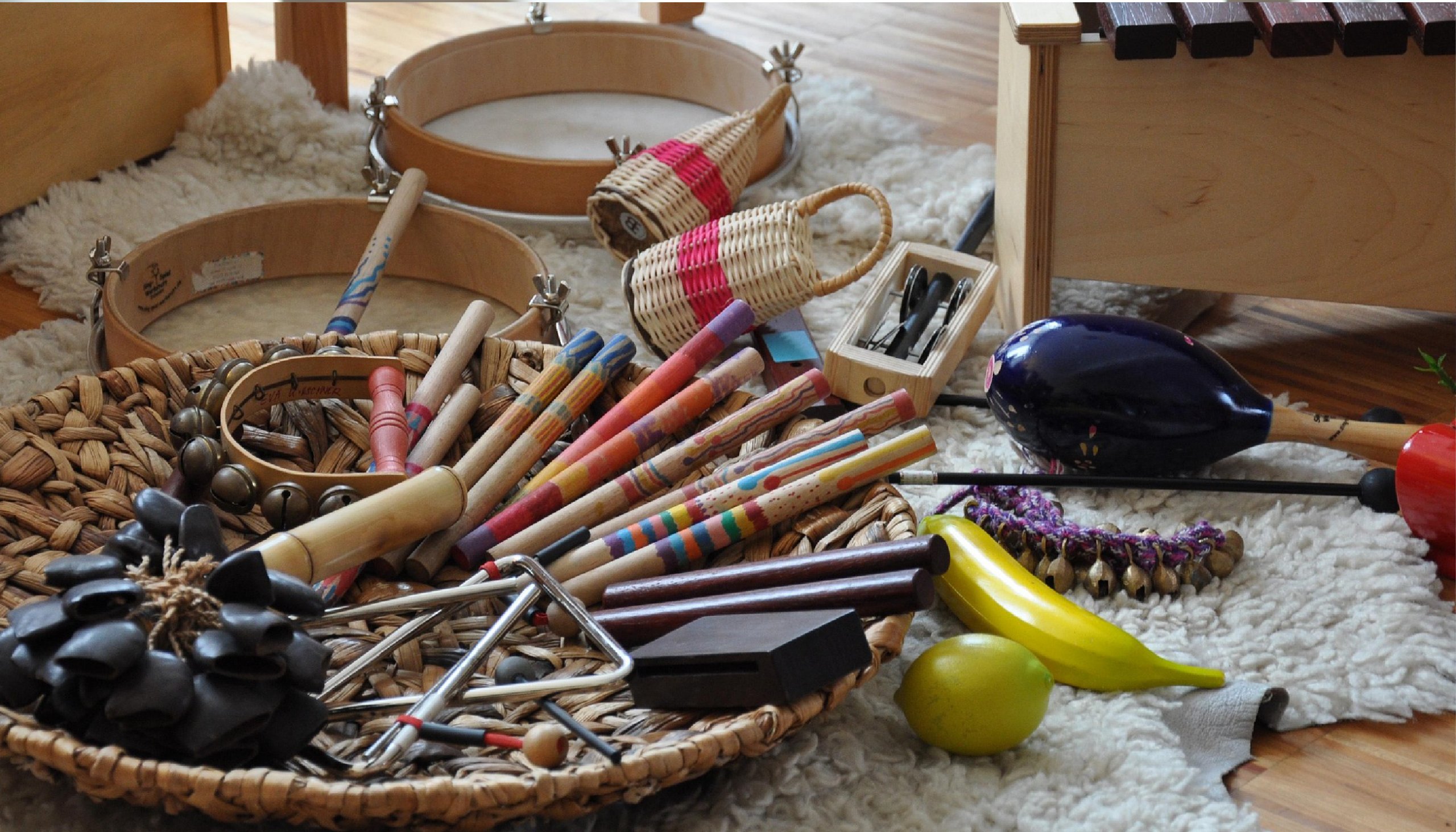
For infants and toddlers, and as a complement to Bell work at all ages, simple percussion instruments form an essential part of the Montessori music environment. Shakers, drums, tambourines, rhythm sticks, and instruments like the rainstick and kalimba offer accessible, multi-sensory musical exploration. These instruments are selected to produce sounds gentle enough for a classroom environment and designed to be manageable for small hands. They are displayed on open shelves where children can select them independently, explore freely, and return them with care.
Music Appreciation Materials
Nomenclature cards featuring musical instruments, books pairing classical music with visual exploration, and listening stations with headphones extend music education into the realm of appreciation and cultural awareness. These materials connect music to the broader Montessori cultural curriculum, enriching lessons about geography, history, and the arts.
Montessori Music Activities by Age Group
One of the most important insights from Montessori music education is that musical engagement should be developmentally matched to the child. What works beautifully for a four-year-old is very different from what serves a seven-month-old baby. Here is a practical guide to age-appropriate Montessori music activities.
Babies (0 to 12 Months)
From the very first weeks of life, babies are already listening, already absorbing the musical quality of the voices and sounds around them. The most powerful musical gift you can give a baby is your own singing voice. Lullabies, gentle nursery rhymes sung during feeding and changing, and soft humming during soothing all provide the earliest musical nourishment. Babies begin to respond to rhythm before they can speak — you will notice a baby becoming still and attentive when a familiar song begins, or beginning to move their arms and kick their legs in response to a strong beat.
- Sing softly during daily caregiving routines — feeding, bathing, dressing
- Introduce gentle rattles and shakers that are safe for mouthing
- Play varied music styles during calm, attentive listening moments (not as constant background noise)
- Use your voice to introduce simple pitch contrasts — high sounds and low sounds
- Move your baby’s body gently to music, supporting the development of rhythm awareness
At The Music Scientist, our Tenderfeet programme is specifically designed for babies from 4 months, combining music, movement, and sensory exploration to support the neural development that happens in these critical early months.
Toddlers (12 to 24 Months)
As children begin to walk and develop greater physical independence, their engagement with music becomes increasingly active and expressive. Toddlers naturally want to move to music, bang on surfaces, and experiment with cause and effect through sound. This is an ideal stage to introduce simple percussion instruments and to encourage singing alongside adults. Songs with simple, repetitive structures and accompanying movements are particularly valuable at this age because they support language development, motor coordination, and memory simultaneously.
- Introduce a small basket of child-safe percussion instruments: shakers, a small drum, rhythm sticks
- Sing action songs that involve clapping, stamping, reaching, and turning
- Clap the syllables of words and names together to build phonological awareness
- Create a dedicated music corner on a low shelf where instruments are always accessible
- Dance freely together, alternating between fast and slow, loud and quiet
Our Happyfeet programme supports toddlers at this stage, using music and movement to develop cognitive, social, and physical skills in a warm, structured environment.
Older Toddlers (24 to 36 Months)
Children at this age are entering one of the most musically rich phases of the sensitive period. They can begin to maintain a steady beat, follow simple musical patterns, and sing recognisable songs from memory. Imaginative and social play increasingly incorporates music and rhythm. Language is expanding rapidly, and music becomes a powerful scaffold for new vocabulary and sentence structure. Songs sung in a second language, and melodies paired with general knowledge themes, take on heightened educational power at this stage.
- Introduce Sound Cylinders to begin developing focused auditory discrimination
- Sing songs that reinforce concepts: colours, numbers, animals, weather, and familiar routines
- Incorporate songs in a second language to support bilingual development
- Encourage creative movement: tiptoeing, galloping, spinning, and freezing in response to musical cues
- Read picture books with accompanying music or sung text
The Groovers programme at The Music Scientist is tailored for children at this stage, combining music and dance to develop coordination, social confidence, and a genuine love of learning through movement.
Preschoolers (3 to 6 Years)
By the preschool years, children are at the height of their sensitive period for music. This is the time to introduce the Montessori Bells in earnest, to teach songs with increasing complexity, and to begin the earliest foundations of musical literacy. Children of this age can learn rounds and multi-verse songs, can follow conducting cues, and can begin to explore the concept of notation. Music at this stage also deepens connections to science, geography, mathematics, and language, as thematic songs and cultural music bring content areas to life.
- Begin work with the Montessori Bells — starting with playing a single bell, then matching pairs
- Teach songs that span multiple verses, introduce rounds, and include varied vocabulary
- Use Walking on the Line activities set to music in varying tempos and moods
- Create music appreciation activities with instrument nomenclature cards
- Invite children to compose short melodies using the Bells or tone bars
- Set up a listening station where children can choose music independently
The Scouts programme integrates catchy, originally composed melodies with science and general knowledge themes, turning complex concepts into memorable musical experiences that build both understanding and enthusiasm for learning.
Bringing Montessori Music into the Home
One of the most reassuring aspects of Montessori music education is that it does not require specialist training or expensive equipment to begin. The most powerful musical instrument available to any child is the human voice — and every parent already has one. Consistency, warmth, and repetition matter far more than technical skill. A song sung slightly off-key by a loving parent is infinitely more valuable to a young child’s development than a perfectly produced recording played passively in the background.
Creating a music-friendly home environment involves a few simple principles. Instruments should be real — not plastic toys that produce pre-recorded sounds, but genuine instruments that respond to the child’s touch and produce authentic acoustic sounds. They should be accessible, stored on a low shelf where the child can reach them independently. Dedicated listening time, where both parent and child give their full attention to music being played, is more beneficial than constant background music, which the child’s developing brain simply learns to filter out.
Here are practical steps to build a Montessori-inspired music environment at home:
- Create a music shelf: A low, open shelf with two or three quality instruments available for independent exploration
- Sing transition songs: Use simple songs to signal the start of tidy-up time, meals, or bedtime — repetition builds anticipation and cooperation
- Prioritise active music-making: Favour activities where your child makes music over passive listening alone
- Choose quality instruments: Small drums, egg shakers, a simple xylophone, rhythm sticks, and a kalimba are all excellent choices
- Rotate materials: Introduce new instruments or songs periodically to maintain interest and provide fresh challenges
- Make silence intentional: Allow quiet periods during the day so that music, when it comes, is experienced with full attention rather than as background noise
- Connect music to learning themes: Sing songs about animals, the weather, colours, and numbers to reinforce vocabulary and conceptual understanding
Integrating Music Throughout the Classroom Day
For Montessori educators, the goal is to make music inseparable from the rhythm of the school day itself. Rather than reserving music for a single scheduled period, effective Montessori music integration finds the natural moments throughout the day where music can deepen engagement, ease transitions, and create community.
Transition moments, the time spent lining up, gathering for circle time, moving between activities, are golden opportunities for song. A class that sings during these in-between moments builds a rich musical repertoire without ever sacrificing work period time. Songs for clean-up, songs for greeting, and songs for farewell create ritual and predictability that young children find deeply reassuring.
The following practices help educators weave music into the full fabric of classroom life:
- Play classical and world music softly during the morning work period to create a calm, focused atmosphere
- Introduce songs connected to the cultural curriculum — continents, seasons, living things, and community life
- Use greeting songs at circle time that name each child individually, building belonging and phonological awareness simultaneously
- Read biographies of composers and musicians alongside geography and history work
- Invite parents and community members to demonstrate instruments they play
- Set up a music shelf with accessible instruments so children can explore independently during free work periods
- Conduct a sound discrimination game during group time: play an instrument hidden under a cloth and ask children to identify it by listening alone
- Teach songs in multiple languages as part of cosmic education and cultural awareness
The goal is not perfection in performance. It is joyful, consistent presence. As Irene Baker, a Montessori educator and music specialist, has noted, a class that learns its entire concert repertoire from songs slipped into transition moments demonstrates the quiet power of music integrated into daily life.
How The Music Scientist Brings These Principles to Life
At The Music Scientist, everything we do is grounded in the same conviction that drives Montessori music education: that music is one of the most powerful tools available for nurturing a young mind. Our programmes are built around developmental milestones, targeting multiple intelligences through originally composed music that pairs melody with meaningful learning themes. Rather than offering music as entertainment, we use it as a medium for building cognitive skills, motor coordination, language, memory, and early numeracy, one song, one movement, and one joyful discovery at a time.
For families with the youngest learners, our Tenderfeet programme supports infants from 4 months, while Happyfeet nurtures toddlers aged 18 months through enrichment classes that blend music, sensory play, and movement. As children grow into the peak of their musical sensitive period, our Groovers programme deepens their engagement through music and dance, and our Scouts programme connects catchy original melodies to science and discovery themes.
For families preparing children for the transition to formal schooling, our SMART-START English and SMART-START Chinese preschool readiness programmes bring language, literacy, and cognitive development together through the medium of music, giving children the confidence and readiness they need to thrive when school begins.
Giving Children the Gift of Music
Montessori music education is not about producing musicians. It is about honouring a child’s natural receptivity to sound and rhythm during the years when that receptivity is at its most powerful. When music is woven into the prepared environment, made freely available through quality instruments and consistent singing, and connected to the full breadth of a child’s developing world, it becomes one of the most holistic educational tools we possess.
Whether you are a parent setting up a small music corner at home, an educator looking to bring greater musical richness into your classroom, or simply someone who wants to understand why a young child lights up at the sound of a familiar song, the answer is the same: music meets children where they are. It speaks directly to the absorbent mind, the moving body, and the social heart of every young learner. The sensitive period will not last forever. The most meaningful thing any of us can do is ensure that it is filled with the joy of making music together.
Ready to Explore Music-Based Learning for Your Child?
At The Music Scientist, we bring the principles of developmentally-focused music education to life through programmes designed specifically for babies, toddlers, and preschoolers aged 4 to 47 months. If you would like to learn more about our programmes or find the right fit for your child’s age and developmental stage, we would love to hear from you.
If you’ve started researching piano lessons for your young child, chances are you’ve come across the Suzuki method. It’s one of the most widely recognised approaches to early childhood music education in the world, celebrated for its philosophy that musical ability is not an inherited gift — it’s a skill that any child can develop with the right environment and guidance.
But how exactly does the Suzuki method work in practice? Is it truly effective for young children? And most importantly, is it the right fit for your family? In this guide, we break down everything you need to know about the Suzuki method for piano — from its fascinating origins and core philosophy to its real-world benefits, potential limitations, and the types of learners who thrive in its approach.
What Is the Suzuki Method?
The Suzuki method is an approach to music education built on the idea that children can learn to play an instrument the same way they learn to speak their native language — through listening, imitation, and consistent repetition in a nurturing environment. Known formally as the “mother-tongue approach” or “talent education,” it prioritises ear-based learning over sheet music in the early stages, allowing very young children to engage with music long before they are developmentally ready to read musical notation.
Unlike traditional music lessons that typically begin with note-reading exercises and scales, the Suzuki approach immerses children in music from the very start. Children are exposed to recordings, encouraged to listen deeply, and guided to reproduce what they hear — just as a toddler absorbs language by hearing it spoken hundreds of times before ever attempting to speak. This makes it particularly well-suited to children aged three to six, whose brains are in a prime window for absorbing new skills through play and imitation.
The Origins of the Suzuki Method
The method was developed in mid-twentieth century Japan by Dr. Shinichi Suzuki, a violinist who had a transformative realisation about the way children learn. Having spent time in Germany, he was struck by how difficult it was for adults to learn a foreign language — yet local children picked up German effortlessly simply through daily exposure and immersion. This observation led him to ask a powerful question: if every child can master the complexity of their native tongue without formal instruction, why couldn’t the same principles be applied to learning music?
Dr. Suzuki began applying the basic principles of language acquisition to music education: listening before playing, imitation before reading, and consistent repetition supported by an encouraging environment. He called his approach “Talent Education” (saino kyoiku in Japanese), based on his firm belief that talent is not inherited — it is cultivated. His method gained international attention in 1958 when a film of his students was shown to American music educators, and it has since spread to countries around the world, now covering instruments from violin and cello to guitar and piano.
The Core Philosophy: Every Child Can Learn
At the heart of the Suzuki method is a deeply optimistic belief: that every child has the potential to develop musical ability, given the right teaching, the right environment, and the right support. Dr. Suzuki was vocal in his assertion that talent is not something children are simply born with. Rather, it emerges when a child is surrounded by music, encouraged consistently, and guided with patience and respect.
This philosophy extends beyond musicianship. Dr. Suzuki’s broader goal was never simply to create skilled instrumentalists — it was to nurture whole human beings. He believed that the discipline, sensitivity, and persistence required to learn music would help shape a child’s character and sense of purpose. In his own words, his aim was to give children “a beautiful heart.” This holistic outlook is one of the reasons the Suzuki method resonates so strongly with parents who see music not just as a hobby, but as a vehicle for deeper development.
How the Suzuki Method Works for Piano
The Suzuki method is made up of several distinctive components that work together to create a natural, immersive learning experience. Here is how each element plays out in a typical Suzuki piano journey.
Listen First, Play Later
Listening is the absolute foundation of the Suzuki approach. Children are introduced to recordings of the pieces they will eventually play — often long before any attempt at the keyboard is made. Parents are encouraged to play Suzuki repertoire at home daily, creating a rich musical atmosphere in which the child can absorb melodies, phrasing, and dynamics naturally. This mirrors the way a child learns words: by hearing them spoken hundreds of times before ever attempting to say them. By the time a child sits at the piano and tries to reproduce a piece, it already feels familiar and achievable.
The Suzuki Triangle: Child, Parent, and Teacher
One of the most distinctive features of the Suzuki method is the central role of the parent. Rather than simply dropping a child at a lesson and collecting them afterwards, Suzuki parents are expected to attend every lesson, take notes, and serve as the “home teacher” during daily practice sessions at home. One parent often begins learning the instrument themselves before the child, so they genuinely understand what is being asked of their young learner. This three-way partnership between child, parent, and teacher is often referred to as the “Suzuki Triangle,” and research consistently supports parental involvement as one of the strongest predictors of a child’s musical success. The close involvement also deepens the parent-child bond, transforming practice time into meaningful shared experience rather than a solo chore.
Repetition and Repertoire
Repetition is central to everything in the Suzuki method. Children revisit and review pieces they have already learned alongside learning new ones, which builds muscle memory, refines technique, and deepens musical expression. The Suzuki piano repertoire spans seven published volumes, beginning with simple, familiar melodies and gradually progressing to more complex classical works by composers such as Bach, Mozart, Beethoven, and Chopin. Each piece is carefully chosen to introduce a new technical skill, meaning children are always developing within the context of real, beautiful music rather than abstract exercises. This keeps lessons engaging and gives children early, tangible feelings of success.
Group and Private Lessons
Suzuki students typically attend both private weekly lessons and group classes. Private lessons allow the teacher to give focused, individual attention to each child’s technique and musical development. Group classes, on the other hand, offer something different — the chance to play alongside peers at various levels, observe more advanced students, and develop a sense of musical community. Children learn enormously from watching others, and the social dynamic of a group class provides natural motivation. Seeing a slightly older child play a piece they are working toward can be more inspiring than any teacher instruction alone.
Delayed Music Reading
One of the most misunderstood aspects of the Suzuki method is its approach to reading sheet music. Suzuki students do not begin reading music notation straight away — instead, notation is introduced only after a child has developed a solid foundation of playing by ear and has built genuine musical competence. This mirrors the way children learn language: speaking comes before reading, not the other way around. It is important to note that this does not mean Suzuki students never learn to read music. They do, just later in the process — and by that point, their well-trained ears and strong technical foundation actually make the transition considerably smoother.
Cognitive and Developmental Benefits of the Suzuki Method
The Suzuki method does far more than teach children to play the piano. Research into early childhood music education has found that children who participate in structured instrumental learning demonstrate improvements across a range of cognitive and developmental domains, including verbal memory, spatial-temporal reasoning, mathematical reasoning, phonological processing, and fine motor skills. The Suzuki method, with its emphasis on listening, memory, repetition, and fine muscle development, is particularly well positioned to support these outcomes.
From a developmental perspective, the Suzuki approach aligns beautifully with what we know about how young children learn best. The early years of a child’s life represent a critical window for brain plasticity — a period when neural pathways are being formed at a remarkable rate. Engaging a child in music during this window, through active listening, imitation, and physical engagement with an instrument, stimulates multiple areas of the brain simultaneously. The Suzuki method’s core elements — repetition, listening, and the gradual building of skill — are precisely the kinds of activities that support healthy cognitive growth. Children also develop important non-musical qualities along the way: focus, discipline, perseverance, confidence, and the ability to receive constructive feedback with a positive mindset.
This connection between music and broader development is something we at The Music Scientist deeply understand. Our programmes for babies and young children are built on the same foundational principle — that music is one of the most powerful tools available for nurturing young minds, developing motor skills, and building the cognitive foundations children will carry into their school years and beyond.
Pros and Cons of the Suzuki Method
Like any teaching methodology, the Suzuki method has genuine strengths alongside real limitations. Understanding both helps parents make a truly informed decision.
Key advantages include:
- Early start: Because no reading is required initially, children can begin as young as three years old, capitalising on the brain’s natural plasticity during the early years.
- Strong musical ear: Children trained by ear develop excellent pitch recognition and can often hear whether they are playing in tune — a skill that benefits them for life.
- Emotional connection to music: Playing by ear means children learn to play with feeling from the outset, rather than mechanically decoding notation.
- Positive and joyful atmosphere: The method emphasises encouragement, avoids discouraging drills, and celebrates progress at every stage, keeping music enjoyable rather than pressured.
- Strong parental bond: The deep involvement required of parents creates meaningful shared experiences and strengthens the parent-child relationship through music.
- Broad developmental benefits: Beyond piano skills, children develop memory, focus, fine motor coordination, discipline, and social skills through group classes.
Potential limitations to consider:
- Significant parental time commitment: Attending every lesson, serving as the home teacher, and facilitating daily listening sessions requires a substantial investment of parental time and energy — which is not always feasible for busy families.
- Delayed music literacy: While note-reading is introduced eventually, children who leave the Suzuki programme early may lack musical literacy skills that their traditionally trained peers have developed.
- Less flexibility for independent learners: The structured, teacher-led approach may feel restrictive for older children or highly self-directed learners who prefer to explore music on their own terms.
- Teacher quality variability: Results depend heavily on the individual teacher. A certified, experienced Suzuki teacher makes an enormous difference, and not all teachers who use Suzuki books have the same depth of training.
- Repetition can feel tedious: Some children, particularly as they get older, may find the constant review of older pieces alongside learning new ones monotonous.
What Age Can Children Start Suzuki Piano?
One of the most common questions parents ask is: how early can my child start? Suzuki piano instruction typically begins between the ages of three and six, with many teachers considering four to five years old as an ideal starting point for piano specifically. Unlike string instruments, which have scaled-down child-sized versions, a standard piano keyboard does not shrink — so very young children need to be developmentally ready to manage sitting at the instrument with appropriate posture and physical control. Most Suzuki piano programmes begin formal individual lessons at around age four to five, though some schools recommend that children younger than five first complete an early childhood music programme to build musical readiness before beginning instrument-specific instruction.
The single most important factor in readiness, however, is not the child’s age but the parent’s willingness to be actively involved. A three-year-old with a fully engaged, present parent will often thrive where a five-year-old whose parent is disengaged may struggle. The atmosphere at home — filled with music, encouragement, and consistent daily listening — is just as important as what happens in the lesson room.
Who Does the Suzuki Method Suit?
The Suzuki method works best for families who are ready to commit fully to the process — not just financially, but in terms of time, presence, and emotional investment. If you are a parent who genuinely enjoys being involved in your child’s learning, who can create a music-rich home environment, and who is willing to attend every lesson and support daily practice, the Suzuki method can be a profoundly rewarding experience for your whole family.
It tends to suit children who:
- Are naturally responsive to music and enjoy listening to it
- Learn well through hearing and imitation rather than visual instruction alone
- Thrive in warm, supportive, and structured environments
- Respond well to encouragement rather than pressure
- Are in the early childhood years (roughly three to seven), when ear-based learning is most natural
It may be less well-suited for families with very limited time for daily practice and parental attendance, or for older children (above eight or nine) who may find it more efficient to begin with traditional notation-based lessons. It may also feel constraining for children who are highly expressive and wish to improvise freely, as the structured repertoire-based approach does not leave much room for spontaneous exploration in the early stages.
That said, many teachers blend Suzuki principles with other approaches, and the method is widely regarded as adaptable. The right teacher will tailor the experience to the individual child’s learning style, pace, and personality — which is ultimately far more important than the method itself.
Building the Musical Foundation Before Suzuki
Whether or not you ultimately choose the Suzuki path, one thing is clear: the earlier a child is immersed in music, the stronger their musical foundation will be. Research supports that musical exposure during infancy and toddlerhood primes the brain for later learning — not only in music, but in language, mathematics, and social-emotional development. The period before formal instrument lessons is therefore not wasted time; it is, in many ways, the most important preparation of all.
At The Music Scientist, we believe that every child’s musical journey begins long before they sit at a piano. Our developmentally-focused programmes are designed to build exactly the kind of musical readiness that makes formal music learning more joyful and effective when the time comes. Our Tenderfeet programme for infants nurtures sensory development and early musical awareness, while our Happyfeet classes engage toddlers around 18 months with music, movement, and multi-sensory play that builds rhythm, language, and coordination. As children grow, our Groovers programme takes toddlers further into music and movement, and our Scouts programme fosters curiosity through science-themed songs. For children approaching school age, our SMART-START English and SMART-START Chinese programmes combine music with early literacy and cognitive readiness skills, preparing children for the transition into formal education with confidence.
Think of our early childhood music classes as the “listening phase” that comes before formal instruction — just as the Suzuki method recommends. By the time your child is ready for piano lessons, whether through the Suzuki method or another approach, they will already carry with them an instinctive love for music, a trained ear, a sense of rhythm, and the focused, curious mind that all great young musicians need.
Final Thoughts
The Suzuki method for piano is a beautifully conceived approach that respects how young children naturally learn, prioritises joy and encouragement over pressure, and builds deep musical instinct from the ground up. For families who are ready to commit to its partnership model — and for children who are immersed in music from an early age — it can be a truly transformative way to begin a musical journey. Like any method, it works best when it is tailored to the individual child, delivered by a skilled teacher, and supported by an engaged, music-loving family at home.
The key takeaway? Whether or not the Suzuki method is ultimately the right fit for your child, starting their musical exposure early matters enormously. The richer and more musical a child’s early environment is, the better prepared they will be for whatever form of formal music learning they choose — and the more deeply they will carry a love for music throughout their life.
Start Your Child’s Musical Journey Today
At The Music Scientist, we help babies, toddlers, and preschoolers in Singapore build the musical foundations that last a lifetime — through play, movement, song, and sensory exploration. Whether your child is a newborn or approaching school age, we have a programme designed just for them.
Imagine your toddler stomping their feet, clapping along to a rhythm, and bursting into spontaneous giggles as they bang on a small xylophone with pure, uninhibited joy. What you are witnessing is not just play; it is learning at its most powerful. This is the spirit of the Orff Method, one of the world’s most beloved and research-backed approaches to early childhood music education.
If you have recently heard the term Orff Schulwerk in conversations about music enrichment classes for your little one, you may be wondering: What does it actually mean? How does it work for babies and toddlers? And most importantly, is it the right fit for your child? This guide answers all of those questions in plain, parent-friendly language. We will walk you through the philosophy, the four-stage learning process, the developmental benefits, and what a real Orff-inspired class looks and feels like so that you can make a confident, informed decision for your family.
What Is the Orff Method (Schulwerk)?
The Orff Method, formally known as Orff Schulwerk, is a developmental approach to music and movement education built entirely around how children naturally learn. The word Schulwerk is German for “schoolwork,” but there is nothing rigid or academic about it. At its core, Orff Schulwerk combines music, movement, drama, and speech into lessons that mirror a child’s world of play. Rather than sitting children down to learn scales or read notation, the Orff approach invites them to sing, chant, move, and create music from their very first session.
One of the most important things to understand as a parent is that the Orff approach is not defined by any one set of instruments. While you may picture xylophones, glockenspiels, and metallophones when you hear the name, the instruments are simply tools. The true heart of Schulwerk lies in a philosophy: that every child is born musical, that all children can make music, and that the best learning happens through active, joyful participation rather than passive instruction. The American Orff-Schulwerk Association describes it as “a child-centered approach” that integrates music, movement, drama, and speech into lessons grounded in play, and that definition captures something deeply important for parents to hold onto.
A Brief History: Carl Orff and the Origins of Schulwerk
The Orff Method was developed by Carl Orff, a German composer and educator who lived from 1895 to 1982, in collaboration with his colleague Gunild Keetman. Orff is perhaps best known to the wider public for his dramatic cantata Carmina Burana, but his educational legacy has arguably touched even more lives. His work on Schulwerk began in the 1920s during his time as music director at the Günther-Schule, a school of music, dance, and gymnastics he co-founded in Munich, where he became deeply interested in the relationship between rhythm, movement, and learning.
Orff’s central conviction was that music should not be taught as a secondary subject layered on top of other learning. He believed that music, movement, and language are inseparable parts of what he called “elemental music”: the most natural, primal form of human expression, rooted in rhythm, melody, and movement working together. He and Keetman documented their approach in the Music for Children series, which provided a flexible framework that could be adapted to any culture, language, or age group. Today, the Orff Schulwerk approach is used in classrooms and music enrichment programs across the world, from Germany to Singapore, because its child-centered principles translate across every cultural context.
The Core Principles of the Orff Approach
Understanding a few foundational principles will help you recognize the Orff approach when you see it in action, and help you understand why it resonates so deeply with parents and early childhood educators alike.
- Experience first, then intellectualize. Children engage with music physically and emotionally before any formal theory or notation is introduced. They feel the rhythm in their bodies before they name it.
- Every child is musical. The Orff approach is fully inclusive. It offers active and creative music-making for all children, not just those considered “naturally talented.”
- Music, movement, speech, and drama are inseparable. An Orff lesson weaves all four together, reflecting the integrated way young children actually experience the world.
- Play is the primary vehicle for learning. Children begin from what they do instinctively: play. Imitation, experimentation, and personal expression occur naturally within that playful framework.
- Children are co-creators, not passive recipients. Students are encouraged to improvise and compose, giving them ownership and a genuine emotional connection to their own musicality.
These principles make the Orff approach particularly well-aligned with what developmental science tells us about how young children learn. The body-first, experience-first philosophy mirrors the way babies and toddlers process the world through their senses and movement long before they develop the capacity for abstract reasoning.
The Four Stages of the Orff Process: What They Mean for Your Child
The Orff Schulwerk approach unfolds through four interconnected stages. These are not rigid steps in a fixed sequence; they are more like a spiral that revisits and deepens each time. Understanding these stages helps parents recognize the learning that is happening even when it looks, from the outside, simply like fun.
1. Imitation — This is where every Orff lesson begins. A teacher or group leader performs a simple melody, rhythmic pattern, or movement, and children repeat it back. Imitation builds a child’s repertoire of rhythms, pitches, tempos, and dynamics, filling a kind of internal “toolbox” of musical material they will draw on later. For very young children, this stage is especially natural, since imitation is one of the primary ways babies and toddlers learn everything from language to social behaviour.
2. Exploration — Once children are comfortable, they are invited to explore and modify what they have learned. They might experiment with different ways to play a rhythm, try a movement in a new direction, or test the sounds different instruments make. This stage awakens curiosity and builds confidence, giving children a sense of agency over their own musical discoveries.
3. Improvisation — Children begin to create their own musical and movement ideas, building on the material they have explored. Improvisation is the heartbeat of the Orff philosophy. It empowers children to express themselves authentically, and it teaches them to take creative risks in a safe, non-judgmental environment. Research suggests that children who regularly improvise are uniquely prepared to solve problems in many other areas of life.
4. Composition (Creation) — The process culminates in the creation of original works, whether a short piece of music, a rhythm, a dance, or a dramatic scene. This stage invites children to synthesize everything they have experienced, explored, and invented, producing something that is genuinely their own. The sense of ownership this creates deepens a child’s connection to music in ways that rote memorisation simply cannot replicate.
These four stages align closely with how children develop musical literacy. Just as a child hears and speaks a language long before they learn to read and write it, the Orff process ensures children feel and make music before any formal notation is introduced. It is a deeply developmental sequence that respects the natural timeline of a child’s growing brain.
What to Expect in an Orff-Inspired Music Class
If you are about to bring your child to an Orff-inspired class for the first time, here is what a typical session might look and feel like. A class blends singing, playing, acting, dancing, chanting, speaking, and improvising, often all within the same 30- to 45-minute session. No two classes are exactly alike because the teacher adapts each lesson to the energy, interests, and developmental stage of the children present.
You might observe the teacher beginning with a simple call-and-response chant, clapping a rhythm and inviting children to echo it back. Movement is woven throughout: children might stomp to represent a character in a story, sway to feel a melody, or use body percussion such as clapping, patting their knees, or tapping their shoulders to internalize a beat before any instrument is touched. When instruments do appear, they are typically simple percussion items designed to be immediately accessible: xylophones, small drums, bells, glockenspiels, and metallophones. These instruments often use a pentatonic (five-note) scale, which means any combination of notes a child plays will sound pleasing, removing the fear of “getting it wrong” and keeping the focus firmly on exploration and creativity.
A key thing parents often notice is that the classroom feels joyful, not evaluative. Children in an Orff environment do not feel the pressure of performance, because every child is treated as an equal participant. There are no soloists standing alone under a spotlight; there is an ensemble of curious little learners discovering music together. For very young children, caregivers are often invited to participate alongside their child, which turns the class into a bonding experience as well as a learning one.
Developmental Benefits of the Orff Method for Young Children
The Orff approach is not just enjoyable; it is backed by a growing body of research demonstrating meaningful developmental outcomes for young children. Here is what the science and practice show:
- Cognitive development and executive function. A randomized controlled trial published in Scientific Reports found that three-year-olds who participated in an Orff Schulwerk-based music play program showed improvements in inhibitory control and demonstrated more efficient neural processing in the prefrontal cortex compared to a control group. These are foundational executive function skills that support attention, self-regulation, and school readiness.
- Language and literacy. Rhythmic speech, chanting, and singing all activate the same neural pathways as language development. The Orff emphasis on rhymes, poems, and melodic speech gives young children rich linguistic input in a highly memorable, multisensory format.
- Motor skills. Body percussion, instrument play, and movement activities directly develop both gross and fine motor skills. Clapping, stomping, mallet technique, and coordinated dance build the physical foundations children need for writing and other school-readiness tasks.
- Social and emotional development. The Orff approach increases self-expression, self-efficacy, and social skills by embedding learning in collaborative group experiences. Children learn to listen, take turns, contribute to an ensemble, and celebrate shared creative outcomes.
- Creativity and problem-solving. By prioritizing improvisation and composition from an early age, Orff Schulwerk nurtures children’s creative thinking. Children who regularly create and compose their own musical ideas are building the cognitive flexibility that supports problem-solving far beyond the music classroom.
- Confidence and intrinsic motivation. Because children experience musical success from the very beginning (every note they play on a pentatonic instrument sounds harmonious), they develop a positive relationship with music-making that fuels continued engagement and a lifelong love of learning.
These benefits align closely with the developmental focus that underpins everything at Tenderfeet, The Music Scientist’s programme for infants from 4 months, where music, movement, and sensory exploration are combined to support the earliest stages of cognitive and physical development.
Orff vs. Other Music Education Approaches
Parents exploring music enrichment options often encounter several well-known approaches side by side. Here is a brief, practical comparison to help you situate Orff Schulwerk within the broader landscape.
- Orff vs. Kodály: The Kodály method centers strongly on the singing voice and uses solfège (do-re-mi) as a systematic tool for building musical literacy. It tends to follow a more structured, sequential curriculum. The Orff approach is broader in its palette, incorporating movement, instruments, drama, and speech alongside singing, and it grants teachers (and children) considerably more creative flexibility.
- Orff vs. Suzuki: The Suzuki method focuses on learning a specific instrument (most often violin or piano) through listening and repetition in close partnership with the parent. It is highly structured and instrument-specific. Orff is group-based, instrument-agnostic, and prioritizes creative play and improvisation over technical mastery of a single instrument.
- Orff vs. Dalcroze (Eurhythmics): The Dalcroze approach emphasizes music through movement and the body’s rhythmic response, which overlaps meaningfully with Orff. However, Dalcroze focuses primarily on how movement reflects musical structure, while Orff’s scope is broader, integrating speech, drama, and percussion instruments as equally central elements.
In practice, many excellent early childhood music programmes draw from more than one tradition. What matters most is that the underlying philosophy is child-centered, developmentally appropriate, and rooted in joyful, active participation.
Is the Orff Method Suitable for Babies and Toddlers?
One of the most common questions parents ask is whether the Orff approach is truly appropriate for very young children, including babies. The answer is an emphatic yes, and in many ways, very young children are the ideal beneficiaries of Orff-inspired learning. The approach recognizes that babies and toddlers learn through their bodies and senses, making it particularly well-suited to the 4-to-47-month age window. For infants, Orff-inspired activities focus on sensory exploration of sound, gentle movement games, caregiver-child musical interactions, and the rhythmic speech and lullabies that form the earliest foundations of musicality.
As children move through the toddler years, the Orff framework grows with them. Simple call-and-response games, body percussion, and exploratory play with percussion instruments introduce musical concepts at a pace that matches their developing brains and bodies. There is never any pressure to perform or produce a “correct” result; the process itself is the goal. This is why programmes like Happyfeet for 18-month-olds and toddlers, and Groovers for older toddlers, draw on Orff-aligned principles of movement, music, and sensory play to meet children exactly where they are developmentally.
For preschool-aged children approaching their school-readiness years, the Orff process becomes even richer. Children at this stage can engage more fully with the improvisation and composition stages, use instruments with greater coordination, and begin connecting their musical experiences to early literacy and numeracy concepts. This is the spirit behind programmes like Scouts, where science themes are woven into catchy, musically rich learning, and the SMART-START English and SMART-START Chinese preschool readiness programmes, which use music as a powerful vehicle to prepare children for the transition into formal education.
Frequently Asked Questions About the Orff Method
Does my child need any prior musical experience?
Not at all. The Orff approach is specifically designed to welcome children with zero prior musical background. It begins from what children already do naturally: listen, move, imitate, and play. No auditions, no prerequisite skills, and no pressure.
What instruments will my child use?
In the early years, children typically work with body percussion (clapping, stomping, tapping), simple rhythm instruments such as bells, tambourines, and maracas, and eventually pitched barred instruments like xylophones and glockenspiels. The instruments are chosen for their accessibility and the immediate success they offer young musicians.
Should I participate in class with my young child?
For babies and very young toddlers, caregiver participation is not just welcome; it is a central part of the experience. Your presence, voice, and movement provide the safe emotional base from which your child explores. As children grow more independent, the caregiver role naturally shifts, but the bond built in those early musical moments is lasting and meaningful.
How is the Orff approach different from a standard music class?
A standard music class may focus on rote learning, performance preparation, or instrument technique. An Orff-inspired class prioritizes the child’s creative process over any specific outcome. The emphasis is on participation, exploration, and joy rather than correct notes or polished performances. Every child contributes at their own level, and the group creates something together that no single child could produce alone.
Giving Your Child the Gift of Musical Discovery
The Orff Method is, at its heart, a profound act of trust in children. It trusts that every child is inherently musical. It trusts that play is the most powerful form of learning. And it trusts that when children are given the freedom to explore, imitate, and create, they will exceed every expectation we set for them. For parents of babies, toddlers, and preschoolers, the Orff Schulwerk approach offers something rare: a music education philosophy that is as developmentally sound as it is genuinely joyful.
Whether your child is just beginning to discover the world of sound at four months, navigating the wonderfully energetic toddler years, or getting ready for their first day of school, there is an Orff-inspired experience designed precisely for where they are right now. The best time to start is always today, because every song, every rhythm, and every joyful stomp of a small foot is building a brain, a confidence, and a love of learning that will last a lifetime.
Ready to See the Orff Magic in Action?
At The Music Scientist, our developmentally-focused programmes for children aged 4 to 47 months bring the principles of Orff Schulwerk to life through original music, movement, and sensory play that grows with your child at every stage. From our infant Tenderfeet programme to our preschool readiness SMART-START series, every class is designed around what the science of early childhood development tells us children need most.
Get in touch with us today to find the perfect programme for your little one and take the first step toward a lifetime of musical discovery.
Every parent who has watched a baby calm at the sound of a lullaby, or seen a two-year-old bounce irresistibly to a beat, has witnessed something profound: music is not a subject children learn — it is a language they are born ready to absorb. The 0–6 music learning window is one of the most extraordinary periods in human development, a time when the brain is primed not just to enjoy music, but to use it as a scaffold for thinking, feeling, moving, and connecting with the world.
Yet, despite growing awareness of music’s developmental power, many parents still treat early childhood music as a bonus rather than a foundation. This article sets out a clear, research-informed framework for understanding how music learning unfolds from birth through age six — stage by stage — and why the quality of musical experiences during these years has consequences that reach far beyond the classroom. Whether you are humming to a newborn or looking for a structured enrichment programme for your four-year-old, this guide will help you understand what your child is developmentally ready for, and how to make the most of this remarkable window.
Why the 0–6 Window Is the Most Important Period for Music Learning
There is a reason researchers and educators consistently describe the early childhood years as a critical period for musical growth. Brain plasticity — the brain’s capacity to form new neural connections in response to experience — is at its highest in the first six years of life. During this time, the brain is not merely learning facts; it is constructing the very architecture through which all future learning will flow. The brain connections in a child are formed during the first three years of life, forming the foundation for speech, language, body movements, and cognitive skills for later stages of life. Music, which simultaneously activates auditory, motor, emotional, and language-processing regions of the brain, is uniquely positioned to accelerate this process.
The early years of life are crucial for establishing a foundation for lifelong music development, and a child’s musical experiences from birth to age five have a particularly profound impact on the extent to which she will be able to understand, appreciate, and achieve in music as an adult. This is not simply about producing future musicians. The skills built through early music engagement — listening with focus, recognising patterns, coordinating movement with rhythm, and expressing emotion through sound — are the same skills that underpin reading, mathematics, memory, and social interaction. Research emphasises the profound influence of music on language acquisition from the onset of life, illustrating how musical elements like rhythm and melody shape language learning, with musical properties having a significant impact on language development in areas such as semantic processing, grammar, syntax, and phonological awareness.
Critically, the benefits of music exposure are not evenly distributed across childhood. Musical development is best understood as a continuum through which each child will progress at their own pace, a pace that may be positively influenced by the frequency, consistency, and quality of musical experiences to which they are exposed. A rich, developmentally matched music environment during the 0–6 years does not just teach children to clap along — it shapes how their brains process sound, pattern, and meaning for a lifetime.
Music Learning and Language Learning: More Similar Than You Think
One of the most illuminating frameworks for understanding early music development is its parallel with language acquisition. Children learn music in much the same way they learn a language: after listening to the sounds of their native language for some months, a child goes through a stage of language babble, in which they experiment with speech sounds that do not make sense to adult listeners — and soon afterward, they “break the code” of the language and are able to first imitate words, then use them meaningfully in phrases and sentences of their own. The same sequence unfolds in music. Children first absorb tonal and rhythmic patterns from their environment, then experiment with them in play, and gradually develop the capacity to produce and organise musical ideas with intention.
This parallel has a vital implication for parents and educators: just as no one would withhold conversation from a baby on the grounds that they cannot yet speak clearly, there is no developmental stage at which musical exposure is premature. Children must be exposed to a rich variety of music during the early years in order to develop the necessary readiness for formal music learning when they are older. Waiting until a child is old enough for “proper” music lessons risks missing the window during which musical understanding is most naturally and efficiently built.
Stage 1 — The Listening Foundation (Birth to 6 Months)
Long before a baby can reach for a rattle, their brain is already doing sophisticated musical work. During the first months of life, an infant’s brain is absorbing the sounds around them; by the end of that first year, the brain starts to prioritise, building greater sensitivity to familiar sounds. Regular exposure to a variety of musical sounds is critical during the first year of life. In the earliest weeks, babies respond to music with whole-body reactions — stilling at a familiar melody, or showing wide eyes and small kicks in response to a lively rhythm. Between 0–6 months, you’ll see them react with wide eyes, smiles, or little kicks when they hear music.
What is happening beneath the surface is remarkable. Exposure to music allows young brains to soak in the range of notes, tones, and words they will later use, essentially introducing them to the key elements of music they will build upon, and in doing so, build neural pathways that can influence and enhance cognitive ability for a lifetime. At this stage, the parent’s role is primarily to provide a consistent, musically rich environment. Singing lullabies, speaking in the musical cadences of infant-directed speech, and introducing gentle rhythmic movement during everyday caregiving all serve as the child’s first music curriculum. When a parent sings or moves in time to the music with a baby, both brains release oxytocin, a bonding hormone that offers a sense of peace and well-being. Music at this stage is inseparable from attachment, making every song a moment of both neurological and emotional nourishment.
At The Music Scientist, our Tenderfeet programme is designed precisely for this stage — pairing infant sensory development with carefully selected music to gently stimulate auditory processing, bonding, and early neural pathway formation in a safe, nurturing environment.
Stage 2 — Sensory Exploration and Sound Play (6 to 18 Months)
As babies cross the six-month mark, their engagement with music becomes increasingly active. By 6–12 months, they start clapping, bouncing, or even shaking tiny instruments as they begin to explore sounds. The baby who was previously a passive listener is now an enthusiastic participant, reaching for anything that makes noise, experimenting with their own voice, and beginning to synchronise their body to rhythmic cues. By one year of age, with emerging language skills, walking, and the ability to stay on task for longer periods, one-year-olds are physically much more engaged with music than infants, and the pitch of their vocalizations begins to reflect the melodic contour of songs they are hearing.
This is also the stage at which sensory play and music naturally converge. Rattles, soft drums, shakers, and textured instruments give babies a physical vocabulary for sound exploration, engaging not just their auditory sense but their tactile and kinesthetic systems as well. Early cognitive development depends upon input through the senses — the experiences of art exercise the senses: visual, aural, tactile, and kinesthetic — and to assure maximum cognitive growth, each sense must have adequate development. Structured music sessions at this age work best when they are grounded in sensory experience: touching, moving, listening, and vocalising together rather than simply observing performance.
The Tenderfeet and Happyfeet programmes at The Music Scientist bridge this stage with intentional sensory music experiences, integrating movement, sound exploration, and caregiver participation to build a rich auditory and kinesthetic foundation during one of the most neurologically fertile windows in early childhood.
Stage 3 — Movement, Rhythm, and Musical Babble (18 Months to 3 Years)
The toddler years represent what researchers describe as the “musical babble” stage — a period of joyful, exploratory, imperfect musical output that is developmentally crucial. From 9 months to 2 years, toddlers respond to music with clear, repetitive movements; they are interested in all sounds and may begin to approximate pitches, and they are primarily attracted to strongly rhythmic music. Between 18 months and 3 years, children begin to attempt whole songs, experiment with tempo and dynamics through their movements, and show strong preferences for particular pieces. The output is rarely accurate in a technical sense, and that is exactly as it should be — accuracy is not the goal at this stage; engagement and experimentation are.
Two and three-year-olds can sing short phrases of a song in tune while singing other phrases not in tune, distinguish between different voices and instruments, demonstrate rhythm with body movements that will sometimes be in tempo, and enjoy marching, walking, dancing, jumping, running, twirling, and finger plays while listening to and creating music. This physical relationship with rhythm is not incidental — it is the developmental precursor to internalised musical understanding. A child who has lived in their body with music will find it far easier to later read it on a page or reproduce it on an instrument.
Toddlers learn with their whole bodies — by doing rather than listening. This insight should sit at the centre of any curriculum designed for this age group. Programmes that rely on children sitting still and watching are working against developmental grain. The most effective music learning at this stage is active, physical, and rooted in play. The Happyfeet and Groovers programmes at The Music Scientist are built around exactly this principle — structured movement, rhythm games, and creative expression that allow toddlers to internalise music through their bodies first.
Stage 4 — Singing, Pattern Recognition, and Musical Expression (3 to 6 Years)
By age three, a significant shift begins. Children move from musical babble toward musical communication — they can sustain melodies with greater accuracy, recognise familiar songs by their opening notes, and begin to use music intentionally to express emotional states. Three-year-olds begin to sing along more accurately, experiment with rhythm, and dance with purpose; by age 4 or 5, they can recognise patterns in music and describe how songs make them feel. This is the stage at which music begins to build bridges to literacy and numeracy in very direct ways: the sequencing in a story-song mirrors the sequencing in a narrative; the patterns in a rhythmic chant mirror the patterns in early mathematics.
Four and five-year-olds can sing phrases within a song, or even an entire song, with accurate pitch, and demonstrate rhythmic accuracy that ranges from occasionally to consistently matching the beat they are listening to, while enjoying playing a wide range of rhythm instruments. Cognitively, these children are ready to start connecting musical experience to broader knowledge — using songs to learn vocabulary, explore themes from nature and science, and prepare for the conceptual demands of formal schooling. This is precisely the philosophical foundation of The Music Scientist’s Scouts programme, which uses catchy, originally composed melodies to anchor science concepts in musical memory, making learning both joyful and remarkably sticky.
The 3–6 age band is also a critical period for school readiness. Children who have had consistent, structured music education during the early years arrive at preschool and primary school with advantages that extend well beyond being able to sing a song. Children who engage regularly with music before school age tend to demonstrate stronger vocabulary, better verbal memory, and more advanced sequencing skills. For families in Singapore navigating the transition into formal education, programmes that specifically target this readiness gap — in both English and Mandarin — offer significant long-term value. The Music Scientist’s SMART-START English and SMART-START Chinese programmes are designed with this transition in mind, using music as the vehicle through which language, cognitive, and social readiness skills are built before the first day of school.
Music and Multiple Intelligences: More Than Just Notes
A common misconception is that music enrichment benefits only children who are “musically talented.” This misses the point entirely. Howard Gardner’s theory of Multiple Intelligences, which places musical intelligence as equal in importance to logical-mathematical, linguistic, spatial, bodily-kinesthetic, interpersonal, and intrapersonal intelligence, offers a more useful lens. When a child engages with music, they are not just exercising one intelligence — they are exercising several simultaneously. A song about animals builds vocabulary (linguistic). A clapping pattern builds sequencing and mathematical thinking (logical). A movement activity builds spatial and body awareness (kinesthetic). A group music class builds cooperation and empathy (interpersonal).
The experience of body movement plays an important role in musical perception even at the infant stage, as evidenced in neuroscience studies, and other experiments have suggested that body movements performed to music will have an influence on the perception of musical features such as rhythm and pitch. This embodied approach to music learning is especially important in the early years, when the body is the primary instrument for making sense of the world. A curriculum that integrates music with movement, storytelling, and sensory play does not dilute the musical experience — it deepens it, because it meets children where they actually are developmentally.
The Role of Parents, Caregivers, and Structured Programmes
No music framework for the early years would be complete without acknowledging the central role of the adults in a child’s life. Research consistently shows that the musical environment a child is raised in has a direct bearing on their musical and cognitive development. Environmental factors play a role in musical development, particularly in the critical period of early childhood; children have the capacity to learn in the first days of life, long before entering formal schooling, and music education during this period is consequently the responsibility of parents, caregivers, and early childhood teachers.
Parent participation in early childhood music classes is not merely logistical — it is developmentally essential. Researchers for decades have pointed to parental and caregiver involvement as a key success factor across nearly all aspects of early childhood development, an impact ranked above many other background influencers such as socioeconomic status or the kind of school attended. When parents sing, move, and play music alongside their children — both in structured class settings and at home — they multiply the developmental effect of every session. When singing a young child’s favourite song, pausing, waiting, and looking for them to fill in the next word or movement creates back-and-forth interactions that support social connections, language, memory, and sequencing skills.
Participating in music enrichment programs during infancy may benefit parent-child language interactions into toddlerhood. This benefit extends in both directions: music enrichment strengthens the child’s development, and it simultaneously strengthens the bond between parent and child — creating a shared language of melody, rhythm, and play that supports attachment and communication long after the class ends.
What to Look for in an Early Years Music Programme
Not every music class is a developmentally meaningful music programme. As you evaluate options for your child, the following qualities distinguish research-informed early years music from generic enrichment activities:
- Developmental alignment: The programme should be structured around what children at each specific age are neurologically and physically ready for, not simply scaled-down versions of adult music instruction.
- Integration of movement and sensory play: Particularly for children under three, physical and sensory engagement is not a supplement to music learning — it is the primary vehicle for it.
- Active participation over passive listening: Young children learn through doing. High-quality programmes create structured opportunities for children to produce, explore, and experiment with sound rather than simply observe.
- Caregiver involvement: For infants and toddlers especially, programmes that actively incorporate parents and caregivers produce stronger developmental outcomes than drop-off classes.
- Original, purposeful curriculum: Look for programmes built on an intentional curriculum — original music composed for developmental goals, not simply a playlist of popular children’s songs.
- School readiness integration: For children aged three and above, programmes that connect music to language, cognitive, and social readiness skills provide compounded value as children approach formal education.
The best type of music education for young children is one that is engaging and age-appropriate; programmes that incorporate singing, dancing, and playing simple instruments are ideal, and it is important to choose a programme that is fun and interactive to keep the child interested and motivated. Behind the fun, however, should be a clear developmental philosophy — a framework that explains not just what children do in class, but why, and what it builds toward.
Building the Foundation That Lasts a Lifetime
The 0–6 years are not simply the beginning of a child’s musical journey — they are the period during which the very capacity for musical, cognitive, and emotional learning is being constructed. A rich, developmentally matched music experience during these years does not just teach children to enjoy music; it trains their brains to listen more carefully, remember more vividly, move with greater awareness, and engage with language and ideas more fluidly. These are not musical skills. They are human skills, and music is one of the most powerful tools we have for building them.
The framework set out in this article — from the listening foundation of early infancy, through the sensory explosion of the first year, into the rhythmic play of toddlerhood, and on to the emerging musical expression of the preschool years — is not a rigid prescription. Every child moves through these stages at their own pace. But every child benefits from being met at their current stage with experiences that are intentionally designed to stretch them forward. That is what developmental music education, at its best, does: it meets the child where they are, and gently, joyfully, leads them further than they could have gone alone.
Ready to Give Your Child the Gift of Music?
At The Music Scientist, every programme — from infant sensory classes to preschool readiness preparation — is built around a clear developmental framework designed to meet your child exactly where they are. Whether your little one is a newborn discovering sound for the first time, or a four-year-old ready to start their school journey, we have a programme thoughtfully designed for their stage.
Explore our full range of developmental music programmes and find the right fit for your child’s age and learning needs. We’d love to help you make the most of this extraordinary window.
Every parent who has watched their toddler bounce spontaneously to a song, bang a pot with gleeful intensity, or light up at a familiar melody has witnessed something real: music is one of the most natural languages young children speak. But when it comes to structured music education, a common question arises — what should a programme for 1 to 3-year-olds actually contain? Not in general terms, but specifically: which elements belong in the room, why do they matter developmentally, and how should they be sequenced across this particular age range?
The answer matters more than many parents realise. Between 12 and 36 months, a child’s brain is undergoing changes that will not happen again at this pace or intensity. The musical experiences a toddler encounters during this window don’t just teach them to clap along to a song — they actively shape neural architecture in ways that support language, memory, motor coordination, emotional regulation, and early numeracy. A well-designed programme capitalises on this. A poorly designed one misses the window entirely.
This guide breaks down every component that belongs in a quality music programme for toddlers aged 1 to 3, explains the developmental rationale behind each element, and helps parents understand what to look for — and what to question — when evaluating their options in Singapore.
Why Ages 1–3 Are a Critical Window for Music Learning
The first three years of life represent an extraordinary period of brain plasticity. During this time, the brain is forming synaptic connections at a rate that will never be replicated, with neural pathways being laid down that will shape how a child processes language, emotion, memory, and learning for decades to come. Music, more than almost any other activity, engages multiple brain regions simultaneously — activating motor regions, auditory processing centres, language areas, and the emotional limbic system all at once. This makes it uniquely powerful during the toddler years, when the brain is still actively building its architecture.
The science is increasingly clear on this point. Research consistently shows that early music education creates neural pathways benefiting children well beyond musical ability itself, supporting language development, spatial reasoning, and social skills. For toddlers specifically, exposure to music and rhythm has been linked to enhanced memory, stronger language skills, and an improved ability to follow and recognise patterns — capacities that serve children across every area of learning. The key is that these benefits are most pronounced when musical experiences are developmentally matched to where a child actually is, not where an adult might wish them to be.
Not One Size: How 12 Months and 36 Months Are Worlds Apart
One of the most important things to understand about music programmes for toddlers is that the age range of 1 to 3 years encompasses enormous developmental variation. A 12-month-old is still refining balance and taking first steps, communicating largely through gesture and single sounds, and experiencing the world almost entirely through sensory exploration. A 3-year-old can follow multi-step instructions, sing recognisable melodic phrases, engage in imaginative play, and begin to understand basic conceptual contrasts like fast and slow, loud and quiet. A programme that serves both well must be thoughtfully differentiated.
For the youngest toddlers, around 12 to 18 months, music activities should be highly repetitive, physically engaging, and centred on imitation. The priority at this stage is building a comfortable, joyful relationship with music-making rather than introducing complex concepts. Call-and-response songs, simple percussion instruments like shakers and hand drums, and movement activities that mirror the educator’s actions all work extremely well here. From 18 months onward, children are walking steadily and can actively take part in structured group activity. By age 2, a programme can begin introducing thematic content — using songs to reinforce concepts like animals, colours, or daily routines — and by age 3, children can handle greater musical complexity including short melodic phrases, dynamic contrasts, and simple group participation formats. A quality programme reflects this developmental arc explicitly rather than treating all toddlers as interchangeable.
At The Music Scientist, this progression is built into the programme structure itself. The Happyfeet programme for 18-month-olds and toddlers is designed around exactly this stage of development, harnessing growing mobility and curiosity through vocabulary-rich songs and movement activities that support rapid language acquisition. As children grow, they transition naturally into Groovers, which offers more structured music and dance experiences specifically designed for the later toddler years.
The Core Components of a Strong Toddler Music Programme
A well-designed music programme for 1 to 3-year-olds is not simply a collection of enjoyable activities. Each element should serve a specific developmental function, and the components together should form a coherent, holistic learning experience. Here is what belongs in the room — and why.
Rhythm and Beat Awareness
Rhythm is the structural backbone of any toddler music programme. When children learn to clap or tap to a beat, they practise anticipating timing and sequence — core elements of problem-solving that directly support future mathematical and logical thinking. The ability to feel and move to a steady beat is also one of the earliest musical capacities to emerge and is closely linked to language processing, since both spoken language and music share rhythmic structure. A good programme introduces beat awareness from the very first session, through clapping, stomping, patting knees, and moving to consistent musical pulse. Echo clapping — where children repeat a pattern back after the teacher — builds auditory memory and sequencing skills essential for later reading.
Movement and Dance
Music and movement are inseparable for young children, and a programme that keeps toddlers seated and passive is missing a critical component of early musical learning. When toddlers engage in coordinated movement with music, they activate connections between sensory inputs and motor skills, laying the foundation for both cognitive and motor development. Movement activities help children understand spatial concepts such as up and down, near and far, big and small — concepts that are foundational to early mathematics and reading comprehension. Dancing to music, marching to a beat, swaying with scarves, and responding with full-body actions to musical cues are not just fun — they are essential developmental experiences that should be structured into every session.
Singing and Vocal Play
Singing is one of the most powerful tools in a toddler music programme because it operates simultaneously as musical education, language development, and emotional expression. Short, repetitive songs build vocabulary and phonological awareness. Call-and-response songs train listening and turn-taking. Songs that name body parts, animals, actions, or objects reinforce conceptual knowledge through auditory repetition — a learning mode that is particularly effective for toddlers whose visual literacy is still emerging. Vocal play, including experimenting with high and low pitch, loud and soft sounds, and different vocal qualities, develops a child’s awareness of their own voice as an instrument. Original, purposefully composed songs — designed with specific developmental goals in mind — are more valuable than repurposed popular music because every word, phrase, and melody can be intentionally calibrated for the age group.
Instrument Exploration
Access to simple, age-appropriate instruments is essential in any toddler music programme. Shakers, hand drums, bells, and rhythm sticks allow children to make music themselves — which is developmentally very different from simply listening to it. Instrument play develops fine and gross motor control, strengthens hand-eye coordination, and builds the satisfying experience of cause and effect (I shake this, a sound comes out). At the younger end of the 1–3 range, free exploration of instruments is equally as valuable as directed play. As toddlers approach age 2 and beyond, guided instrument activities — playing a steady beat, stopping on a musical cue, or taking turns — begin to build self-regulation alongside musical skill. The instruments themselves should always be child-safe, age-appropriate, and varied enough to expose children to a range of timbres and textures.
Sensory Play Integrated with Music
Toddlers learn through all their senses, and quality music programmes reflect this by integrating tactile, visual, and kinesthetic elements alongside auditory ones. Sensory props like scarves, ribbons, textured objects, and visually stimulating musical materials add additional layers of engagement and reinforce musical concepts in multisensory ways. Waving a scarf to slow, flowing music teaches tempo through physical experience rather than verbal instruction. Feeling the vibration of a drum teaches children about sound production in a way no explanation can match. Programmes that incorporate movement, tactile instruments, visual cues, and vocal play rather than relying on passive listening deliver richer learning experiences — and keep toddlers meaningfully engaged for longer.
The Tenderfeet programme at The Music Scientist, designed for infants from 4 months, begins building this sensory-rich musical foundation from the earliest months. The continuity into toddler programmes means children arrive at the 1–3 stage having already developed a comfort with and curiosity about musical environments.
Language Development and Early Literacy
One of the most well-supported connections in early childhood research is the relationship between music and language. When words are presented within a rhythmic context, children process them in multiple areas of the brain simultaneously — the auditory cortex handles the sounds, the motor cortex engages with the rhythm, and the language centres process meaning. This multi-sensory integration creates stronger neural connections and better word retention. Rhymes, chants, echo songs, and vocabulary-rich musical themes all serve as vehicles for accelerating language acquisition during a period when toddlers are typically adding several new words to their vocabulary each week. A strong music programme for 1–3-year-olds is, in this sense, simultaneously a language enrichment programme.
This is particularly relevant in Singapore’s bilingual context. Families prioritising both English and Mandarin development benefit from programmes that incorporate purposefully designed musical content in both languages. The Music Scientist’s SMART-START English and SMART-START Chinese programmes address this need directly for children approaching preschool readiness, building on the musical-linguistic foundations laid during the toddler years.
Thematic and Conceptual Learning
For toddlers aged 2 and above especially, organising musical content around themes — animals, nature, the human body, community, seasons — provides cognitive anchors that help children connect musical experiences to broader knowledge. When a song about frogs teaches both a musical concept (high and low pitch) and a factual concept (frogs jump), the learning density of that activity doubles. The music becomes a memory vehicle, and the thematic knowledge becomes easier to retain because it arrives through melody rather than instruction alone. This integration of originally composed music with general knowledge themes is a hallmark of developmentally sophisticated programmes and is especially effective during the 2–3 year range, when conceptual curiosity is rapidly expanding.
At The Music Scientist, the Scouts programme takes this principle further by fostering a love for science through catchy melodies — demonstrating how the connection between music and knowledge content can extend all the way into early science literacy.
The Caregiver’s Role Inside the Classroom
For children under 3, the presence and active participation of a parent or caregiver is not simply a logistics convenience — it is a developmentally significant feature of programme design. Young toddlers use their caregiver as a social reference point. When a trusted adult participates enthusiastically in a musical activity, it signals safety and permission to engage. The toddler is far more likely to attempt something new, make sounds freely, and sustain attention when they can see their parent doing the same. Programmes that actively include caregivers in the session also strengthen the parent-child bond and extend learning beyond the classroom, as parents leave with songs, movements, and activities they can use at home to reinforce what was introduced in class.
This means that the best programmes do not simply tolerate caregivers in the room — they design the class around caregiver involvement. Teachers should actively guide parents on how to participate, what developmental purposes each activity serves, and how to continue musical engagement at home. A parent who understands why a particular echo song builds phonological awareness will engage with it differently — and more effectively — than one who sees it simply as a children’s rhyme.
Why Routine and Repetition Are Features, Not Flaws
Parents new to toddler music programmes sometimes wonder why the same songs appear week after week. This is not a limitation of the curriculum — it is one of its most important design principles. Toddlers thrive with predictable routines because consistency provides the psychological safety they need to take risks and try new things. Children build confidence and mastery through repetition. A song that was merely listened to in week one will be partially imitated in week three and fully participated in by week six, and each stage of that progression represents genuine developmental growth. A consistent opening ritual — a welcome song that signals the start of class — establishes a framework of familiarity from which new activities can be introduced without overwhelming a toddler’s still-developing capacity for change.
Quality programmes balance this necessary repetition with enough novelty to sustain engagement. New themes, new instrument rotations, and new movement activities can be layered onto a familiar structural scaffold without disrupting the routine that helps toddlers feel secure. Repetition across weeks also mirrors how toddlers learn in every other context — through patient, accumulated exposure rather than single-session instruction.
What a Well-Designed Toddler Programme Looks Like in Practice
A well-structured toddler session typically runs between 30 and 45 minutes — long enough to move through several distinct activities, short enough to match the attention span of a 1 to 3-year-old. The session should follow a consistent sequence that toddlers come to recognise and anticipate: a welcome or greeting song, a warm-up movement activity, structured singing or vocal play, instrument exploration, a listening or sensory experience, and a closing ritual. Within that structure, there should be variety in pace, volume, and activity type — alternating between high-energy movement and quieter listening moments keeps the session balanced and avoids overstimulation.
The physical environment matters too. Toddlers need space to move safely. The setting should be free of hazards, and instruments and props should be child-safe and age-appropriate. Small group sizes, typically no more than six to eight toddlers with their caregivers, allow the educator to give individual attention while preserving the social dynamic that makes group learning valuable. Educators should have training in both music and early childhood development — not just musical proficiency, but the capacity to read a toddler’s cues, adapt on the fly, and hold a room full of very young children with warmth and confidence.
From Toddler Programme to Preschool Readiness
A strong toddler music programme is not a standalone experience — it is the foundation of a developmental journey. The focus, auditory discrimination, pattern recognition, language skills, and social behaviours built during the 1–3 years of musical enrichment become the scaffolding for the more structured learning environments children encounter in preschool and beyond. In Singapore’s early childhood landscape, where the transition to formal schooling carries particular weight, this continuity matters. Children who have spent their toddler years in well-designed music programmes arrive at preschool with longer attention spans, stronger language bases, more developed self-regulation, and a genuine confidence in group settings.
The Music Scientist’s curriculum reflects this continuum explicitly. The developmental arc moves from sensory-rich infant experiences in Tenderfeet, through the movement-centred toddler programmes of Happyfeet and Groovers, and ultimately into the preschool readiness content of the SMART-START programmes. Music is not treated as an enrichment add-on — it is the medium through which cognitive, linguistic, and social development is actively pursued at every stage.
Choosing the Right Programme in Singapore
When evaluating a music programme for your toddler, the most important questions go beyond logistics. Ask whether the curriculum is grounded in developmental milestones and designed to evolve as children grow through the age group. Ask whether the educators have training in both music and early childhood development — not just the ability to lead a fun session, but the knowledge to understand why each activity matters for a 22-month-old versus a 32-month-old. Ask whether the music content is original and purposefully composed, rather than simply adapted from popular children’s songs. And ask whether caregivers are genuinely integrated into the learning experience, not just seated observers at the side of the room.
The best programmes are transparent about their philosophy and can articulate the developmental rationale behind their choices. They treat music not as the goal itself but as the most powerful tool available for nurturing a young child’s whole development — cognitive, physical, emotional, and social. In Singapore’s rich but varied early childhood enrichment landscape, that kind of developmental intentionality is the most reliable indicator of a programme worth committing to.
The Programme Is the Foundation
What belongs in a music programme for 1 to 3-year-olds is not simply a collection of enjoyable activities — it is a carefully considered developmental framework. Rhythm and beat awareness, movement and dance, vocal play, instrument exploration, sensory integration, language enrichment, and thematic learning all belong in the room, each serving a specific and evidence-supported function during this critical window of brain development. The caregiver’s active presence, a consistent session structure, and the deliberate use of repetition alongside novelty are not secondary considerations — they are what make the difference between a music class and a music programme.
The toddler years pass quickly. The neural connections being formed right now, through every song sung, every beat clapped, and every instrument explored, are not just musical memories — they are the foundations of attention, language, coordination, and confidence that your child will carry forward into every classroom, every conversation, and every challenge ahead. Choosing a programme that understands this is one of the most meaningful investments you can make during these years.
Explore Music Enrichment Programmes for Your Toddler
At The Music Scientist, every programme — from Tenderfeet for infants to Happyfeet and Groovers for toddlers — is designed around your child’s developmental stage, not just their age. Our curriculum combines originally composed music with movement, sensory play, and conceptual learning to give Singapore’s youngest learners the strongest possible foundation.
Kindergarten is one of the most musically receptive stages in a child’s life. At this age, children are naturally drawn to rhythm, movement, and song — and with the right activities in place, those instincts become powerful engines for learning. From building early literacy and numeracy skills to strengthening social confidence and attention, kindergarten music activities do far more than fill the class schedule with fun. They lay the cognitive and emotional groundwork that children carry with them long after the school year ends.
The challenge for teachers and parents alike is knowing which activities to use, and when to use them. A random selection of songs and games can be enjoyable, but a thoughtfully sequenced programme — one that builds concept upon concept across each school term — is what transforms music time into meaningful developmental work. This guide walks you through a full year of ready-to-use kindergarten music ideas, organised by school term, so that every session has purpose and every child has the chance to grow.
Why Music Matters in Kindergarten
Before diving into the activities themselves, it is worth understanding why music is such a potent learning tool at this age. Music engages multiple areas of the brain simultaneously, strengthening neural pathways linked to language, memory, attention, and even early mathematical reasoning. For five- and six-year-olds, whose brains are developing at a remarkable pace, this full-brain engagement means that musical experiences are not merely enjoyable — they are genuinely formative. Every song learned, every rhythm clapped, and every melody traced in the air is building cognitive infrastructure that supports reading, listening, and problem-solving for years ahead.
The developmental benefits are wide-ranging. Songs with repetitive lyrics and patterns make it easier for children to recognise and retain new vocabulary. Clapping syllables and chanting rhymes develops phonological awareness — the foundational skill that underpins reading fluency. Moving to music builds gross and fine motor skills, spatial awareness, and body confidence. Group singing and instrument play teach turn-taking, active listening, and emotional regulation. Kindergarten music, done well, is not a break from learning. It is the learning.
Term 1: Building a Foundation in Rhythm and Beat
The first term of kindergarten is about familiarity, routine, and establishing a shared musical language. Children arrive with vastly different experiences of music — some have sung at home since infancy, others are encountering a structured musical environment for the first time. The activities you choose in Term 1 should welcome every child at the same starting point: the body and its natural sense of pulse.
Core Activities for Term 1
Body percussion and echo clapping are the most natural starting points for kindergarteners. Begin with simple clapping routines — the teacher claps a short pattern, children echo it back. This structure demands both listening and responding, two skills that underpin all future musical learning. As children grow more confident, introduce stomping, knee-patting, and finger-clicking to vary the texture and keep energy high. Pair these activities with familiar children’s songs so that the rhythm work feels grounded in something meaningful rather than abstract.
Beat versus rhythm exploration is one of the key conceptual goals for this term. Many children arrive already able to clap instinctively along to music, but Term 1 is the right time to make that instinct conscious. Use simple chants — try clapping the syllables of each child’s name to the beat — to help children feel the difference between the steady pulse (beat) and the pattern of long and short sounds (rhythm). This cross-curricular link to phonological awareness is particularly powerful: clapping the syllables of vocabulary words bridges music and early literacy in one seamless activity.
Greeting songs and name games serve double duty in Term 1: they build classroom community while introducing musical concepts. Sing a consistent hello song at the start of every session, inserting each child’s name into the melody. The repetition makes the structure predictable, which is deeply reassuring for kindergarteners adjusting to a new environment, and hearing their own name sung aloud creates an immediate sense of belonging. Over time, children will begin singing the song before you even ask — a reliable sign that the musical routine has taken hold.
A few other activities that work particularly well in Term 1:
- Movement songs with clear start/stop cues — songs that require children to freeze on a musical signal build listening skills and self-regulation from the very first week
- Clap-along nursery rhymes — familiar texts reduce the cognitive load, letting children focus on the rhythmic dimension
- Simple call-and-response chants — you call a phrase, they answer; this structure teaches children to listen carefully, predict patterns, and join in at the right moment
- Scarf movement activities — flowing scarves give children a physical extension of the music, allowing free expression through jumping, spinning, and swaying while they internalise rhythmic pulse
By the end of Term 1, children should be able to maintain a steady beat alongside a song, distinguish clapped rhythms from a steady pulse, and participate eagerly in group musical routines. That foundation makes everything in subsequent terms significantly easier to build.
Term 2: Exploring Pitch, Melody, and the Singing Voice
With rhythm confidence established, Term 2 is the natural moment to shift focus toward pitch and melody. Young voices are wonderfully expressive but also developmentally variable — some children find their singing voice easily, while others speak-sing or feel self-conscious. The activities in this term should make exploring pitch feel playful and low-stakes, so that every child feels encouraged to participate fully.
Core Activities for Term 2
Singing games and call-and-response songs are the workhorses of Term 2. Because the playful format keeps performance anxiety at bay, children are far more likely to use their singing voices freely. Begin with the musical interval that young voices find most natural: the falling minor third (sol-mi), heard in playground chants like “nah-nah-nah-nah-nah.” Build outward from there, adding a third note to create simple three-note songs. Echo singing — where children repeat short phrases sung by the teacher — is particularly effective because it gives every child a clear cue for when to join in and what to sing.
Movement as a melody map is a powerful technique for making pitch visible and tangible. Ask children to use their hands to trace the shape of a melody in the air — rising when the notes go up, falling when they go down. They might walk up an imaginary staircase during an ascending scale or crouch low when the music dips. These kinesthetic representations of abstract pitch concepts are remarkably effective because they transform something invisible and auditory into something children can see and feel. By the end of this term, most kindergarteners can tell you whether a melody moves up, down, or stays the same — a foundation for reading musical notation in later years.
Vocal exploration games round out the Term 2toolkit. Encourage children to experiment with whispering voices, speaking voices, calling voices, and singing voices as distinct and equally valid modes of expression. Simple storytelling activities work brilliantly here: narrate a short tale and ask children to match their voices to the characters — a thundering giant, a tiny mouse, a soaring bird. This builds vocal range, dynamic awareness, and dramatic confidence simultaneously.
Additional Term 2 ideas worth incorporating:
- Alphabet songs in different styles — sing the alphabet to a waltz rhythm, a slow lullaby tempo, or a reggae beat; changing the melody forces children to focus on the letters themselves rather than rote memorisation of a single tune
- Vocabulary songs built around current themes — work with children to build a simple song around five new words from a class topic; vocabulary learned in a musical context tends to stick more effectively because the melody provides an additional memory anchor
- Finish-the-lyric games — sing a familiar song and pause before the last word of each phrase, inviting children to fill the gap; this develops predictive listening and strengthens phonological awareness naturally
- Rhythmic picture book sessions — choose books with strong, repetitive text and read them aloud with musical expression, varying pitch and tempo for different characters; children who experience stories musically develop stronger comprehension and recall
Term 3: Instruments, Dynamics, and Group Play
Term 3 is when the instruments come out, and the energy in the room tends to rise considerably. Handing a percussion instrument to a kindergartener is one of the most reliably joyful moments in the school music calendar. However, this is also the term that requires the most deliberate teaching of listening etiquette and group awareness. The core lesson of Term 3 is that making music together requires listening to each other at least as much as playing.
Core Activities for Term 3
Introducing unpitched percussion instruments is the right place to begin. Rhythm sticks, hand drums, egg shakers, tambourines, and triangles are all highly accessible for small hands and produce immediate, satisfying sounds. Start with a single instrument type for the whole class, teaching correct handling and basic technique before introducing variety. Simple echo rhythm activities work beautifully here: the teacher plays a short pattern on a drum, and children echo it back on their own instruments. Begin with slow, steady phrases and gradually layer in more complexity as the weeks progress.
Conductor cue games introduce dynamics — the contrast between loud (forte) and soft (piano) — in a format that gives children a sense of musical agency. Designate one child as the conductor, using visual gestures to signal whether the group should play loudly or softly. Children are generally delighted to discover that music has a volume control and that mastering it is a form of musical power. Pair dynamic work with storytelling to make the concept vivid: a sleeping giant wakes slowly as the music crescendos, or a tiny mouse tiptoes through a quiet melody. By the end of Term 3, children should be able to respond reliably to a conductor’s visual cues — a wonderful exercise in group attention and self-regulation.
Cumulative instrument songs add a collaborative dimension to instrument play. Assign different children specific instruments that correspond to particular characters, words, or events in a song. Those with shakers play whenever they hear the wind; those with drums play on the thunder. This structure keeps every child actively listening even when it is not their turn, because missing a cue means missing their moment. It also introduces children to the fundamental idea of an ensemble: everyone’s part matters, and the whole is greater than the sum of its parts.
More activities to try in Term 3:
- Drum-along storytime — read a picture book aloud and incorporate simple drumming at key moments: every time a character speaks, or when an exciting event occurs; this pairs literacy and rhythm in a memorable, multisensory experience
- Tempo exploration with movement — march slowly like a turtle, then faster like a rabbit, matching tempo changes to instrument playing; this builds sensitivity to expressive variation in music
- Homemade instrument making — fill plastic bottles with rice or beans to create shakers; simple DIY projects introduce basic principles of sound and give children ownership over their musical tools
- Body percussion ensembles — clap, stomp, and tap in patterns as a group, with a rotating rhythm leader; this builds beat awareness, listening skills, and leadership confidence without requiring any instruments at all
Term 4: Bringing It All Together
The final term of the kindergarten year is a time for synthesis, celebration, and consolidation. Children have now spent three terms building individual skills in rhythm, melody, and instrument play. Term 4 asks them to use those skills simultaneously — maintaining a steady beat while singing a melody with dynamic variation, for example — and to experience the particular joy of musical performance, however informal that might be.
Core Activities for Term 4
Simple ostinato and ensemble pieces bring together everything children have learned. An ostinato is a short, repeated rhythmic or melodic phrase played underneath a song — children’s first experience of musical parts. Assign one group to clap a steady beat while another group plays a simple two-note ostinato on shakers and a third group sings the melody. The result, even at kindergarten level, is a genuine musical ensemble. This kind of layered music-making is deeply satisfying for children because it sounds far more complex than any individual part feels.
Theme-based song sets are a powerful way to consolidate vocabulary and make the year’s learning feel cohesive. Organise a whole session — or several sessions — around a single theme such as animals, weather, the ocean, or community helpers. Sing multiple songs on the same theme, explore high and low pitches by mimicking different animals, use percussion to create weather soundscapes, and finish by letting children compose their own short musical story about the theme. The thematic coherence deepens conceptual understanding while ensuring that music remains connected to the wider curriculum.
Informal sharing or performance gives children a memorable way to mark their musical growth over the year. This does not need to be a formal concert — even a simple “music circle” where parents are invited to join a regular session is enough to give children the experience of performing for an audience. That experience builds confidence, public speaking skills, and a sense of pride in their musical achievements. It also gives families a window into the rich learning that has been taking place in every music session throughout the year.
Practical Tips for Making Every Session a Success
Regardless of the term or activity, a few overarching principles will consistently make your kindergarten music sessions more effective. These are not complicated strategies — they are simply habits that experienced music educators return to again and again because they work.
Revisit songs often. Young children thrive on repetition. Returning to the same song across multiple sessions is not lazy programming — it is developmentally appropriate pedagogy. Each revisit allows children to engage more deeply, notice new details, and build genuine confidence. A song they barely knew in week one becomes a proud favourite by week four.
Balance active and receptive learning. Children need moments where they are making sound and moving, but they also benefit from quieter listening experiences that develop auditory discrimination. Rotating between these modes keeps energy levels manageable and ensures that different types of learners — kinesthetic, auditory, visual, and linguistic — are all reached within a single session.
Keep the activities varied but the structure consistent. A predictable lesson format — greeting song, movement activity, focused concept work, instrument play, closing song — gives children the security of knowing what to expect, which actually frees them to engage more adventurously with the musical content within that framework.
Praise participation over perfection. In kindergarten music, the goal is never pitch accuracy or rhythmic precision for its own sake. What matters is that every child feels safe enough to try. When children feel psychologically secure, musical accuracy follows naturally in its own time. Build a classroom culture where risk-taking is celebrated, and the music will take care of itself.
Taking Music Beyond the Classroom
The activities in this guide are designed for classroom settings, but music’s developmental benefits are not limited to school hours. Parents who want to extend their child’s musical learning at home will find that even simple, informal activities — singing during daily routines, making up silly songs about everyday objects, clapping the syllables of familiar words — contribute meaningfully to the same skills being built in the classroom. The more children encounter music as a natural part of life rather than a scheduled subject, the more deeply those neural pathways are reinforced.
For families who want to offer their child a more structured musical environment outside of school, dedicated early childhood music programmes provide a level of developmental scaffolding that home singing alone cannot fully replicate. These programmes offer peer interaction, carefully sequenced activities that build progressively on each other, and exposure to a wider range of musical instruments, styles, and concepts. They also give children the valuable experience of learning within a group — a skill that becomes essential when they transition into formal schooling.
At The Music Scientist, every programme is carefully mapped to children’s developmental milestones, ensuring that musical experiences are always age-appropriate, enriching, and genuinely joyful. For the youngest learners, Tenderfeet provides a gentle, sensory-rich musical introduction for babies and young infants. As children grow, Happyfeet and Groovers build on that foundation with increasingly dynamic music and movement experiences designed for toddlers. The Scouts programme takes a particularly creative approach, using catchy original melodies to foster a love of science and general knowledge. For older preschoolers preparing for the transition into kindergarten and beyond, SMART-START English and SMART-START Chinese use music as the central vehicle for building literacy, numeracy, and cognitive readiness in both English and Mandarin — giving children a confident, joyful foundation for everything that follows.
A Year of Music Is a Year of Growth
A well-structured year of kindergarten music activities does more than fill time with enjoyable experiences. It builds the rhythm awareness that underpins reading fluency. It develops the listening skills that make learning in any subject more effective. It grows the confidence that allows children to express themselves, take risks, and belong to a group. And it plants a love for music that, with the right nurturing, will stay with a child for life.
The key is progression — moving from rhythm to melody, from singing to instruments, from individual participation to ensemble playing — so that each term’s activities feel both fresh and connected to everything that came before. With the ideas in this guide, you have a full year of ready-to-use kindergarten music activities to draw from, whatever your setting, experience level, or available resources. Start where your children are, follow their enthusiasm, and trust that the music will do the rest.
Ready to Give Your Child a Musical Head Start?
At The Music Scientist, we specialise in developmentally-focused music programmes for babies, toddlers, and preschoolers in Singapore. Whether your child is just starting their musical journey or preparing for the leap into formal school, we have a programme designed to meet them exactly where they are.
Walk into a kindergarten classroom mid-music session and you’ll likely see something magical: children clapping to a beat they instinctively feel, singing lyrics they memorised without even trying, and moving their bodies with an uninhibited joy that older learners often lose. Kindergarten music lesson plans are the quiet architects behind those moments. When thoughtfully structured, they don’t just teach children to sing in tune — they build memory, sharpen listening skills, develop motor coordination, and lay the groundwork for reading and language acquisition.
Whether you’re a classroom teacher squeezing music into a packed weekly schedule, a specialist music educator, or a parent running an informal home programme, having a clear plan makes all the difference. This guide gives you everything you need: a ready-to-use lesson plan template, a full year-long scope and sequence mapped to kindergarten developmental stages, practical activity ideas, and expert tips for keeping five- and six-year-olds genuinely excited about music — week after week.
🎵 Visual Summary
Kindergarten Music Lesson Plans
Free templates & a year-long scope to build confident, curious young learners through joyful, developmentally-rich music experiences
🎶 For ages 5–6 · 30–45 min sessions · 4 terms
✨ 5 Key Takeaways
Music = Whole-Brain Learning
One clapping exercise simultaneously builds sequencing, phonological awareness & fine motor skills
Plan for Short Attention Spans
Break sessions into varied mini-activities & rotate between active and receptive learning modes
Scope & Sequence Matters
A 4-term framework ensures concepts build logically: Rhythm → Melody → Instruments → Synthesis
Repetition Builds Confidence
Young children thrive on revisiting songs — it’s reassuring, not boring, and consolidates real learning
Process Over Product
Celebrate effort & risk-taking above perfection — psychological safety is the greatest predictor of musical growth
📅 Year-Long Scope & Sequence
T1
Rhythm & Beat
Body percussion, echo clapping, beat vs. rhythm, iconic notation
T2
Melody & Movement
Pitch, sol-mi interval, singing games, kinesthetic pitch mapping
T3
Instruments & Dynamics
Unpitched percussion, loud vs. soft, conductor cues, storytelling
T4
Bringing It Together
Ostinato, ensemble, cross-cultural music, end-of-year sharing
📝 Lesson Plan Template — Key Sections
📌 Each lesson should include:
🎯 Learning Intentions
2–3 specific, observable goals for the session
📖 Key Vocabulary
3–5 music terms introduced or reinforced
🌅 Warm-Up (5 min)
Greeting song, echo clapping, or body percussion
🎵 Main Activity 1 (10 min)
Core concept via song, movement, or listening
🥁 Main Activity 2 (10 min)
Instruments, creative movement, or group activity
🌙 Cool-Down (5 min)
Quiet listening, lullaby, or group reflection
🔍 Assessment Cues
What to look & listen for during activities
🔗 Cross-Curricular Links
Connections to literacy, numeracy, or classroom themes
💡 Top Tips for Lasting Engagement
1
Open with a consistent ritual
A greeting song sung every lesson signals music class has begun — children will sing it before you even ask
2
Keep transitions snappy
Dead time evaporates engagement — set up the next activity before the current one ends
3
Follow the children’s energy
When a song generates exceptional excitement, lean in — authentic enthusiasm is the most powerful learning accelerator
4
Repeat, repeat, repeat
Revisiting the same songs is reassuring and builds confidence — young children need multiple encounters before concepts consolidate
5
Celebrate effort over perfection
Praise the risk-taking — pitch accuracy follows naturally when children feel psychologically safe to participate fully
🎵 Expert Music Education for Your Child
The Music Scientist offers developmentally-focused programmes for babies, toddlers & preschoolers in Singapore — combining music, movement & sensory play to nurture young minds
Why Music Matters in Kindergarten
Music isn’t a nice-to-have extra for young children — it’s a core learning tool. Decades of developmental research show that musical experiences in early childhood strengthen neural pathways associated with language processing, mathematical thinking, and emotional regulation. When a kindergartener claps a rhythm pattern, they are simultaneously practising sequencing, building phonological awareness, and refining fine motor control. That’s three learning objectives in one clap.
For children aged five to six, music also serves a deeply social function. Group singing and ensemble movement activities teach turn-taking, listening to others, and contributing to something bigger than oneself — all foundational social-emotional competencies. The key is delivering music in a way that feels like pure play, even while significant developmental work is happening beneath the surface. A well-crafted lesson plan makes that balance possible.
What Makes a Good Kindergarten Music Lesson Plan?
Effective kindergarten music lessons share a few non-negotiable qualities. First, they respect the short attention spans of five- and six-year-olds by breaking the session into varied mini-activities rather than sustaining one format for too long. Second, they connect new concepts to things children already know — a familiar nursery rhyme rhythm becomes the vehicle for teaching beat vs. melody. Third, they build progressively, so each lesson adds a small layer of complexity onto what was established the week before.
A strong lesson plan also balances active and receptive learning. Children need moments where they are making sound and moving, but they also benefit from quiet listening experiences that develop auditory discrimination. Rotating between these modes keeps energy levels manageable and ensures a range of learners — kinesthetic, auditory, visual, and linguistic — are all reached within a single session. Finally, good plans include clear learning intentions (what will children understand or be able to do?) alongside assessment cues (how will you know they’ve got it?).
Free Kindergarten Music Lesson Plan Template
Use the template below as a flexible starting point. Adapt the timing and activities to suit your class size, available instruments, and specific curriculum goals. Each section heading is a prompt — fill in the details that make the lesson your own.
| Section | Details to Fill In |
|---|---|
| Lesson Title | e.g., “Steady Beat Explorers” or “High and Low Sounds” |
| Age Group | Kindergarten (approx. 5–6 years) |
| Duration | 30–45 minutes recommended |
| Learning Intentions | 2–3 specific, observable goals (e.g., “Children will maintain a steady beat while walking to music”) |
| Key Vocabulary | 3–5 music terms introduced or reinforced (e.g., beat, rhythm, loud, soft, high, low) |
| Materials Needed | Instruments, props, recorded music, visual aids |
| Warm-Up (5 min) | Greeting song, body percussion sequence, or echo clapping to settle and focus the group |
| Main Activity 1 (10 min) | Introduction or reinforcement of core concept through song, movement, or listening |
| Main Activity 2 (10 min) | Instrument play, creative movement, or partner/group activity to deepen understanding |
| Cool-Down (5 min) | Quiet listening activity, a familiar lullaby, or a brief group reflection (“What did we learn today?”) |
| Assessment Cues | What to look and listen for (e.g., children matching pitch, sustaining beat, using vocabulary correctly) |
| Extension Ideas | For children who grasp the concept quickly — a more complex pattern, a leadership role, or a creative challenge |
| Cross-Curricular Links | Connections to literacy, numeracy, science, or social studies themes running in the main classroom |
Printing this template and keeping a folder of completed plans builds a personal resource library that grows more valuable with every year you teach. Over time, you’ll naturally begin annotating lessons with notes like “this song needed slower pacing” or “the instrument rotation worked perfectly” — observations that make next year’s planning far quicker and more effective.
A Year-Long Scope and Sequence for Kindergarten Music
A scope and sequence maps out what you’ll teach across the year and when you’ll teach it, ensuring concepts build logically rather than appearing in random order. The following framework divides the year into four terms and assigns each a central musical focus, while still weaving in revision and cross-concept connections throughout.
Term 1: Building a Foundation with Rhythm and Beat
The first term is all about helping children feel at home in music class and establishing the most fundamental musical concept: the steady beat. Many children arrive in kindergarten already able to clap along to songs instinctively, but Term 1 turns that instinct into conscious understanding. Activities centre on body percussion — clapping, patting knees, stomping — paired with familiar songs and chants. Echo clapping games are particularly effective because they demand both listening and responding, two skills that underpin all future musical learning.
By the end of Term 1, children should be able to distinguish between beat (the steady pulse) and rhythm (the pattern of long and short sounds in words or melodies). Introduce simple rhythm notation using iconic symbols — a filled circle for a short sound, a long rectangle for a held sound — before any formal notation is presented. Cross-curricular links to early literacy are natural here: clapping the syllables of children’s names or vocabulary words bridges phonological awareness and music seamlessly.
Term 2: Exploring Melody and Movement
With rhythm confidence established, Term 2 introduces pitch and melody. Start with the musical interval that young voices find most natural: the falling minor third (sol-mi), as heard in the universal playground chant “nah-nah-nah-nah-nah.” Build outward from there, adding the la pitch to create simple three-note songs. Singing games, call-and-response songs, and echo singing help children develop their singing voice without self-consciousness, since the playful format keeps performance anxiety at bay.
Movement becomes a melody-mapping tool in Term 2. Children use their hands to trace high and low sounds in the air, walk upstairs on an ascending scale, or drop to the floor when the music dips. These kinesthetic representations of abstract pitch concepts are enormously effective for young learners because they make the invisible audible and visible. By the end of this term, most kindergarteners can identify whether a melody moves up, down, or stays the same — a foundation for reading musical notation later on.
Term 3: Introducing Simple Instruments and Dynamics
Term 3 is when the instruments come out, and energy levels in the classroom tend to rise accordingly. Introduce unpitched percussion first — rhythm sticks, hand drums, shakers, and triangles — focusing on technique, listening etiquette, and taking turns before any complex patterns are attempted. A critical lesson at this stage is the difference between noise and music: children learn that playing together requires listening to each other as much as playing themselves.
Dynamics (loud and soft) are the expressive concept of Term 3. Children are generally delighted to discover that music has a volume dial and that controlling it is a form of musical power. Pair dynamic work with storytelling — a sleeping giant wakes slowly as the music crescendos, or a tiny mouse tiptoes through a quiet melody — to make the concept vivid and memorable. By the end of Term 3, children should be able to respond to a conductor’s visual cues for louder and softer playing, a wonderful exercise in group attention and self-regulation.
Term 4: Bringing It All Together
The final term revisits and synthesises everything learned across the year. Activities now ask children to apply multiple concepts simultaneously — maintaining a steady beat while singing a melody with dynamic variation, for example. Simple ostinato patterns (short repeated rhythmic or melodic phrases) introduce children to the idea of musical parts and ensemble playing. A short end-of-year sharing session or informal concert gives children a meaningful goal to work toward and builds the kind of confident self-expression that carries well beyond music class.
Term 4 is also a good moment to introduce cross-cultural musical exploration — listening to music from different countries, exploring different rhythmic traditions, or learning a song in another language. In Singapore’s richly multicultural context, this dimension of music education is both culturally relevant and deeply enriching for young learners.
Tips for Keeping Kindergarteners Engaged Lesson After Lesson
Even the best-designed lesson plan can fall flat if delivery doesn’t match the energy and developmental needs of the room. A few practical strategies make a significant difference in maintaining genuine engagement across the year.
- Use a consistent opening ritual. A greeting song sung at the start of every lesson signals to children that music class has begun and creates a comforting sense of predictability. Over time, children begin singing it before you even ask.
- Keep transitions snappy. Dead time between activities is where kindergarten engagement evaporates. Have your next activity fully set up before the current one ends, and use a short transitional chant or countdown to move the group smoothly.
- Follow the children’s energy. If a particular song or game generates exceptional excitement, lean in rather than sticking rigidly to the plan. Authentic enthusiasm is the most powerful learning accelerator available to you.
- Repeat, repeat, repeat. Young children need to encounter a concept many times before it becomes truly consolidated. Revisiting the same songs across multiple lessons isn’t boring to them — it’s reassuring and builds confidence.
- Celebrate effort over perfection. A child who sings enthusiastically but slightly off-key is doing exactly what they should be doing. Praise the risk-taking, and pitch accuracy will follow naturally over time.
Consistency in these small routines creates a classroom culture where every child feels safe to participate fully — and that psychological safety is the single greatest predictor of musical growth in young children.
Music Education Beyond the Classroom
Structured lesson plans are essential, but the richest musical development happens when music becomes woven into a child’s everyday life rather than confined to a single weekly session. Parents play an enormous role in this: singing in the car, dancing while cooking, making up silly rhymes at bath time — these informal musical moments reinforce everything a child is learning in a formal setting and build the intrinsic love of music that sustains learning for a lifetime.
For families who want to offer their young children a more structured musical environment outside of school, dedicated early childhood music programmes provide the developmental scaffolding that home singing can’t fully replicate. At The Music Scientist, programmes are carefully mapped to developmental milestones from infancy right through to preschool readiness. The Tenderfeet programme supports sensory and musical development in infants, while Happyfeet and Groovers take toddlers on a joyful journey through music and movement as their coordination and language blossom. For older preschoolers preparing for formal schooling, the SMART-START English and SMART-START Chinese programmes use music as the central vehicle for building literacy, numeracy, and cognitive readiness in both English and Mandarin.
For educators, The Music Scientist also partners directly with preschools and childcare centres, bringing their holistic, developmentally-informed approach into institutional settings. The Scouts programme offers a particularly creative example of what music-integrated learning can look like, weaving science concepts into catchy, memorable melodies that children carry with them long after the lesson ends.
Planning with Purpose, Teaching with Joy
A kindergarten music lesson plan is far more than an administrative document — it’s a promise to a room full of five-year-olds that this time together will be structured, intentional, and genuinely wonderful. The template and year-long scope outlined here give you a solid framework, but the magic comes from you: the teacher who knows which child needs an extra moment to find their voice, who notices when a song has caught fire with a group, and who understands that in music class, the process of making music is always more important than the product.
Start with the template, adapt it freely, and let the scope and sequence guide you without constraining you. Above all, let your own love of music be visible in every lesson. Children are extraordinary observers — when they see that music matters to you, it begins to matter to them too. And that, more than any perfectly executed lesson plan, is what builds a lifelong relationship with music.
Looking for Expert Music Education for Your Child?
At The Music Scientist, we believe every child deserves a music education built around how they actually develop — not a one-size-fits-all curriculum. Our programmes for babies, toddlers, and preschoolers in Singapore are designed by specialists who understand the science behind musical learning at every stage.