





How to Create a Calming Sensory Corner at Home for Your Child’s Development
Table Of Contents
- Understanding Sensory Corners: Benefits for Child Development
- Planning Your Sensory Corner Space
- Essential Elements for an Effective Sensory Corner
- Age-Appropriate Considerations
- Budget-Friendly Sensory Corner Ideas
- Integrating Music and Learning into Your Sensory Corner
- Maintenance and Refreshing Tips
Every child experiences the world through their senses. From the gentle texture of a soft blanket to the soothing rhythm of a lullaby, sensory experiences form the foundation of how children learn, develop, and find comfort. In today’s stimulating world, creating a dedicated calming sensory corner at home can provide your child with a safe haven to explore their senses, regulate their emotions, and nurture their developing minds.
A well-designed sensory corner isn’t just a trendy addition to your home—it’s a developmentally sound space that supports your child’s cognitive, emotional, and physical growth. At The Music Scientist, we understand the powerful connection between sensory experiences and brain development, which is why we’ve created this comprehensive guide to help you establish an effective sensory corner that complements the developmental journey your child experiences in our programs.
Whether you’re creating a space for an infant who’s just beginning to discover the world around them, a curious toddler seeking tactile adventures, or a preschooler who needs a calming retreat, this guide will walk you through everything you need to know about creating a sensory corner that grows with your child and supports their unique developmental needs.
Understanding Sensory Corners: Benefits for Child Development
A sensory corner is a dedicated space filled with items that stimulate or soothe the senses—sight, sound, touch, smell, taste, and the often-overlooked vestibular (balance) and proprioceptive (body awareness) senses. These areas serve multiple purposes in your child’s development journey:
Sensory corners provide a controlled environment for children to process sensory information at their own pace. Research shows that children who engage in regular sensory play demonstrate improved cognitive development, better language acquisition, and enhanced problem-solving abilities. When children explore different textures, sounds, and visual stimuli, they’re building neural pathways that form the foundation for more complex learning later in life.
Beyond cognitive benefits, sensory corners offer emotional regulation tools for children. The predictable, calming elements can help children who feel overwhelmed or overstimulated to self-soothe and regain emotional balance. This is particularly valuable for transitions between activities or before bedtime when children need to calm their bodies and minds.
For younger children, sensory experiences are intrinsically linked to motor development. As babies grasp soft objects or toddlers manipulate textured materials, they’re refining both fine and gross motor skills that are essential for development. These early sensory-motor experiences create the neural foundation that later supports activities from writing to sports.
Planning Your Sensory Corner Space
Before purchasing materials for your sensory corner, carefully consider where this special area will be located in your home. Ideally, a sensory corner should be:
Accessible yet contained: Choose a corner of a commonly used room where you can easily supervise, but that also feels slightly separate from main traffic areas. This might be a corner of the living room, playroom, or even a quiet section of your child’s bedroom.
The right size: Your sensory corner doesn’t need to be large—even a 3×3 foot space can work effectively. What matters more is that it’s clearly defined. Consider using a small rug, cushions, or even a pop-up tent to visually mark the boundaries of this special space.
Free from distractions: Position your sensory corner away from screens, busy windows, or high-traffic doorways. The goal is to create a space where your child can focus on the sensory experiences without unnecessary distractions.
Comfortable and safe: Ensure the base of your sensory corner is comfortable with soft flooring like foam tiles, a plush rug, or cushions. Check that all elements are securely fastened and age-appropriate to prevent safety hazards.
Remember that the ideal sensory corner evolves with your child. A space designed for a crawling baby will look quite different from one created for an active preschooler, so plan with flexibility in mind.
Essential Elements for an Effective Sensory Corner
A well-rounded sensory corner engages multiple sensory systems. Here’s how to incorporate elements that stimulate each sense in a balanced, developmentally appropriate way:
Visual Elements
Visual stimulation forms a crucial part of early sensory development. Consider including:
For calming effects: Soft fairy lights (securely placed out of reach for younger children), a small lamp with a color-changing bulb, or a simple tabletop fountain with gentle movement. These provide visual interest without overwhelming the nervous system.
For engagement: Mirrors (unbreakable), kaleidoscopes for older children, colorful sensory bottles filled with water, food coloring and glitter, or simple light projectors that cast gentle patterns on the wall.
Balance is key when selecting visual elements. Too many bright, flashing lights can overstimulate rather than calm, so choose items that provide gentle visual interest rather than intense stimulation.
Auditory Elements
Sound plays a powerful role in creating either a calming or stimulating environment. Consider:
For calming: A small Bluetooth speaker for playing gentle instrumental music or nature sounds. Research consistently shows that certain music, particularly classical compositions with 60-80 beats per minute, can help regulate children’s nervous systems. At The Music Scientist’s Tenderfeet program, we use specially composed melodies that support infant development—similar music can be effective in your home sensory corner.
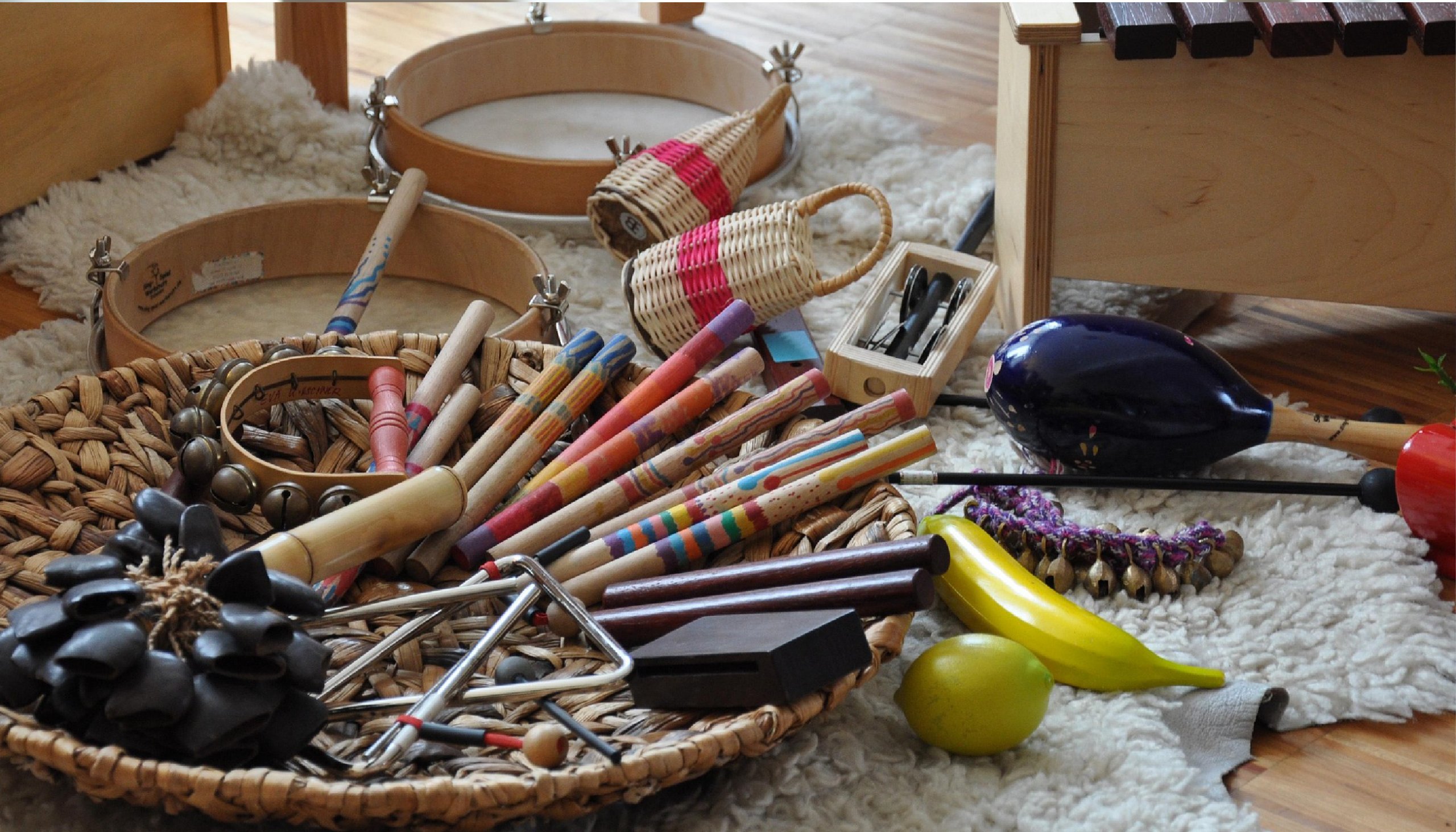
For exploration: Simple instruments like egg shakers, a small rain stick, or a gentle wind chime allow children to control sound production and understand cause and effect. Older children in our Groovers program enjoy more complex rhythm exploration—consider adding simple drums or xylophones for preschoolers.
Remember that auditory elements should be controlled by either you or your child—background noise from televisions or household appliances can interfere with the intentional auditory experience of your sensory corner.
Tactile Elements
Touch is perhaps the most fundamental sense for early learning and provides powerful calming and stimulating experiences:
Varied textures: Include a basket of items with different textures—silky scarves, bumpy balls, soft plush toys, and smooth wooden objects. Textured wallpaper samples, fabric swatches, or sensory boards with different materials attached can provide rich tactile feedback.
Manipulatives: For toddlers and preschoolers in our Happyfeet program, we incorporate tactile exploration that supports fine motor development. Similar items for your sensory corner might include therapy putty, kinetic sand in a small container, or water beads (for older children with supervision).
Weighted items: Small weighted stuffed animals or lap pads can provide calming proprioceptive input for children who seek pressure. A child-sized weighted blanket (never more than 10% of your child’s body weight) can be particularly soothing for some children.
Proprioceptive and Vestibular Elements
These often-overlooked senses relate to body position, movement, and balance—crucial for physical development and self-regulation:
Proprioceptive input: Include items that provide gentle resistance or pressure, such as stretchy fabric tunnels, compression sheets, or small therapy bands. These help children understand where their body is in space and can be particularly calming.
Vestibular stimulation: Small rocking chairs, wobble cushions, or balance discs provide gentle movement that helps develop the vestibular system. For very young children, supervised tummy time on a slightly wedged cushion in the sensory corner can provide appropriate vestibular input.
The movement activities we incorporate in our Scouts program demonstrate how vestibular and proprioceptive stimulation support learning across multiple domains—your home sensory corner can complement these benefits with appropriately scaled equipment.
Age-Appropriate Considerations
Children’s sensory needs evolve dramatically in the early years. Here’s how to adapt your sensory corner for different developmental stages:
For Babies (4-12 months)
Babies are just beginning to make sense of sensory input and need simple, clear experiences:
Focus on contrast: High-contrast black and white patterns are visually stimulating for young babies. Consider simple contrast cards or fabric.
Emphasize safety: All items should be washable and too large to pose a choking hazard. Avoid small pieces entirely.
Support position changes: Include a supportive floor cushion that helps with tummy time and sitting practice when supervised.
Simple sounds: Musical toys with clear, gentle sounds rather than electronic cacophony support auditory development without overwhelming.
Our Tenderfeet program introduces sensory experiences like these in a structured environment—your home sensory corner can reinforce these developmental benefits.
For Toddlers (1-2 years)
Toddlers are active explorers who need opportunities to move, manipulate, and discover:
Cause and effect: Items that provide clear feedback when manipulated—such as pop-up toys, simple switches that activate lights, or musical instruments that respond to touch.
Gross motor opportunities: Small climbers, stepping stones, or a balance beam set low to the ground (with supervision) help develop body awareness.
Sensory bins: Introduce supervised sensory bin play with larger materials like fabric pompoms, scarves, or large pasta shapes that pose no choking hazard.
Movement and music: Toddlers in our Happyfeet program thrive with movement paired with music—incorporate similar elements by providing scarves for dancing or simple percussion instruments.
For Preschoolers (3-4 years)
Preschoolers benefit from more complex sensory experiences that support emerging skills:
Problem-solving elements: Incorporate sensory-based puzzles, matching games with textured pieces, or exploration kits with magnifying glasses.
Emotional regulation tools: Introduce items specifically designed to help name and manage emotions—stress balls, glitter calm-down jars, or picture cards showing different feelings.
Pretend play: Add sensory-rich elements that support imaginative scenarios, such as scented playdough for “baking,” fabric pieces for creating landscapes, or sound effect makers for storytelling.
Learning connections: Our SMART-START English and SMART-START Chinese programs use sensory experiences to build pre-academic skills—incorporate similar concepts by adding alphabet texture cards, counting objects with different textures, or books with sensory elements.
Budget-Friendly Sensory Corner Ideas
Creating an effective sensory corner doesn’t require expensive equipment. Consider these affordable alternatives:
Repurposed household items: A collection of kitchen utensils with different textures and weights makes excellent sensory exploration tools. Empty food containers can become drums or shakers when filled with different materials.
Natural materials: Collect smooth stones, pine cones, feathers, or shells (for children past the mouthing stage). These provide authentic sensory experiences and connection to the natural world.
DIY sensory bottles: Create calming visual tools by filling clean plastic bottles with water, a drop of food coloring, and materials like glitter, beads, or small toys. Securely seal the cap with strong glue for safety.
Fabric scraps: Collect fabric samples or old clothing with different textures to create sensory books, texture walls, or simple sorting activities.
Cardboard constructions: Use cardboard boxes to create sensory spaces—cut and cover holes with different textured fabrics for exploration, or create a simple “car” with different tactile experiences on the dashboard.
Remember that rotating items regularly keeps the sensory corner fresh and engaging without requiring constant new purchases.
Integrating Music and Learning into Your Sensory Corner
One of the most powerful ways to enhance your sensory corner is through intentional integration of music and learning principles. At The Music Scientist, we’ve observed how music naturally amplifies the benefits of sensory experiences:
Rhythmic elements: Simple rhythm instruments like egg shakers, small drums, or rhythm sticks can be integrated into your sensory corner. Research shows that engaging with rhythm helps children develop sequential memory and listening skills that transfer to other learning domains.
Musical transitions: Consider creating a special “entering the sensory corner” song or chime sequence that signals to your child it’s time for this special experience. Consistent musical cues help children transition between activities and prepare their bodies and minds for the sensory experience ahead.
Themed explorations: Much like our Scouts program that uses music to explore scientific concepts, you can create themed sensory experiences. For example, an “ocean” theme might include blue sensory materials, recordings of wave sounds, and ocean-themed songs that teach vocabulary about marine life.
Language development: Pairing sensory experiences with specific vocabulary enriches language development. Narrate the sensory experience using descriptive words: “You’re touching something bumpy! Now you feel something smooth and cool.” This builds vocabulary in a meaningful context, similar to how we integrate language learning in our SMART-START English program.
Maintenance and Refreshing Tips
To keep your sensory corner effective and engaging over time:
Regular cleaning: Establish a cleaning schedule for all sensory items, particularly those that are frequently handled or mouthed. Many fabric items can be machine washed, while plastic components can be sanitized with child-safe cleaning solutions.
Rotation system: Children’s interests and developmental needs change rapidly. Create a simple rotation system where you introduce new sensory elements every few weeks while storing others. This keeps the space fresh without requiring constant new purchases.
Seasonal refreshes: Align some sensory corner elements with the changing seasons. Summer might feature cool-touch materials and ocean sounds, while winter could introduce warm textiles and gentle snowfall visuals.
Observe and adapt: Pay attention to which elements your child gravitates toward and which they ignore. This gives you valuable information about their sensory preferences and needs. Some children seek intense sensory input, while others prefer gentler stimulation—there’s no one-size-fits-all approach.
Involve your child: As your child grows, involve them in decisions about their sensory corner. This builds ownership and helps them develop self-awareness about what helps them feel calm and regulated.
Remember that your sensory corner should evolve as your child grows. What works beautifully for your 18-month-old may need significant adjustment by the time they’re three. The investment in understanding and responding to their changing sensory needs pays dividends in their development across all domains.
Creating a calming sensory corner at home is more than just a trendy addition to your living space—it’s an investment in your child’s neurological, emotional, and cognitive development. By thoughtfully designing an environment that engages multiple senses in a balanced way, you’re providing your child with valuable tools for self-regulation, exploration, and learning.
The beauty of sensory corners lies in their adaptability. Whether you have an infant just beginning to explore their world through sensory experiences in our Tenderfeet program, a curious toddler developing language and movement skills in Happyfeet, or a preschooler preparing for formal education through our SMART-START programs, a sensory corner can be customized to support their unique developmental journey.
Remember that consistency is key. Even a simple sensory corner, regularly available and thoughtfully maintained, offers more developmental benefits than an elaborate setup used inconsistently. Start with the basics, observe what resonates with your child, and gradually expand your sensory offerings as you learn together.
The sensory experiences you provide at home complement and reinforce the structured developmental approach we take at The Music Scientist. Together, we’re creating rich, multisensory environments that nurture your child’s natural curiosity and lay the foundation for lifelong learning and emotional well-being.
Want expert guidance on supporting your child’s sensory and cognitive development through music and movement? The Music Scientist offers developmentally-focused programs for children from 4 to 47 months old. Contact us today to learn how our specialized programs can complement your home sensory activities and support your child’s holistic development.
Table Of Contents
- Understanding Musical Readiness: When Can Children Start Piano?
- Developmental Milestones Related to Piano Learning
- Age-Based Recommendations for Piano Instruction
- Early Signs Your Child Might Be Ready for Piano
- Piano Preparation Activities for Different Age Groups
- What Research Tells Us About Starting Age
- The Parent’s Role in Early Piano Education
- Choosing the Right Piano Teacher for Your Child’s Age
- Conclusion: Finding the Right Time for Your Child
The question of when to start piano lessons is one that many parents deliberate over with careful consideration. Is age 4 too young? Is 10 too late? As specialists in early childhood music education at The Music Scientist, we understand these concerns and recognize that each child’s developmental journey is unique.
Piano education isn’t merely about learning to play an instrument—it’s a multifaceted developmental activity that engages cognitive, motor, and emotional skills simultaneously. The optimal starting age depends on various factors including fine motor development, attention span, and a child’s natural interest in music.
In this comprehensive guide, we’ll explore evidence-based recommendations for the best age to begin piano lessons, examine the developmental foundations that support musical learning at different stages, and provide practical guidance to help you make an informed decision for your child’s musical journey. Whether you have a music-loving toddler or a school-aged child expressing interest in piano, this article will help you navigate the path forward with confidence.
Understanding Musical Readiness: When Can Children Start Piano?
Musical readiness isn’t determined by age alone but rather by a constellation of developmental factors. Before diving into specific age recommendations, it’s important to understand what “readiness” actually means in the context of piano education.
Musical readiness encompasses several key areas: physical development (particularly fine motor skills), cognitive abilities (including focus and pattern recognition), emotional maturity (patience and frustration tolerance), and intrinsic motivation (genuine interest in music). Children develop these capabilities at different rates, which is why rigid age-based recommendations can sometimes be misleading.
Research in music cognition suggests that while music appreciation begins in infancy, the ability to engage with structured piano instruction typically emerges between ages 5-7 for most children. However, modified approaches can be effective with children as young as 3-4, provided the teaching methodology is developmentally appropriate.
At The Music Scientist, we’ve observed that early exposure to music through programs like our Tenderfeet infant classes creates a foundation for musical aptitude that can translate to readiness for instrument-specific learning at a younger age than might otherwise be expected.
Developmental Milestones Related to Piano Learning
Piano education requires a specific set of developmental capabilities that emerge sequentially as children grow. Understanding these milestones can help parents gauge their child’s readiness for piano instruction:
Fine Motor Development: Piano playing requires independent finger movement, hand-eye coordination, and proper hand positioning. By age 5-6, most children have developed sufficient fine motor control to begin basic piano techniques, though this varies considerably among individuals.
Cognitive Processing: Reading music notation involves multiple cognitive skills including symbol recognition, pattern identification, and spatial understanding. These abilities typically begin to solidify around age 6-7, though preliminary music reading concepts can be introduced earlier.
Attention Span: Productive piano practice requires sustained focus. By age 6, most children can maintain attention for 15-20 minutes—sufficient for beginning lessons. Younger children generally benefit from shorter, more frequent music interactions, like those structured in our Happyfeet toddler program.
Emotional Maturity: Learning piano involves perseverance through challenges. Around ages 7-8, children typically develop the emotional regulation needed to work through difficulties in learning new pieces. Younger students can still engage with piano but may need more support and appropriately scaled expectations.
Number Recognition and Basic Math: Understanding rhythm requires basic mathematical concepts like counting and fractions. Most children develop sufficient numerical literacy for basic rhythm reading by age 5-6.
Age-Based Recommendations for Piano Instruction
While recognizing individual differences, research and pedagogical experience provide some general guidelines for age-appropriate piano education approaches:
Birth to 3 Years: Early Music Exposure
For the youngest children, formal piano lessons aren’t developmentally appropriate, but this period is crucial for establishing musical foundations. During these formative years:
Children benefit enormously from being immersed in musical environments rich with diverse sounds, rhythms, and melodies. Research by neuroscientists like Dr. Laurel Trainor has demonstrated that musical exposure during infancy helps develop auditory processing pathways in ways that benefit later musical learning.
Movement-based music activities, like those we incorporate in our Groovers classes, help children internalize rhythm and develop whole-body musical awareness. This embodied understanding of music creates neural pathways that support later instrument learning.
Simple keyboard exploration can begin around age 2-3, focusing on discovery rather than technique. At this stage, children enjoy producing sounds and observing cause and effect relationships, but structured practice isn’t developmentally appropriate.
4-5 Years: Pre-Piano Preparation
The preschool years represent a transitional period when many children begin showing readiness for more structured musical learning. Appropriate approaches include:
Group music classes that incorporate pre-keyboard activities focusing on rhythm, singing, and musical games. These activities develop musical thinking while maintaining engagement through developmentally appropriate practices.
Our Scouts program introduces foundational musical concepts through engaging, science-themed melodies that prime children for future instrument learning while building focus and listening skills.
Modified piano approaches using color-coding, simplified notation, or by-ear learning can be effective with this age group. Programs like Wunderkeys, Piano Safari, and Music for Little Mozarts are specifically designed for preschool-aged beginners.
Lessons for this age group should be kept short (15-20 minutes), playful, and varied to accommodate developing attention spans. The focus should be on fostering music enjoyment rather than technical perfection.
6-8 Years: Traditional Piano Instruction
Many piano pedagogues consider ages 6-8 the sweet spot for beginning traditional piano instruction. By this stage, most children have developed:
Sufficient fine motor control to manage basic piano technique requirements. The hand size is still growing but generally adequate for beginning repertoire, especially with appropriately selected teaching materials.
The cognitive capacity to understand musical notation and apply it to the keyboard. At this age, children can grasp abstract concepts like staff notation and begin developing music reading fluency.
Attention spans sufficient for 30-minute lessons and short daily practice sessions. The ability to follow multi-step instructions makes lessons more productive and efficient.
Children in our SMART-START English or SMART-START Chinese programs often transition smoothly to piano instruction around this age, having developed strong foundational musical skills and learning patterns.
9+ Years: Benefits for Older Beginners
Children who begin piano study at age 9 or older bring distinct advantages to their musical learning:
More developed reasoning skills allow older beginners to progress more quickly through foundational concepts. Abstract thinking abilities support understanding musical theory and structure.
Greater physical strength and coordination enable faster technical development. Hand size is rarely a limitation at this stage, opening up a wider range of repertoire earlier in the learning process.
Enhanced self-discipline and organizational skills support more independent practice habits. Older beginners typically require less parental supervision during practice sessions.
The notion that children must begin piano by a certain age to succeed is not supported by research. Many accomplished pianists began their studies at age 10 or later, progressing rapidly due to their advanced cognitive and physical development.
Early Signs Your Child Might Be Ready for Piano
Regardless of age, certain behaviors indicate a child may be ready to begin piano education:
Sustained Musical Interest: Does your child gravitate toward musical activities, instruments, or show consistent enjoyment of music over time? Intrinsic motivation is one of the strongest predictors of musical persistence.
Physical Readiness Indicators: Watch for fine motor development in everyday activities. Can your child manipulate small objects with precision? Draw shapes with control? Button clothing independently? These skills transfer to piano technique.
Listening Behaviors: Children who can identify different instruments in recordings, remember melodies, or show rhythmic responses to music demonstrate auditory processing abilities that support piano learning.
Focus During Structured Activities: Observe how your child engages with other learning activities that require sustained attention. Can they follow multi-step instructions? Complete age-appropriate tasks without constant redirection?
Alphabet and Number Recognition: Basic literacy and numeracy support music reading fundamentals. While not absolutely necessary for beginning piano (especially with by-ear approaches), these skills facilitate progress as instruction advances.
Piano Preparation Activities for Different Age Groups
While waiting for the optimal time to begin formal piano lessons, parents can facilitate musical development through age-appropriate preparation activities:
For Toddlers (1-3 years): Focus on music immersion through singing, movement, and listening games. Simple percussion instruments help develop rhythm awareness and coordination. Our Tenderfeet and Happyfeet programs are specifically designed to build these foundational skills through developmentally appropriate play.
For Preschoolers (3-5 years): Introduce keyboard exploration with simple finger plays and pattern games. Rhythm activities like clapping or marching to music help develop the internal timekeeping essential for piano playing. Programs like Groovers provide structured music and movement experiences that prepare children for future instrument study.
For Early Elementary (5-7 years): Try pre-reading music activities using colors, shapes, or simplified notation. Finger games that develop independence between fingers prepare hands for piano technique. Our SMART-START programs incorporate musical literacy activities that transfer directly to piano learning.
These preparation activities not only develop musical readiness but also help gauge a child’s interest level and learning style, informing decisions about when and how to begin formal piano instruction.
What Research Tells Us About Starting Age
Scientific research provides valuable insights into the relationship between starting age and musical development:
A longitudinal study by Gary McPherson at the University of Melbourne found that starting age was less predictive of musical achievement than practice quality, motivation, and parental support. This suggests that how children learn may be more important than when they begin.
Neuroscience research indicates that while early childhood (before age 7) represents a sensitive period for developing absolute pitch, most aspects of musical skill development remain plastic well into adolescence and beyond.
The work of Dr. Robert Duke at the University of Texas demonstrated that beginning students who received developmentally appropriate instruction showed similar progress regardless of whether they started at age 5 or 9, though their learning trajectories differed.
Research on music and cognitive development has consistently shown that structured music education at any age produces benefits in non-musical domains including language processing, executive function, and spatial reasoning.
These findings suggest that while early childhood represents a unique developmental window, there is no single “best age” for all children to begin piano. The optimal approach depends on the individual child’s developmental profile and the teaching methodology employed.
The Parent’s Role in Early Piano Education
Parents play a crucial role in supporting early piano education, particularly for younger beginners:
Home Environment: Creating a musical home with regular listening opportunities and visible value placed on music lays groundwork for instrumental learning. Research by Peter Miksza at Indiana University found that musical home environments were stronger predictors of persistence than starting age.
Practice Support: Younger students (under age 8) typically need parental involvement during practice sessions. This might include reading instructions, maintaining focus, or providing encouragement through challenges. As children mature, this role gradually shifts toward greater independence.
Commitment Considerations: Beginning piano study represents a significant commitment of family resources including time, energy, and finances. Parents should realistically assess their capacity to provide consistent support before embarking on this journey.
Balancing Expectations: Parents should maintain realistic expectations aligned with their child’s developmental stage. Progress timelines differ significantly between a 5-year-old and 9-year-old beginner due to fundamental developmental differences.
Choosing the Right Piano Teacher for Your Child’s Age
The ideal piano teacher will vary based on your child’s age and developmental needs:
For Younger Beginners (4-6): Look for teachers with specialized early childhood training who use age-appropriate methods like Yamaha, Suzuki, or Wunderkeys. These approaches accommodate shorter attention spans and less developed abstract thinking.
For Elementary-Aged Beginners (7-9): Traditional piano methods work well for this age group, but the teacher should still incorporate game-like activities and varied approaches to maintain engagement.
For Older Beginners (10+): Seek teachers who can adapt materials and pacing to respect the cognitive abilities of older children while building technical foundations. Avoiding materials that feel “babyish” is important for motivation at this age.
When interviewing potential teachers, ask about their experience with your child’s specific age group, their teaching philosophy regarding developmental readiness, and how they adapt their approach to individual learning styles. The teacher-student relationship is often as important as the teaching method itself in determining long-term musical outcomes.
Conclusion: Finding the Right Time for Your Child
The question of the “best age” to start piano lessons doesn’t have a universal answer. Current research and pedagogical experience suggest that while ages 6-8 often represent an optimal balance of developmental readiness and learning potential for traditional piano instruction, meaningful musical engagement can begin much earlier, and successful piano study can certainly start later.
At The Music Scientist, we recognize that each child follows a unique developmental trajectory. Our approach to early music education honors these individual differences while providing research-based programming that builds the foundational skills needed for successful instrumental study when the time is right.
Rather than focusing exclusively on age, we encourage parents to consider their child’s developmental readiness, interest level, and family circumstances when making decisions about piano instruction. Early exposure to quality music education—like that provided in our specialized programs for infants through preschoolers—creates neural pathways that support later instrumental learning regardless of when formal piano study begins.
The most successful piano journeys start not at a particular age, but when there is alignment between a child’s developmental capabilities, a teaching approach suited to their learning style, and a supportive environment that nurtures their musical growth. By focusing on these elements rather than arbitrary age thresholds, parents can help their children develop lifelong musical skills and appreciation.
Ready to Start Your Child’s Musical Journey?
At The Music Scientist, we offer developmentally appropriate music programs for children from infancy through preschool age. Our research-based curriculum builds the cognitive, motor, and listening skills that form the foundation for successful piano study when your child is ready.
Contact us today to schedule a trial class or consultation to discuss how we can support your child’s unique musical development path.
Table Of Contents
- Understanding Sound Waves: The Science Behind Music
- Benefits of Sound Experiments for Child Development
- Experiment 1: Create a Simple String Telephone
- Experiment 2: Dancing Rice with Sound Vibrations
- Experiment 3: Water Glass Symphony
- Experiment 4: Straw Pan Flutes
- Experiment 5: Balloon Speaker Amplifier
- Experiment 6: Sound Wave Visualization with Salt
- Experiment 7: Bottle Blow Orchestra
- Experiment 8: Rubber Band Guitar
- Experiment 9: Sound Proof Science Challenge
- Experiment 10: Sound Wave Art Creation
- Connecting These Experiments to Musical Learning
- Conclusion: Sound Science for Young Minds
Have you ever watched your child’s eyes light up when they discover something new about the world? That magical moment of connection happens when learning transforms into play—exactly what sound-wave science experiments can deliver right in your living room. Sound waves are fascinating phenomena that surround us daily, especially in music, making them perfect for introducing young minds to scientific concepts.
At The Music Scientist, we believe that understanding the science behind music enhances a child’s appreciation and cognitive development. Sound experiments offer a multisensory approach to learning that engages multiple intelligences—logical reasoning as children predict outcomes, musical intelligence as they observe sound properties, and kinesthetic learning as they physically manipulate materials.
This guide presents 10 simple yet captivating sound-wave experiments that require minimal materials but deliver maximum educational impact. These activities are perfect for children aged 2-5 years, though even the littlest scientists in your Tenderfeet programs (4-17 months) will enjoy watching and listening. Each experiment demonstrates fundamental sound principles while creating opportunities for parent-child bonding and early scientific thinking. Let’s transform your living room into a laboratory of sonic discovery!
Understanding Sound Waves: The Science Behind Music
Before diving into our experiments, let’s explore what sound waves actually are. Sound is created when objects vibrate, causing the air around them to vibrate too. These vibrations travel through the air as waves, eventually reaching our ears where they’re interpreted as sound by our brains.
For young children, this concept might seem abstract, but it becomes tangible through hands-on exploration. When a drum is struck, the surface vibrates. When a guitar string is plucked, it moves back and forth rapidly. These vibrations are the foundation of all music and sound.
Key sound properties that children can observe through our experiments include:
- Pitch: Higher pitches come from faster vibrations, while lower pitches come from slower vibrations
- Volume: Louder sounds come from larger vibrations, softer sounds from smaller vibrations
- Timbre: The unique quality of different sounds (why a piano sounds different from a flute, even playing the same note)
Through play-based exploration, children naturally begin to understand these properties, building both scientific knowledge and musical appreciation simultaneously.
Benefits of Sound Experiments for Child Development
Sound-wave experiments offer tremendous developmental benefits for young children, aligning perfectly with the holistic approach we embrace at The Music Scientist. These activities support:
Cognitive Development: When children predict what will happen in an experiment and observe the results, they’re developing critical thinking skills and scientific reasoning.
Language Skills: Discussing experiments introduces new vocabulary words like “vibration,” “sound wave,” and “frequency”—enriching verbal intelligence similarly to our SMART-START English program.
Fine Motor Skills: Many of these experiments require careful manipulation of objects, strengthening the same finger and hand muscles developed in our Happyfeet classes.
Sensory Integration: Sound experiments engage multiple senses simultaneously—hearing the sounds, seeing the vibrations, and feeling the materials—similar to our sensory-rich Tenderfeet program.
Parent-Child Bonding: These shared discoveries create meaningful connections between you and your child, supporting emotional development.
Now let’s explore these fascinating experiments that bring sound science to life!
Experiment 1: Create a Simple String Telephone
Materials Needed:
2 paper cups, string (about 3-5 meters), paperclip, scissors
Step-by-Step Instructions:
1. Poke a small hole in the bottom of each cup using the paperclip
2. Thread one end of the string through each hole and secure with a knot inside each cup
3. Have your child hold one cup while you take the other and walk away until the string is taut
4. Take turns speaking into your cup while the other person listens
The Science Behind It:
When you speak into the cup, your voice creates vibrations that travel along the string to the other cup. The string transmits these vibrations much better than air does, especially if kept tight. This demonstrates how sound waves need a medium to travel through—just like the vibrations we create in our Groovers classes when children use percussion instruments.
For younger children, you can simplify the explanation: “Your voice is making tiny movements (vibrations) that travel along the string to the other cup, where they become sound again!”
Experiment 2: Dancing Rice with Sound Vibrations
Materials Needed:
Plastic wrap, large bowl, uncooked rice, rubber band, metal spoon
Step-by-Step Instructions:
1. Stretch plastic wrap tightly over the bowl and secure with a rubber band
2. Place a small handful of rice grains on top of the plastic wrap
3. Hold the metal spoon near (but not touching) the plastic wrap and tap it gently
4. Observe the rice grains jumping in response to the sound vibrations
The Science Behind It:
The sound waves from tapping the spoon cause the air to vibrate, which makes the plastic wrap vibrate. The rice grains dance because they’re sitting on this vibrating surface. Try making different sounds and see how the rice responds differently—louder sounds typically create more movement, showing how sound volume relates to the amplitude of sound waves.
This visual representation of sound helps children understand that even though we can’t see sound waves, they have physical effects on objects around us—a perfect complement to the musical movement activities in our curriculum.
Experiment 3: Water Glass Symphony
Materials Needed:
5-6 identical glass cups, water, metal spoon
Step-by-Step Instructions:
1. Arrange glasses in a row
2. Fill each glass with different amounts of water (empty, 1/4 full, 1/2 full, 3/4 full, completely full)
3. Gently tap each glass with the spoon and listen to the different tones
4. Try creating a simple melody by tapping the glasses in sequence
The Science Behind It:
The pitch of each glass depends on how much water it contains. Less water means more space for air to vibrate, creating higher pitches. More water means less air space, resulting in lower pitches. This experiment beautifully demonstrates how pitch works, a fundamental concept in our Scouts program where children learn musical concepts through catchy melodies.
For older preschoolers, you can introduce the concept of a musical scale and challenge them to arrange the glasses to play “do-re-mi.” This combines science learning with musical ear training.
Experiment 4: Straw Pan Flutes
Materials Needed:
6-8 plastic straws, scissors, tape, ruler
Step-by-Step Instructions:
1. Cut the straws to different lengths (start with one full length, then cut each subsequent straw about 1 cm shorter)
2. Arrange the straws from longest to shortest and tape them together side by side
3. Blow across the top of each straw (not into them) to create different notes
The Science Behind It:
The length of each straw determines the pitch it produces. Longer straws create lower pitches because the air inside takes longer to vibrate. Shorter straws produce higher pitches because the air vibrates more quickly. This demonstrates the same principle that makes different-sized instruments in an orchestra produce different sounds.
This hands-on instrument making connects science with creative expression, similar to how our SMART-START Chinese program connects language learning with music to enhance memory and retention.
Experiment 5: Balloon Speaker Amplifier
Materials Needed:
Balloon, empty toilet paper tube, tape, smartphone playing music
Step-by-Step Instructions:
1. Cut the neck off the balloon
2. Stretch the balloon tightly over one end of the toilet paper tube and secure with tape
3. Place a phone playing music inside the open end of the tube
4. Listen to how the sound changes with and without the balloon amplifier
The Science Behind It:
The balloon acts as a diaphragm (like the one in real speakers) that vibrates in response to the sound waves from your phone. These vibrations are transferred to the air in the tube, amplifying the sound. This simple device demonstrates how speakers work and how sound can be manipulated.
Try playing different types of music and asking your child if they can feel the balloon vibrating differently with different sounds. This multisensory experience helps children connect what they hear with the physical properties of sound—a key aspect of our holistic approach to learning.
Experiment 6: Sound Wave Visualization with Salt
Materials Needed:
Metal baking tray, salt, rubber mallet or wooden spoon
Step-by-Step Instructions:
1. Sprinkle a thin, even layer of salt across the baking tray
2. Hold the tray by one corner
3. Gently strike the edge of the tray with the mallet or spoon
4. Observe the patterns that form in the salt
The Science Behind It:
When you strike the tray, you create vibrations that travel through the metal. These vibrations cause certain areas of the tray to move up and down more than others (called nodes and antinodes). The salt collects in the areas that aren’t moving (nodes), creating visible patterns called Chladni patterns that reveal the invisible sound waves.
For younger children in our Tenderfeet program, this experiment is primarily a visual wonder. For older children approaching preschool age, it’s an opportunity to discuss how scientists sometimes make invisible things visible to study them better.
Experiment 7: Bottle Blow Orchestra
Materials Needed:
5-6 identical glass bottles, water, measuring cup
Step-by-Step Instructions:
1. Fill each bottle with different amounts of water
2. Blow gently across the top of each bottle
3. Listen to the different tones created
4. Experiment with adding or removing water to change the pitches
The Science Behind It:
When you blow across the bottle opening, you create a vibration in the air column inside the bottle. The pitch depends on the size of this air column—less water means a larger air column and a lower pitch, more water means a smaller air column and a higher pitch. This is the opposite of our water glass experiment, where we tapped the glasses instead of blowing across them.
This experiment is particularly valuable for demonstrating how the same materials can create different sounds depending on how they’re used—a concept that mirrors our Groovers classes where children discover different ways to create sounds with their bodies and instruments.
Experiment 8: Rubber Band Guitar
Materials Needed:
Empty tissue box, 4-6 rubber bands of different widths, pencil
Step-by-Step Instructions:
1. Stretch rubber bands around the empty tissue box, over the opening
2. Arrange bands from thickest to thinnest
3. Pluck each band and listen to the different sounds
4. Place a pencil under the bands to create a “bridge” and see how it changes the sound
The Science Behind It:
This homemade string instrument demonstrates how thickness affects pitch. Thicker rubber bands vibrate more slowly, creating lower pitches, while thinner bands vibrate faster, creating higher pitches. The tissue box serves as a resonator, amplifying the sound—just like the body of a guitar or violin.
This experiment connects directly to stringed instruments in music, making it a perfect complement to our Happyfeet classes where toddlers are introduced to different instrument families.
Experiment 9: Sound Proof Science Challenge
Materials Needed:
Small musical toy or alarm clock, various materials (cotton balls, aluminum foil, fabric, plastic wrap, etc.), box
Step-by-Step Instructions:
1. Place the musical toy or ticking clock in the box
2. Try different materials to wrap or stuff around it
3. Close the box and listen to how each material affects the sound
4. Discuss which materials block sound best and why
The Science Behind It:
Different materials absorb or reflect sound waves differently. Soft, porous materials like cotton tend to absorb sound, while hard, dense materials often reflect it. This experiment introduces the concept of soundproofing and acoustics—the science of how sound interacts with different environments.
For children in our Scouts program, this experiment connects to how we use our understanding of sound to design concert halls, recording studios, and even everyday spaces like classrooms where controlling sound is important.
Experiment 10: Sound Wave Art Creation
Materials Needed:
Small plastic container with lid, watered-down paint, paper, rubber band, small speaker or smartphone
Step-by-Step Instructions:
1. Cut a circle of paper to fit the top of the container
2. Secure the paper to the container with a rubber band (like a drum)
3. Place a few drops of watered-down paint on the paper
4. Hold a speaker playing music against the side of the container
5. Watch the paint dance and create patterns based on the music’s vibrations
The Science Behind It:
The sound vibrations from the music travel through the container and cause the paper “drum” to vibrate. These vibrations move the paint, creating unique patterns that are a visual representation of the sound waves. Different types of music (classical, rock, lullabies) will create different patterns.
This artistic experiment beautifully connects science, music, and visual arts—a perfect illustration of our multiple intelligences approach at The Music Scientist where we recognize that children learn in different ways and through different modalities.
Connecting These Experiments to Musical Learning
These sound-wave experiments do more than just demonstrate scientific principles—they lay important groundwork for musical understanding. When children see and feel how sound waves work, they develop a deeper appreciation for the music they experience in our classes.
To extend the learning from these experiments:
Compare and Contrast: After doing the bottle blow orchestra and water glass symphony experiments, discuss how they’re similar and different. Both use water and glass, but one involves blowing and the other involves tapping. Why do they work differently?
Make Connections to Instruments: When making the rubber band guitar, talk about how real guitars and other string instruments work using the same principles. If possible, show children a real string instrument to compare.
Incorporate Movement: Just as in our Groovers program, encourage children to move their bodies to represent sound waves—stretching tall for high pitches, crouching low for deep sounds, moving arms in waves to show how sound travels.
By engaging multiple senses and learning styles, these experiments reinforce the same developmental principles that make our music programs so effective. They foster curiosity, critical thinking, and creative expression—all essential skills for preschool readiness and beyond.
Conclusion: Sound Science for Young Minds
Through these 10 living room sound-wave experiments, you’ve provided your child with more than just entertainment—you’ve offered meaningful learning experiences that connect science and music in tangible ways. Each experiment demonstrates how sound works while fostering development across multiple domains—cognitive, physical, sensory, and emotional.
The beauty of these activities lies in their simplicity and accessibility. Using everyday materials, you’ve created opportunities for scientific discovery that align perfectly with young children’s natural curiosity. You’ve also strengthened the neural pathways that will support both musical aptitude and scientific thinking as your child grows.
At The Music Scientist, we believe that the most powerful learning happens when children are engaged, delighted, and connecting ideas across different domains. These sound-wave experiments embody that philosophy by making abstract concepts concrete and turning scientific principles into playful exploration.
We invite you to continue this journey of discovery in our specialized programs, where we’ve carefully designed music-based curricula to support every stage of your child’s development from infancy through preschool. Whether your little one is just beginning to explore sensory experiences in our Tenderfeet program or preparing for formal education in our SMART-START programs, we provide the perfect environment for nurturing curious, confident, and capable young learners.
Experience the Magic of Music-Based Learning
Ready to see how music can transform your child’s development? The Music Scientist offers specialized programs for children from 4 to 47 months that harness the power of music to build cognitive, physical, and social-emotional skills.
Schedule a free trial class today and watch your child’s eyes light up with the joy of discovery!
Table Of Contents
- Introduction: The Evolution of Music-Tech in Early Childhood Education
- AI-Personalized Musical Learning Paths
- Spatial Audio and Immersive Sound Environments
- Haptic Feedback Instruments for Sensory Development
- Multilingual Music-Learning Platforms
- Neurofeedback-Enhanced Musical Experiences
- Mixed Reality Music Education Environments
- Implementing Future Music-Tech: Practical Considerations
- Conclusion: The Harmonious Future of Early Learning
The landscape of early childhood education is experiencing a remarkable transformation, with music technology standing at the forefront of innovation. As we look toward 2026, emerging music-tech solutions are revolutionizing how our youngest learners engage with sound, rhythm, and melody—creating unprecedented opportunities for cognitive, emotional, and social development during the critical first years of life.
For decades, research has consistently demonstrated the profound impact of music on early brain development. Now, technological advancements are amplifying these benefits, providing more personalized, immersive, and developmentally appropriate musical experiences for infants and toddlers. These innovations are particularly significant for children aged 4 to 47 months—precisely the developmental window where The Music Scientist focuses its specialized curriculum.
This comprehensive trend report examines the most promising music-tech innovations emerging by 2026, their developmental implications, and how they align with evidence-based approaches to early learning. From AI-personalized learning paths to haptic feedback instruments and neurofeedback-enhanced experiences, we’ll explore how these technologies are being thoughtfully integrated into early childhood education programs to nurture multiple intelligences and prepare young minds for future learning success.
As Singapore continues to position itself at the intersection of educational excellence and technological innovation, understanding these trends offers valuable insights for parents, educators, and institutions committed to providing the most effective early learning experiences possible. Let’s explore how the harmonious marriage of music and technology is composing a new symphony for early childhood development.
AI-Personalized Musical Learning Paths
By 2026, artificial intelligence will transform early childhood music education through sophisticated adaptive learning systems that respond to each child’s unique developmental trajectory. These AI-powered platforms analyze a child’s interactions, preferences, and developmental milestones to create personalized musical experiences that evolve in real-time.
Unlike the static musical content of previous decades, these systems continuously adjust difficulty levels, tempo, complexity, and thematic elements based on the child’s engagement patterns. For instance, if a 14-month-old demonstrates particular responsiveness to rhythm-based activities, the AI might introduce more complex rhythmic patterns while maintaining appropriate developmental scaffolding.
Advanced voice recognition technology enables these systems to track a child’s vocal development—from early cooing to first words and simple phrases. The Music Scientist’s Tenderfeet program, which focuses on infant care and sensory development, could be significantly enhanced by such technology, allowing for personalized vocal development tracking that complements the program’s existing focus on auditory discrimination and early language acquisition.
These AI systems also provide parents and educators with detailed developmental insights, highlighting progress across multiple domains—from auditory processing and linguistic development to emotional regulation and cognitive growth. This data-driven approach enables more targeted interventions and activities, aligning perfectly with The Music Scientist’s methodology of addressing multiple intelligences through musical experiences.
Perhaps most importantly, AI personalization ensures that children remain in what developmental psychologists call the “zone of proximal development”—challenging enough to foster growth but not so difficult as to cause frustration. This precise calibration maximizes learning outcomes while maintaining the joy and playfulness essential for early childhood engagement with music.
Spatial Audio and Immersive Sound Environments
Spatial audio technology is poised to create revolutionary immersive learning environments for young children by 2026. Unlike traditional stereo or surround sound, spatial audio creates three-dimensional soundscapes that accurately represent how sound exists in physical space, allowing children to experience music as a fully immersive phenomenon rather than simply something they hear.
These immersive sound environments enable children to physically locate different instruments within a musical piece, differentiate between sounds more effectively, and develop enhanced auditory processing skills. For toddlers in developmental programs like The Music Scientist’s Happyfeet, this technology transforms abstract musical concepts into tangible, spatial experiences that align perfectly with how young children naturally learn—through multisensory exploration.
Developmental Benefits of Spatial Audio
Research indicates that spatial audio experiences contribute significantly to the development of critical cognitive skills in early childhood. Specifically, these immersive sound environments help children develop:
Superior auditory discrimination abilities, allowing them to distinguish between similar sounds—a foundational skill for phonological awareness and later reading success. Enhanced spatial reasoning capabilities, as children learn to track and locate sounds in three-dimensional space. Improved attention span and focus, as the immersive nature of the experience naturally captivates young minds while reducing external distractions.
By 2026, we anticipate seeing specialized spatial audio environments designed specifically for developmental milestones between 4 and 47 months. These might include sound gardens where toddlers physically walk through different musical elements, interactive floors that respond to movement with spatially-appropriate sounds, and multisensory rooms where musical elements are mapped to physical spaces.
For programs like Groovers, which focuses on music and dance for toddlers, spatial audio technology creates opportunities for movement activities where children physically navigate through sound, creating a profound connection between bodily awareness, spatial understanding, and musical concepts.
Haptic Feedback Instruments for Sensory Development
The integration of advanced haptic feedback technology into musical instruments and learning tools represents one of the most promising developments for early childhood music education by 2026. These innovations enable children to literally feel music through precisely calibrated vibrations, creating a multisensory learning experience that addresses multiple developmental domains simultaneously.
Haptic-enhanced instruments designed specifically for children aged 4-47 months will include adaptive resistance features that respond to a child’s developmental stage. For example, percussion instruments might provide subtle vibration patterns that guide rhythmic development, while simplified string or keyboard instruments could offer gentle physical cues to help small hands find correct positions.
For infants in the Tenderfeet program, haptic technology offers remarkable opportunities for sensory integration. Specialized mats and cushions with embedded haptic feedback allow pre-mobile infants to experience musical vibrations throughout their bodies, supporting neural development and establishing foundational connections between sound, touch, and movement.
These technologies are particularly valuable for fostering inclusive learning environments. Children with hearing impairments can experience music through tactile sensation, while those with sensory processing differences might benefit from the additional input channel. This aligns perfectly with The Music Scientist’s commitment to addressing multiple learning styles and intelligences through their curriculum.
By 2026, we anticipate seeing sophisticated haptic wearables designed specifically for early childhood music education. These might include gentle wristbands or lightweight vests that translate musical elements into precise tactile patterns, allowing children to literally “wear” the music as they learn and develop. For programs like Groovers, these haptic wearables could enhance rhythm understanding through gentle pulses that correspond to beat patterns, creating a direct body-music connection.
Multilingual Music-Learning Platforms
By 2026, multilingual music education technology will offer unprecedented opportunities for language acquisition during the critical early development window. These advanced platforms seamlessly integrate musical experiences with multiple language exposures, leveraging the unique ability of music to enhance language learning through rhythm, melody, and repetition.
The most sophisticated of these platforms will utilize adaptive language sequencing based on developmental linguistics research. For example, they might introduce basic vocabulary through melodic patterns in multiple languages, gradually building to simple phrases and eventually more complex linguistic structures—all embedded within engaging musical activities appropriate for each developmental stage.
This trend aligns perfectly with The Music Scientist’s dual-language approach seen in their SMART-START English and SMART-START Chinese programs. These technologies could enhance these offerings by providing personalized language learning pathways that respect each child’s existing language exposure while introducing new linguistic elements through familiar musical frameworks.
Cross-Cultural Musical Experiences
Beyond basic language acquisition, these multilingual platforms will incorporate authentic musical traditions from diverse cultures, exposing children to different tonal systems, rhythmic patterns, and musical structures. This not only enhances cognitive flexibility but also fosters cultural awareness and appreciation from the earliest developmental stages.
For Singapore’s multicultural context, this technology offers particularly valuable opportunities. Children can develop familiarity with the musical and linguistic patterns of multiple cultural traditions simultaneously, preparing them for success in Singapore’s diverse educational and social environment. The Music Scientist could potentially enhance their Scouts program, which already uses catchy melodies to foster a love for science, by incorporating multilingual elements that connect scientific concepts across language boundaries.
Advanced speech recognition capabilities will allow these platforms to provide gentle correction and encouragement as children experiment with new sounds and words across languages. For parents concerned about proper pronunciation in multiple languages, these technologies offer valuable support, ensuring children develop accurate phonological awareness across their linguistic repertoire.
Neurofeedback-Enhanced Musical Experiences
One of the most revolutionary developments anticipated by 2026 is the integration of child-appropriate neurofeedback technology with early music education. These systems use non-invasive monitoring of brain activity to create responsive musical experiences that adapt based on a child’s cognitive engagement, emotional state, and attention patterns.
Unlike adult neurofeedback systems that often require complex setups, these child-friendly versions utilize lightweight, comfortable sensors embedded in headbands, caps, or even stuffed animals. These devices monitor key indicators of brain activity and feed this information to AI systems that adjust musical elements accordingly.
For instance, if a child shows signs of heightened focus during a particular rhythmic pattern, the system might extend that segment or gradually increase its complexity to sustain optimal engagement. Conversely, if attention appears to wane, the music might shift to more stimulating elements or incorporate familiar favorites to recapture interest.
Beyond simple attention metrics, these systems will be capable of identifying emotional responses, allowing the music to adapt based on whether a child appears calm, excited, frustrated, or curious. This emotional responsiveness creates opportunities for developing emotional regulation through musical interaction—a sophisticated application of music as a developmental tool that aligns perfectly with The Music Scientist’s holistic approach to early childhood development.
For programs like Tenderfeet and Happyfeet, neurofeedback technology offers unprecedented insights into how different musical elements impact infant and toddler brain development. These insights can inform curriculum refinements and personalized approaches that maximize developmental benefits across cognitive, emotional, and social domains.
Parents and educators will have access to developmentally appropriate data visualizations that illustrate patterns in a child’s engagement over time, identifying which musical elements consistently trigger positive responses. This information enables more targeted and effective musical experiences both in structured learning environments and during everyday interactions at home.
Mixed Reality Music Education Environments
By 2026, mixed reality (MR) technology will create unprecedented opportunities for immersive musical learning experiences specifically designed for early childhood education. These age-appropriate MR systems will blend physical and digital elements to create engaging, multisensory environments that support development across multiple domains simultaneously.
Unlike virtual reality, which completely replaces the physical world, mixed reality overlays digital elements onto real environments—making it ideal for young children who need to maintain connection with concrete, tangible experiences. For toddlers in programs like Groovers, these technologies might project visual representations of sound waves or musical notation that respond to their movements or vocalizations, creating immediate connections between physical actions and musical concepts.
Interactive Projection Environments
Advanced projection systems will transform ordinary spaces into interactive musical playgrounds where children can physically engage with musical concepts. Floor and wall projections might display colorful shapes representing different tones or instruments that respond when children touch, step, or move near them. These systems create opportunities for whole-body musical engagement that supports kinesthetic learning while simultaneously developing gross motor skills.
For programs focusing on preschool readiness like SMART-START English and SMART-START Chinese, mixed reality can create seamless connections between musical activities and early literacy. For example, children might see letters or Chinese characters appear and animate in response to specific musical phrases, creating multi-sensory associations that strengthen both musical comprehension and pre-reading skills.
These environments can also foster collaborative musical experiences where multiple children interact with the same musical elements simultaneously, developing social skills alongside musical understanding. A simple tapping game might evolve into a collaborative rhythm-making activity where children must coordinate their actions to create harmonious patterns, building teamwork and mutual awareness through musical play.
For the Scouts program, which already connects music with scientific concepts, mixed reality offers extraordinary possibilities. Children might see visual representations of sound waves, experience simulations of how different animals hear, or interact with animated models of the human ear while simultaneously experiencing the corresponding sounds—creating concrete, memorable connections between musical experiences and scientific knowledge.
Implementing Future Music-Tech: Practical Considerations
As these exciting technologies emerge, educational institutions and parents face important considerations regarding their implementation. The most successful applications of music-tech in early childhood settings will balance innovation with developmental appropriateness, ensuring technology enhances rather than replaces crucial human interactions and physical experiences.
Educational programs like those offered by The Music Scientist will need to develop thoughtful integration strategies that maintain their core developmental focus while leveraging these new technologies. This might include specialized training for educators, carefully structured implementation phases, and ongoing assessment of developmental outcomes to ensure technologies are serving their intended purpose.
Balancing Screen Time and Sensory Experiences
Even as technology advances, developmental specialists continue to emphasize the importance of limiting screen time for young children while prioritizing hands-on, multisensory experiences. The most effective music-tech implementations will minimize traditional screens in favor of embodied interactions, tangible interfaces, and technologies that enhance rather than replace physical engagement with musical instruments and materials.
For programs like Tenderfeet, which focuses on sensory development for the youngest learners, this might mean prioritizing haptic technologies and spatial audio over visual displays. For older toddlers in Happyfeet and Groovers, mixed reality implementations might carefully balance visual elements with physical movement and tactile experiences.
Parents will also need guidance on home implementation, including recommendations for age-appropriate technology use that complements rather than replaces traditional musical activities like singing, dancing, and exploring physical instruments. Educational providers like The Music Scientist are ideally positioned to offer this guidance, helping families navigate the evolving technological landscape while maintaining developmentally sound practices.
Accessibility and Equity Considerations
As these technologies become more prevalent, ensuring equitable access becomes increasingly important. Educational institutions will need to consider how to make these innovations available to all children regardless of socioeconomic background, potentially through community programs, sliding-scale fee structures, or partnerships with public institutions.
The most forward-thinking educational providers will also prioritize inclusive design that accommodates children with diverse abilities and needs. Adaptable interfaces, multiple interaction modalities, and customizable sensory settings ensure that all children can benefit from these technological advancements regardless of their developmental profile or physical capabilities.
Conclusion: The Harmonious Future of Early Learning
As we look toward 2026, the convergence of music and technology offers unprecedented opportunities for enhancing early childhood development. These emerging innovations—from AI-personalized learning paths and spatial audio environments to haptic feedback instruments, multilingual platforms, neurofeedback systems, and mixed reality experiences—represent not merely technological advancement but a profound evolution in our approach to nurturing young minds.
What makes these developments particularly significant is their alignment with established developmental principles. Rather than technology for technology’s sake, these innovations extend and enhance proven approaches to early learning, creating more personalized, engaging, and effective educational experiences while respecting developmental appropriateness and the essential role of human connection.
For educational providers like The Music Scientist, these technologies offer exciting possibilities for enhancing already robust programs. The integration of these innovations with established curricula like Tenderfeet, Happyfeet, Groovers, Scouts, and the SMART-START programs creates opportunities for even more precise developmental targeting and personalized learning approaches while maintaining the joy and wonder that should characterize early childhood experiences.
Parents and educators navigating this evolving landscape should approach these technologies as powerful tools rather than substitutes for meaningful human interaction. The most effective implementations will blend technological innovation with developmental wisdom, creating harmonious learning environments where children thrive across multiple developmental domains.
As Singapore continues to position itself at the forefront of educational innovation, thoughtful integration of these music-tech advances will help ensure that our youngest learners develop not only musical appreciation but the cognitive, emotional, and social foundations that will serve them throughout their educational journey and beyond.
Experience The Future of Music Education Today
At The Music Scientist, we’re constantly evolving our curriculum to incorporate evidence-based innovations that enhance early childhood development. Curious about how our developmentally-focused music programs can benefit your child?
Contact us today to learn more about our specialized programs for infants and toddlers aged 4-47 months, or to schedule a trial class where you can experience our unique approach firsthand.
Table Of Contents
- Introduction: The Musical Journey Begins
- Sign #1: Increased Attention Span
- Sign #2: Responds Enthusiastically to Music
- Sign #3: Attempts to Sing Along
- Sign #4: Shows Interest in Musical Instruments
- Sign #5: Can Follow Simple Instructions
- Sign #6: Developing Social Skills
- Sign #7: Demonstrates Rhythmic Movement
- Sign #8: Expresses Musical Preferences
- Sign #9: Increased Verbal Communication
- Sign #10: Shows Independence and Confidence
- Benefits of Early Group Music Education
- Conclusion: Taking the Next Step in Your Child’s Musical Journey
As parents, we’re constantly watching for signs that our little ones are ready for new experiences and learning opportunities. Music education stands out as one of the most enriching activities for toddlers, offering benefits that extend far beyond simply learning to sing or play an instrument. But how do you know when your energetic toddler is truly ready to participate in and benefit from structured group music lessons?
At The Music Scientist, we’ve observed thousands of young children as they discover the joy of music through our developmentally-focused programs. Our experience has shown that toddlers display clear signals when they’re ready to engage with music in a group setting. These readiness indicators align perfectly with key developmental milestones between 18-47 months.
In this article, we’ll explore the 10 telltale signs that your toddler may be ready to join other little music-makers in a structured learning environment. Understanding these signals will help you make an informed decision about when to introduce your child to the magical world of group music education.
Sign #1: Increased Attention Span
One of the clearest indicators that your toddler might be ready for group music lessons is an emerging ability to focus for longer periods. While toddlers naturally have shorter attention spans than older children, you may notice your little one can now engage with a favorite book, toy, or activity for 10-15 minutes without becoming distracted.
In our Happyfeet program for 18-month-olds and toddlers, we’ve designed activities that work with this developing attention span. The curriculum includes short, engaging segments that maintain interest while gradually building concentration skills. When your toddler can sit through a short song or simple activity without constantly wandering off, they’re showing an important readiness sign for group learning.
What to look for: Your child can engage with a single activity for at least 10-15 minutes, especially when the activity involves music, movement, or rhythmic elements. They show the ability to return to an activity after a brief distraction.
Sign #2: Responds Enthusiastically to Music
Does your toddler light up when they hear music playing? Do they stop what they’re doing to listen, or immediately start moving to the beat? This natural responsiveness to musical stimuli is a strong indicator that they’re ready to engage with music in a more structured environment.
Children who show genuine excitement when music plays are demonstrating that their brains are actively processing and enjoying musical input. This neurological engagement is precisely what makes music such a powerful learning tool for developing minds.
What to look for: Your toddler smiles, laughs, or shows visible excitement when music starts playing. They might request favorite songs repeatedly or become noticeably calmer or more animated in response to different types of music.
Sign #3: Attempts to Sing Along
Even if your toddler isn’t forming clear words yet, attempts to vocalize along with music indicate readiness for group music learning. These early singing attempts might sound like humming, babbling with melodic inflection, or repeating fragments of familiar songs.
This vocal experimentation shows that your child is not just passively listening to music but actively trying to participate in creating it. In our Groovers music and dance classes for toddlers, we encourage these vocal explorations through specially composed songs that match toddlers’ natural vocal ranges and capabilities.
What to look for: Your toddler attempts to join in when songs are playing, even if they’re just matching a few notes or rhythms. They might remember and repeat musical phrases from familiar songs throughout the day.
Sign #4: Shows Interest in Musical Instruments
A fascination with instruments is another strong indicator of music lesson readiness. This might manifest as excitement when seeing instruments, attempts to explore how instruments make sound, or sustained interest in watching others play.
This curiosity about sound production demonstrates cognitive development and a natural interest in cause and effect. When toddlers understand that their actions can create sounds, they’ve reached an important developmental milestone that prepares them for more structured music learning.
Our sensory-rich environments at The Music Scientist provide safe opportunities for toddlers to explore various age-appropriate instruments, satisfying this curiosity while building fundamental musical concepts.
What to look for: Your toddler reaches for instruments, attempts to play them appropriately, or shows sustained interest in watching others play. They may try to create their own “instruments” from household items.
Sign #5: Can Follow Simple Instructions
Group music lessons involve following directions, taking turns, and participating in structured activities. While perfect compliance isn’t expected from toddlers, a basic ability to understand and follow simple, one-step instructions indicates readiness for group learning.
In our Scouts program, we use catchy melodies to help reinforce instructions, making them more engaging and memorable for young learners. This musical approach to instruction-following builds both musical skills and executive function simultaneously.
What to look for: Your toddler can respond appropriately to simple requests like “clap your hands” or “stamp your feet,” especially when these instructions are part of a song or rhyme.
Sign #6: Developing Social Skills
While toddlers naturally engage in parallel play (playing alongside rather than with other children), readiness for group music lessons often coincides with emerging interest in peer interactions. You might notice your child watching other children more attentively, attempting to join their play, or showing excitement about being around other little ones.
Group music classes provide an ideal environment for developing these early social skills in a structured, supportive setting. When children make music together, they experience the joy of collective creation while learning fundamental social concepts like taking turns and sharing attention.
What to look for: Your toddler shows interest in other children, may imitate their actions, and doesn’t show excessive distress in group settings. They might share toys occasionally or engage in simple back-and-forth interactions.
Sign #7: Demonstrates Rhythmic Movement
One of the most delightful signs of music readiness is rhythmic movement in response to music. This connection between hearing and movement indicates that your toddler’s brain is processing and responding to musical patterns – an essential foundation for music learning.
In our Groovers program, we build on this natural movement response, helping children refine their coordination while experiencing the joy of expressing music through their bodies. This kinesthetic approach engages multiple learning styles and helps develop gross motor skills alongside musical understanding.
What to look for: Your toddler bounces, sways, or moves in time with music. They might clap along with songs or develop a signature “dance move” they use when music plays.
Sign #8: Expresses Musical Preferences
Has your toddler started requesting specific songs or showing clear preferences for certain types of music? This discernment indicates developing musical awareness and the ability to distinguish between different sounds, rhythms, and melodies – all important foundations for music education.
When toddlers express musical preferences, they’re demonstrating an active relationship with music rather than passive reception. They’re listening critically and forming opinions, which shows cognitive development and engagement with musical concepts.
What to look for: Your child requests favorite songs by name or with gestures. They might react differently to various musical styles or show excitement when familiar songs begin playing.
Sign #9: Increased Verbal Communication
While fluent speech isn’t necessary for music participation, increasing verbal skills often coincide with readiness for group music lessons. As toddlers develop their language abilities, they become more equipped to engage with the verbal components of music instruction, including singing lyrics and responding to verbal cues.
Our SMART-START English program and SMART-START Chinese program use music as a powerful medium for language development, creating natural connections between musical and verbal expression. These programs support toddlers as they develop both musical and linguistic skills simultaneously.
What to look for: Your toddler is expanding their vocabulary, attempting to sing words in songs, or using words to request music. They might repeat phrases from songs in their everyday communication.
Sign #10: Shows Independence and Confidence
The final sign of readiness involves your toddler’s growing sense of self and willingness to engage with new experiences. Children who show curiosity about new environments and can separate from caregivers for short periods often thrive in structured group settings like music classes.
This emerging independence doesn’t mean your toddler won’t experience separation anxiety or need your support during the transition to group learning. Rather, it indicates they’re developing the emotional resources to benefit from expanding their experiences beyond the home environment.
At The Music Scientist, our programs are designed to support this growing independence while maintaining the security toddlers need. Many of our classes welcome parent participation, creating a gentle bridge between home and group learning environments.
What to look for: Your toddler shows interest in new environments and experiences. They can separate from you for short periods during play or when engaged with interesting activities. They demonstrate pride in new accomplishments.
Benefits of Early Group Music Education
When your toddler shows several of these readiness signs, introducing them to group music education can yield remarkable benefits for their overall development. At The Music Scientist, our developmentally-focused approach ensures these benefits extend far beyond musical skills.
Research consistently shows that early music education supports cognitive development in multiple areas. Through our carefully designed programs, toddlers develop:
Enhanced Language Skills: Music and language processing occur in overlapping brain regions. When toddlers engage with lyrics and musical patterns, they’re simultaneously building neural pathways that support language acquisition and verbal expression.
Mathematical Thinking: The patterns, sequences, and rhythmic elements in music naturally introduce mathematical concepts in an engaging, accessible format. Our Tenderfeet program introduces these concepts through sensory-rich experiences that lay the groundwork for later mathematical understanding.
Social-Emotional Development: Group music-making creates opportunities for cooperation, turn-taking, and emotional expression. Toddlers learn to recognize and respond to others’ feelings while developing confidence in their own expressive capabilities.
Memory and Attention: The structured nature of music, with its predictable patterns and repetitions, supports the development of working memory and sustained attention – skills that will benefit children throughout their educational journey.
Most importantly, quality early music education fosters a lifelong appreciation for music and learning. By introducing music in a developmentally appropriate, joyful context, we help toddlers form positive associations with both music and the learning process.
Conclusion: Taking the Next Step in Your Child’s Musical Journey
Recognizing these 10 signs of readiness in your toddler can help you make an informed decision about introducing group music lessons. Remember that children develop at different rates, and it’s perfectly normal if your child shows some indicators but not others.
At The Music Scientist, our developmentally-focused programs are designed to meet children where they are, providing appropriate challenges that support growth while maintaining the joy and playfulness essential to early learning. From our Happyfeet program for toddlers starting at 18 months to our Groovers music and dance classes, each curriculum element is carefully crafted to nurture multiple intelligences through musical exploration.
The early years represent a critical window for brain development, and music offers one of the most complete, engaging ways to support your child’s cognitive, physical, and social-emotional growth. When your toddler shows signs of readiness, providing them with quality music education is one of the most valuable gifts you can give – one that will continue enriching their life long after childhood.
If you’ve observed several of these readiness signs in your toddler, we invite you to explore how our specialized early childhood music programs can support their development and nurture their natural love for music.
Ready to start your toddler’s musical journey? Contact us today to schedule a trial class or learn more about our age-appropriate music programs for toddlers and young children.
Table Of Contents
As parents, we’re always on the lookout for engaging, educational activities that spark joy and curiosity in our little ones. Music education offers a wonderful pathway to cognitive development, and introducing children to musical instruments at an early age can have remarkable benefits. At The Music Scientist, we understand that musical exposure during the formative years (4-47 months) creates neural pathways that enhance not just musical ability, but overall learning capacity.
That’s why we’ve created these printable instrument flashcards as part of our Parent Toolkit series. These carefully designed visual aids introduce your child to the fascinating world of musical instruments in a format that’s accessible, engaging, and developmentally appropriate. Whether your little one is just beginning to recognize images or already showing an interest in different sounds, these flashcards offer a foundation for musical appreciation that complements our holistic approach to early childhood education.
In this article, we’ll explore how these simple yet powerful learning tools can enhance your child’s musical journey, support cognitive development, and create opportunities for joyful learning moments at home. Plus, you’ll get access to our free, downloadable set of instrument flashcards that you can start using right away!
Printable Instrument Flashcards
Supporting Your Child’s Musical Journey
Multiple Intelligence Development
Supports logical, musical, kinesthetic, and verbal-linguistic development pathways.
Educational Foundation
Builds vocabulary, visual recognition skills, and creates a foundation for musical appreciation.
Age-Appropriate Learning
Tailored activities for infants (4-12 months), young toddlers (12-24 months), and older toddlers (24-47 months).
Benefits of Instrument Flashcards
Visual Recognition
Enhances shape and detail discrimination skills.
Vocabulary
Builds musical terms and general language development.
Auditory Skills
Develops sound discrimination and musical awareness.
Cultural Awareness
Introduces instruments from various world cultures.
Creative Ways to Use the Flashcards
Simple Identification
Introduce 2-3 instruments at a time. Show each card, name the instrument, and describe its sound.
Sound Matching
Play audio clips of instruments and have your child match the sound to the correct flashcard.
Movement Integration
Encourage your child to mimic playing each instrument, connecting physical movements to visual concepts.
Sorting Games
With older toddlers, sort the flashcards into instrument families (string, percussion, wind, brass).
Age-Appropriate Activities
Infants (4-12 months)
- Show one card at a time during alert moments
- Pair with recorded instrument sounds
- Allow supervised handling of laminated cards
Young Toddlers (12-24 months)
- Play simple identification games
- Incorporate movement and imitation
- Create consistent flashcard routines
Older Toddlers (24-47 months)
- Introduce instrument family concepts
- Play “I Spy” with instrument features
- Create stories about the instruments
Ready to Start Your Child’s Musical Journey?
Download our free printable instrument flashcards today and watch your child’s musical awareness blossom!
Download Flashcards Now
Benefits of Using Instrument Flashcards
Instrument flashcards are more than just pretty pictures – they’re powerful educational tools that support multiple aspects of your child’s development. When used consistently, these visual aids offer significant advantages:
Visual Recognition Skills: Regular exposure to instrument images helps children develop the ability to distinguish between different shapes, sizes, and visual details – a foundation for later reading skills. The distinctive shapes of instruments like the violin, piano, or trumpet help train your child’s eye to notice visual differences and similarities.
Vocabulary Building: Each flashcard introduces a new word to your child’s growing vocabulary. As you name each instrument, you’re helping your little one build their lexicon in a context that’s engaging and meaningful. This vocabulary development supports both musical knowledge and general language acquisition.
Auditory Awareness: When paired with sound samples (which we’ll discuss later), flashcards help children connect visual representations with specific sounds, enhancing auditory discrimination – a crucial skill for both music appreciation and language development.
Cultural Awareness: Different instruments originate from various cultures around the world. Introducing these instruments helps broaden your child’s cultural horizons from an early age, setting the foundation for global awareness and appreciation of diversity.
Quality Family Time: Perhaps most importantly, using flashcards creates opportunities for meaningful interaction between you and your child. These moments of focused attention and shared discovery strengthen your bond while supporting learning.
How Instrument Recognition Supports Child Development
At The Music Scientist, our approach to early childhood education is deeply rooted in developmental science. We’ve designed our programs and resources, including these flashcards, to target multiple intelligences and learning pathways:
Logical Intelligence: As children begin to categorize instruments (string, wind, percussion), they develop early classification skills that form the foundation of logical thinking. Recognizing patterns in how instruments are grouped and played builds cognitive frameworks that extend beyond music.
Musical Intelligence: Early exposure to various instruments helps children develop an ear for different timbres and sounds. This auditory discrimination is the cornerstone of musical intelligence and supports phonological awareness for language development.
Kinesthetic Learning: When children mimic playing the instruments they see on flashcards, they engage in symbolic play that connects physical movements to concepts. This mind-body connection strengthens neural pathways and enhances learning retention.
Verbal-Linguistic Development: Discussing instruments, their sounds, and how they’re played enriches vocabulary and expressive language. Children who can name and describe instruments are building valuable communication skills that transfer to other learning areas.
These developmental benefits align perfectly with our Tenderfeet program for infants and our Happyfeet classes for toddlers, where we use multiple sensory inputs to create rich learning experiences.
Our Printable Instrument Flashcards
We’re delighted to offer you a free, downloadable set of instrument flashcards specifically designed for young learners. Our flashcards feature:
Clear, Vibrant Images: Each flashcard displays a high-quality image of a musical instrument against a clean background, making it easy for young eyes to focus on the essential details. The visuals are age-appropriate and visually appealing to capture and maintain your child’s attention.
Simple, Bold Text: The name of each instrument appears in child-friendly typography that’s easy to read. For parents working with pre-readers, this text serves as a helpful prompt, while older children may begin to recognize these words as part of early literacy development.
Diverse Instrument Selection: Our set includes a carefully curated selection of instruments from different families (percussion, string, wind, and brass), exposing children to a wide range of musical possibilities. From familiar instruments like drums and piano to less common ones like the xylophone and cello, we’ve created a well-rounded collection.
Durable Design: Our flashcards are designed to be printed on standard paper and can be laminated for extended use. Simple instructions for printing and preparation are included in the downloadable package.
To access your free instrument flashcards, simply click the download button at the end of this article. The PDF file includes 15 instrument flashcards, printing instructions, and bonus activity suggestions.
Creative Ways to Use Instrument Flashcards
Maximizing the educational value of these flashcards depends on how you incorporate them into your daily interactions with your child. Here are some engaging ways to use them:
Simple Identification: Begin by introducing just 2-3 instruments at a time. Show the card, name the instrument, and describe its sound. For example, “This is a drum. It makes a boom-boom sound when we hit it.” Allow your child to handle the card and repeat this process regularly until recognition becomes consistent.
Sound Matching: Use short audio clips of instruments (easily found online) and challenge your child to match the sound to the correct flashcard. This multisensory approach strengthens the connection between visual and auditory processing centers in the brain.
Movement Integration: Encourage your child to pretend to play each instrument as you show the flashcard. This kinesthetic component adds another dimension to the learning experience and makes it more memorable. “Look, it’s a violin! Can you show me how to play the violin?” This activity is particularly effective for children in our Groovers program, which emphasizes movement and dance.
Sorting Games: With older toddlers, introduce the concept of instrument families by sorting the flashcards into groups (string instruments, percussion instruments, etc.). This classification activity builds cognitive skills and deepens understanding of musical concepts.
Memory Games: Place 3-4 flashcards face up, talk about each one, then turn them face down. Ask your child to remember where a specific instrument is located. This simple memory game strengthens recall abilities and focused attention.
Age-Appropriate Activities with Flashcards
Different age groups will interact with instrument flashcards in distinct ways. Here’s how to tailor your approach based on your child’s developmental stage:
Infants (4-12 months)
For our youngest music enthusiasts, similar to those in our Tenderfeet program, the focus is primarily on sensory exposure and building neural connections:
Show one flashcard at a time during quiet, alert moments. Hold it about 20-30 cm from your baby’s face and simply name the instrument. Your infant is absorbing language and visual information even if they can’t respond yet.
Pair the flashcard with the actual sound of the instrument (recorded or live if available). Watch how your baby responds to different timbres – you might notice preferences emerging!
Allow your baby to safely handle laminated flashcards during supervised play. This tactile exploration is valuable sensory input that complements the visual learning.
Young Toddlers (12-24 months)
Children in this age range, similar to our Happyfeet participants, are developing language skills and beginning to make connections:
Play simple identification games: “Can you find the drum?” or “Where’s the piano?” Celebrate their successes enthusiastically to build confidence.
Begin incorporating movement by demonstrating how to “play” each instrument and encouraging imitation. This connects the visual image to physical experience.
Create consistent routines with the flashcards, perhaps reviewing 2-3 cards before naptime or as part of your bedtime ritual. Repetition is key to learning at this stage.
Older Toddlers (24-47 months)
More advanced learners, like those in our Groovers and Scouts programs, are ready for more complex interactions:
Introduce the concept of instrument families, grouping cards into categories like “string instruments” or “instruments we hit to make sound.”
Play “I Spy” with instrument characteristics: “I’m thinking of an instrument that has strings and is very large.” (Double bass)
Create simple stories about the instruments or discuss where they might see or hear these instruments in real life. Connecting to real-world experiences deepens learning.
For children approaching preschool age, like those in our SMART-START English or SMART-START Chinese programs, you can begin integrating pre-reading activities by pointing to the instrument names as you read them.
Extending the Learning Experience
While flashcards provide an excellent foundation, there are many ways to build on this learning to create a richer musical environment for your child:
Live Demonstrations: Whenever possible, show your child real instruments that match the flashcards. Many community centers and music schools (including The Music Scientist) host instrument exploration sessions where children can see and touch actual instruments.
Musical Outings: Attend child-friendly concerts or musical performances where your little one can see and hear instruments being played. Point out instruments they recognize from their flashcards to reinforce the connection between images and real-world experiences.
DIY Instruments: Create simple homemade versions of instruments for hands-on play. A rice shaker in a secure container can represent maracas, while pots and pans with wooden spoons make excellent impromptu drums. These tactile experiences complement the visual learning from flashcards.
Music Appreciation: Listen to pieces that prominently feature different instruments, calling attention to the sound. “Do you hear the flute? It sounds like a bird singing!” This helps your child develop listening skills and auditory discrimination.
Book Connections: Look for picture books about musical instruments at your local library. Reading these books while referencing your flashcards creates a multi-dimensional learning experience that supports literacy alongside musical knowledge.
For parents seeking more structured musical experiences, our range of programs at The Music Scientist offers developmentally appropriate curricula that build on these fundamental concepts. From our sensory-rich Tenderfeet sessions for infants to our comprehensive SMART-START programs for preschool preparation, we provide learning environments where these early musical explorations can flourish.
Conclusion
Introducing musical instruments to your child through these printable flashcards opens a world of learning possibilities that extend far beyond music education. As we’ve explored throughout this article, these simple visual tools support cognitive development, language acquisition, cultural awareness, and quality parent-child interaction.
At The Music Scientist, we believe that early exposure to music and musical concepts creates neural pathways that benefit children across all learning domains. These instrument flashcards represent just one component of our holistic approach to early childhood education – an approach that values the integration of music, movement, and sensory experiences to nurture young minds.
We encourage you to download our free printable instrument flashcards and incorporate them into your daily routines with your little one. Remember that consistency is key – even just a few minutes of flashcard exploration each day can yield significant developmental benefits over time. As your child grows, you can adapt how you use these resources to match their evolving capabilities and interests.
For families interested in a more immersive musical learning experience, we invite you to explore our range of developmentally-focused programs at The Music Scientist. From infant-centered sensory classes to preschool readiness programs, we’ve created learning environments where your child’s natural curiosity and love for music can thrive.
Ready to Download Your Free Instrument Flashcards?
Click the button below to access your printable instrument flashcards and start your child’s musical journey today!
For more information about our music enrichment programs for children aged 4-47 months, or to schedule a trial class, please visit our contact page or call us at +65 XXXX XXXX.
Table Of Contents
As parents, we’re constantly seeking engaging, educational resources that support our children’s development. At The Music Scientist, we understand that early exposure to musical instruments plays a crucial role in cognitive and sensory development, particularly during the formative years from infancy through preschool. That’s why we’ve created these printable instrument flashcards as part of our parent toolkit—designed specifically to nurture young minds through music education.
These instrument flashcards aren’t just colorful pictures; they’re powerful learning tools that support multiple aspects of your child’s development. From enhancing memory and language acquisition to building cultural awareness and fostering a lifelong appreciation for music, these simple resources can have profound effects on your child’s learning journey.
In this article, we’ll explore how our carefully designed instrument flashcards can be used across different age groups, provide creative activity ideas, and explain the developmental benefits behind these seemingly simple learning tools. Whether your child is just beginning to recognize images or is ready to learn more complex musical concepts, these flashcards will grow with your child throughout their early years.
Musical Instrument Flashcards
Supporting Early Childhood Development Through Music
Age-Appropriate Activities
4-12 Months (Tenderfeet)
High-contrast images, sensory exploration, simple sound matching
12-24 Months (Happyfeet)
Interactive matching games, movement activities, following directions
24-36 Months (Groovers)
Instrument categorization, sound matching, simple memory games
36-47 Months (Scouts & SMART-START)
Storytelling with instruments, cultural connections, pre-literacy activities
Developmental Benefits
Cognitive Development
Memory formation, classification skills, visual discrimination
Language Development
Vocabulary expansion, descriptive language, multilingual support
Cultural Awareness
Global instrument exposure, musical diversity, cultural appreciation
Musical Development
Instrument recognition, sound discrimination, musical interest
Flashcard Set Features
- 24 diverse instruments spanning string, percussion, wind, and keyboard families
- High-quality images with realistic instrument depictions
- Global diversity including instruments from different cultural traditions
- Clear, child-friendly labels with readable font sizes
- Carefully selected colors for optimal visual engagement
- Developmentally appropriate design for young learners
Creative Extension Activities
Sound Exploration Stations
Create homemade instrument stations to connect 2D flashcards with 3D objects
Musical Scavenger Hunts
Hide flashcards and give clues related to instrument characteristics
Orchestra Role Play
Arrange family members or toys as an orchestra with assigned instruments
Tips for Effective Flashcard Use
1
Follow Your Child’s Lead
Focus on instruments that capture your child’s interest and respect their attention signals
2
Use Multi-Sensory Approaches
Combine visual cards with sounds, movements, and tactile experiences for deeper learning
3
Connect to Real Experiences
Link flashcards to real instruments, videos, or live performances when possible
Ready to enhance your child’s musical journey?
Download Free Flashcards Today
Benefits of Using Instrument Flashcards
Musical instrument flashcards offer far more developmental benefits than many parents realize. When incorporated into regular play and learning routines, these simple visual tools can support multiple intelligences and learning pathways.
Cognitive Development
Even the simplest flashcard activities engage your child’s cognitive abilities in meaningful ways. When children view instrument images and learn their names, they’re building neural connections that support memory formation and retrieval. This process strengthens both short-term and long-term memory pathways, skills that will benefit all areas of learning.
Classification and categorization are foundational cognitive skills that emerge during early childhood. As children sort instruments into families (string, percussion, wind, etc.), they develop logical thinking and pattern recognition abilities. These classification skills transfer to other academic areas, supporting mathematical thinking and scientific reasoning.
Visual discrimination—the ability to identify differences and similarities between images—receives significant stimulation through flashcard use. As children distinguish between similar-looking instruments (like the violin and viola), they refine this crucial pre-reading skill that will later help them distinguish between letters and words.
Language Development
Vocabulary expansion occurs naturally as children learn instrument names, many of which may be unfamiliar words. This specialized vocabulary builds linguistic confidence and expands your child’s communication abilities. Research consistently shows that children with larger vocabularies have greater reading readiness and academic success.
Descriptive language flourishes when discussing instruments. Children learn to articulate shapes, sizes, colors, and sounds, developing more sophisticated language patterns. When you ask questions like, “How would you describe this trumpet?” you’re fostering rich language development.
For multilingual families, instrument flashcards provide excellent opportunities for second language reinforcement. The concrete visual reference helps children connect words across languages, strengthening neural pathways for both languages simultaneously.
Cultural Awareness
Our instrument flashcards feature diverse musical instruments from around the world, introducing children to global musical traditions. This exposure helps children develop cultural appreciation and curiosity about different ways people make music across cultures.
Through exploring various instruments, children begin to understand that music is a universal human experience with rich diversity. This foundation of cultural respect and appreciation is invaluable in our increasingly connected world.
Age-Appropriate Flashcard Activities
The beauty of our instrument flashcards lies in their versatility across different developmental stages. Here’s how to maximize their benefits at each age:
4-12 Months (Tenderfeet Stage)
For our youngest learners in our Tenderfeet program, sensory exploration is paramount. At this stage, high-contrast images with bold colors are most engaging. Hold flashcards approximately 20-30 cm from your baby’s face, allowing them to focus on the images. Name the instruments clearly while showing the cards, as this period is crucial for language processing development.
Create a sensory experience by playing recorded sounds of each instrument as you show the corresponding flashcard. This multisensory approach strengthens neural connections between visual and auditory processing centers. For tactile engagement, consider laminating the flashcards and allowing supervised exploration with little hands.
12-24 Months (Happyfeet Stage)
Toddlers in our Happyfeet program thrive with interactive flashcard activities. At this stage, children begin recognizing and identifying images more consistently. Play simple matching games by placing two different instrument cards on the floor and asking your child to find the one you name.
Incorporate movement by playing a modified version of musical flashcards. Lay several cards on the floor, play music, and when the music stops, ask your child to find a specific instrument. This combines auditory processing, visual recognition, and physical movement—a powerful combination for toddler development.
Build receptive language by giving simple directions with the flashcards: “Can you put the drum on the chair?” or “Please give Mommy the piano card.” These interactions build vocabulary while strengthening listening and direction-following skills.
24-36 Months (Groovers Stage)
Children in our Groovers program are ready for more complex flashcard interactions. Create instrument sorting activities by category—string instruments, wind instruments, percussion instruments. This builds classification skills and deeper conceptual understanding.
Introduce sound-matching games where you play instrument sounds and ask your child to select the matching flashcard. This strengthens auditory discrimination—an essential pre-reading skill. Expand vocabulary by discussing instrument parts and how each instrument makes sound.
Begin incorporating simple memory games with the flashcards. Start with just 3-4 cards, and gradually increase the number as your child’s memory capacity grows. Memory games build concentration and cognitive flexibility.
36-47 Months (Scouts & SMART-START Stage)
Preschoolers in our Scouts and SMART-START English or SMART-START Chinese programs are ready for more advanced learning with flashcards. Create storytelling opportunities using the instrument cards as characters or elements in a story. This builds narrative skills and creative thinking while reinforcing instrument knowledge.
Introduce cultural connections by discussing where different instruments originate. Show simple maps and talk about how music differs around the world. This builds global awareness and cultural appreciation.
Support emergent literacy by adding simple written labels to the flashcards. Point to the words as you read them, helping your child make connections between spoken and written language. For children showing interest, discuss the beginning sounds of instrument names, supporting phonological awareness.
Our Printable Instrument Flashcard Set
Our carefully curated set of printable instrument flashcards has been designed with early childhood development in mind. Each flashcard features:
High-quality, realistic images that accurately represent each instrument, providing visual clarity for young learners. The images have been selected to show the instruments from angles that make their distinctive features clear and recognizable.
Clear, child-friendly labels using a readable font size appropriate for early readers. We’ve chosen a clean sans-serif font that resembles early handwriting patterns, supporting pre-literacy skills.
Careful color selection to enhance visual engagement while avoiding overstimulation. Our design team has balanced vibrant colors with appropriate contrast to make the flashcards visually appealing without being overwhelming.
The complete set includes 24 instruments spanning different families:
String instruments: Violin, cello, guitar, harp, ukulele, and erhu (Chinese two-stringed fiddle)
Percussion instruments: Drum, tambourine, xylophone, triangle, maracas, and cymbals
Wind instruments: Flute, clarinet, trumpet, trombone, saxophone, and recorder
Keyboard instruments: Piano, accordion, and organ
Unique instruments: Bagpipes, sitar (Indian stringed instrument), and guzheng (Chinese zither)
This diverse selection introduces children to both familiar and less common instruments, expanding their musical horizons and cultural awareness. The inclusion of instruments from different cultural traditions reflects our commitment to providing children with a global music education.
Extension Activities for Musical Learning
Take your child’s learning beyond basic identification with these enriching extension activities:
Sound Exploration Stations
Create simple home music stations where children can connect flashcards to actual instruments or sound-makers. Even if you don’t have real instruments, you can create homemade versions—rubber bands stretched over a shoe box for string instruments, pots and wooden spoons for percussion, or paper towel tubes for wind instruments.
This hands-on approach bridges the gap between 2D images and 3D real-world objects, supporting spatial understanding and concrete learning connections. When children make these connections, they develop deeper conceptual understanding and stronger neural pathways.
Musical Scavenger Hunts
Hide flashcards around your home and give clues related to the instruments’ characteristics or sounds. For example, “I’m looking for an instrument that you blow into and has a bright, brassy sound” would lead to the trumpet card.
This activity combines physical movement with cognitive challenges, making it particularly effective for active learners. The problem-solving element engages executive function skills like planning and working memory.
Orchestra Role Play
Use the flashcards to assign “instruments” to family members or stuffed animals, arranging them as an orchestra with different sections. Take turns being the conductor as you play recorded classical music. This role play builds understanding of how orchestras function and introduces concepts like musical ensembles.
This imaginative play scenario develops social understanding and cooperative play skills while reinforcing musical knowledge. It’s particularly valuable for children who learn best through dramatic play and social interaction.
Connecting Flashcards to Developmental Milestones
At The Music Scientist, we design all our resources to support key developmental milestones. Here’s how our instrument flashcards align with critical developmental areas:
Visual Processing Development
As babies progress from preferring high-contrast patterns to distinguishing more complex images, our flashcards support this visual maturation process. The clear, well-defined images help children practice focus and visual tracking, skills that later support reading readiness.
When children match identical instrument flashcards or find specific instruments among others, they’re developing visual discrimination skills essential for identifying letters and words later on. These visual processing skills form the foundation for academic learning across subjects.
Memory and Attention
Each interaction with flashcards exercises working memory and attention span. As children progress from identifying one instrument to remembering multiple instruments in sequence, their memory capacity expands. This increased capacity transfers to other learning contexts, supporting academic readiness.
Sustained attention—the ability to focus on a task for an extended period—develops gradually through engaging activities like flashcard games. By making these interactions playful and motivating, we help children build attention stamina in an age-appropriate way.
Cross-Modal Integration
When children connect instrument images with their corresponding sounds, they’re developing cross-modal integration—the ability to process and connect information from different sensory channels. This sophisticated cognitive skill supports reading development, as reading requires connecting visual symbols (letters) with auditory information (sounds).
Activities that combine visual flashcards with listening experiences strengthen the neural networks responsible for this integration. Research shows that children with strong cross-modal skills have advantages in reading acquisition and musical learning.
Tips for Using Instrument Flashcards Effectively
Maximize the educational value of our instrument flashcards with these research-backed approaches:
Follow Your Child’s Lead
Child-directed learning yields the strongest results. Pay attention to which instruments capture your child’s interest and expand on those natural curiosities. If your toddler is fascinated by the drum flashcard, introduce different types of drums from around the world or explore various drumming patterns together.
Be attuned to attention signals—when your child looks away or loses interest, it’s time to wrap up the activity. Short, engaging interactions are more effective than prolonged sessions that exceed attention capacity. Remember that attention spans typically correlate with age in minutes (e.g., a 3-year-old has approximately a 3-minute focused attention span for structured activities).
Incorporate Multi-Sensory Elements
Children learn most effectively when multiple senses are engaged simultaneously. Pair visual flashcards with recorded instrument sounds, or add textured elements to cards for tactile feedback. This multi-sensory approach creates stronger, more diverse neural connections supporting deeper learning and better retention.
Movement adds another powerful dimension to learning. Encourage children to move like they’re playing each instrument—bowing motion for strings, blowing for wind instruments, or striking for percussion. This kinesthetic engagement activates motor memory pathways, creating another learning channel.
Make Connections to Real-Life Experiences
Whenever possible, connect flashcard learning to authentic musical experiences. After exploring instrument flashcards, watch videos of musicians playing those instruments, or better yet, attend a live performance where children can see and hear real instruments in action.
Point out instruments in favorite songs or during everyday listening experiences: “Do you hear the violin in this song? Remember our violin flashcard?” These real-world connections transform abstract knowledge into meaningful understanding.
Create opportunities to see and touch real instruments when possible. Many museums, music stores, and community music programs offer “touch and try” experiences for children. These concrete experiences powerfully reinforce and expand upon the learning introduced through flashcards.
Conclusion
Our printable instrument flashcards represent much more than simple learning tools—they’re gateways to musical exploration, cognitive development, and cultural discovery for young children. By incorporating these flashcards into your regular activities using the age-appropriate suggestions we’ve provided, you’re supporting multiple aspects of your child’s development while fostering a lifelong appreciation for music.
At The Music Scientist, we understand that early childhood is a critical period for establishing neural pathways that will support all future learning. That’s why we’ve carefully designed these flashcards to align with developmental milestones and support multiple intelligences. Whether your child is in our Tenderfeet, Happyfeet, Groovers, Scouts, or SMART-START programs, these instrument flashcards will complement and extend the learning happening in our classes.
We encourage you to download our printable flashcards today and begin this musical journey with your child. Remember that the most important element is making the experience joyful and pressure-free. When children associate music with positive, playful interactions, they develop not just knowledge but a genuine love for musical exploration that can last a lifetime.
Our printable instrument flashcards offer a simple yet powerful way to enhance your child’s early learning experience through music. By incorporating these flashcards into regular play and learning routines, you’re supporting cognitive development, language acquisition, cultural awareness, and musical appreciation during the critical early years.
Remember that consistency is key—brief, regular exposure to these musical concepts will yield greater benefits than occasional intensive sessions. Most importantly, keep these musical moments playful and positive, following your child’s interests and developmental readiness.
We invite you to download our free instrument flashcards today and begin integrating them into your daily routines with your little one. As you embark on this musical journey together, you’re laying the groundwork for not just musical understanding, but for the cognitive, social, and emotional skills that will benefit your child throughout life.
Ready to enhance your child’s musical journey with our printable instrument flashcards? Contact us today to receive your free downloadable set and learn more about our developmentally-focused music programs for children aged 4-47 months. Let’s nurture your child’s musical potential together!
Table Of Contents
As parents, we’re constantly seeking engaging, educational resources that support our children’s development. At The Music Scientist, we understand that early exposure to musical instruments plays a crucial role in cognitive and sensory development, particularly during the formative years from infancy through preschool. That’s why we’ve created these printable instrument flashcards as part of our parent toolkit—designed specifically to nurture young minds through music education.
These instrument flashcards aren’t just colorful pictures; they’re powerful learning tools that support multiple aspects of your child’s development. From enhancing memory and language acquisition to building cultural awareness and fostering a lifelong appreciation for music, these simple resources can have profound effects on your child’s learning journey.
In this article, we’ll explore how our carefully designed instrument flashcards can be used across different age groups, provide creative activity ideas, and explain the developmental benefits behind these seemingly simple learning tools. Whether your child is just beginning to recognize images or is ready to learn more complex musical concepts, these flashcards will grow with your child throughout their early years.
Musical Instrument Flashcards
Supporting Early Childhood Development Through Music
Age-Appropriate Activities
4-12 Months (Tenderfeet)
High-contrast images, sensory exploration, simple sound matching
12-24 Months (Happyfeet)
Interactive matching games, movement activities, following directions
24-36 Months (Groovers)
Instrument categorization, sound matching, simple memory games
36-47 Months (Scouts & SMART-START)
Storytelling with instruments, cultural connections, pre-literacy activities
Developmental Benefits
Cognitive Development
Memory formation, classification skills, visual discrimination
Language Development
Vocabulary expansion, descriptive language, multilingual support
Cultural Awareness
Global instrument exposure, musical diversity, cultural appreciation
Musical Development
Instrument recognition, sound discrimination, musical interest
Flashcard Set Features
- 24 diverse instruments spanning string, percussion, wind, and keyboard families
- High-quality images with realistic instrument depictions
- Global diversity including instruments from different cultural traditions
- Clear, child-friendly labels with readable font sizes
- Carefully selected colors for optimal visual engagement
- Developmentally appropriate design for young learners
Creative Extension Activities
Sound Exploration Stations
Create homemade instrument stations to connect 2D flashcards with 3D objects
Musical Scavenger Hunts
Hide flashcards and give clues related to instrument characteristics
Orchestra Role Play
Arrange family members or toys as an orchestra with assigned instruments
Tips for Effective Flashcard Use
1
Follow Your Child’s Lead
Focus on instruments that capture your child’s interest and respect their attention signals
2
Use Multi-Sensory Approaches
Combine visual cards with sounds, movements, and tactile experiences for deeper learning
3
Connect to Real Experiences
Link flashcards to real instruments, videos, or live performances when possible
Ready to enhance your child’s musical journey?
Download Free Flashcards Today
Benefits of Using Instrument Flashcards
Musical instrument flashcards offer far more developmental benefits than many parents realize. When incorporated into regular play and learning routines, these simple visual tools can support multiple intelligences and learning pathways.
Cognitive Development
Even the simplest flashcard activities engage your child’s cognitive abilities in meaningful ways. When children view instrument images and learn their names, they’re building neural connections that support memory formation and retrieval. This process strengthens both short-term and long-term memory pathways, skills that will benefit all areas of learning.
Classification and categorization are foundational cognitive skills that emerge during early childhood. As children sort instruments into families (string, percussion, wind, etc.), they develop logical thinking and pattern recognition abilities. These classification skills transfer to other academic areas, supporting mathematical thinking and scientific reasoning.
Visual discrimination—the ability to identify differences and similarities between images—receives significant stimulation through flashcard use. As children distinguish between similar-looking instruments (like the violin and viola), they refine this crucial pre-reading skill that will later help them distinguish between letters and words.
Language Development
Vocabulary expansion occurs naturally as children learn instrument names, many of which may be unfamiliar words. This specialized vocabulary builds linguistic confidence and expands your child’s communication abilities. Research consistently shows that children with larger vocabularies have greater reading readiness and academic success.
Descriptive language flourishes when discussing instruments. Children learn to articulate shapes, sizes, colors, and sounds, developing more sophisticated language patterns. When you ask questions like, “How would you describe this trumpet?” you’re fostering rich language development.
For multilingual families, instrument flashcards provide excellent opportunities for second language reinforcement. The concrete visual reference helps children connect words across languages, strengthening neural pathways for both languages simultaneously.
Cultural Awareness
Our instrument flashcards feature diverse musical instruments from around the world, introducing children to global musical traditions. This exposure helps children develop cultural appreciation and curiosity about different ways people make music across cultures.
Through exploring various instruments, children begin to understand that music is a universal human experience with rich diversity. This foundation of cultural respect and appreciation is invaluable in our increasingly connected world.
Age-Appropriate Flashcard Activities
The beauty of our instrument flashcards lies in their versatility across different developmental stages. Here’s how to maximize their benefits at each age:
4-12 Months (Tenderfeet Stage)
For our youngest learners in our Tenderfeet program, sensory exploration is paramount. At this stage, high-contrast images with bold colors are most engaging. Hold flashcards approximately 20-30 cm from your baby’s face, allowing them to focus on the images. Name the instruments clearly while showing the cards, as this period is crucial for language processing development.
Create a sensory experience by playing recorded sounds of each instrument as you show the corresponding flashcard. This multisensory approach strengthens neural connections between visual and auditory processing centers. For tactile engagement, consider laminating the flashcards and allowing supervised exploration with little hands.
12-24 Months (Happyfeet Stage)
Toddlers in our Happyfeet program thrive with interactive flashcard activities. At this stage, children begin recognizing and identifying images more consistently. Play simple matching games by placing two different instrument cards on the floor and asking your child to find the one you name.
Incorporate movement by playing a modified version of musical flashcards. Lay several cards on the floor, play music, and when the music stops, ask your child to find a specific instrument. This combines auditory processing, visual recognition, and physical movement—a powerful combination for toddler development.
Build receptive language by giving simple directions with the flashcards: “Can you put the drum on the chair?” or “Please give Mommy the piano card.” These interactions build vocabulary while strengthening listening and direction-following skills.
24-36 Months (Groovers Stage)
Children in our Groovers program are ready for more complex flashcard interactions. Create instrument sorting activities by category—string instruments, wind instruments, percussion instruments. This builds classification skills and deeper conceptual understanding.
Introduce sound-matching games where you play instrument sounds and ask your child to select the matching flashcard. This strengthens auditory discrimination—an essential pre-reading skill. Expand vocabulary by discussing instrument parts and how each instrument makes sound.
Begin incorporating simple memory games with the flashcards. Start with just 3-4 cards, and gradually increase the number as your child’s memory capacity grows. Memory games build concentration and cognitive flexibility.
36-47 Months (Scouts & SMART-START Stage)
Preschoolers in our Scouts and SMART-START English or SMART-START Chinese programs are ready for more advanced learning with flashcards. Create storytelling opportunities using the instrument cards as characters or elements in a story. This builds narrative skills and creative thinking while reinforcing instrument knowledge.
Introduce cultural connections by discussing where different instruments originate. Show simple maps and talk about how music differs around the world. This builds global awareness and cultural appreciation.
Support emergent literacy by adding simple written labels to the flashcards. Point to the words as you read them, helping your child make connections between spoken and written language. For children showing interest, discuss the beginning sounds of instrument names, supporting phonological awareness.
Our Printable Instrument Flashcard Set
Our carefully curated set of printable instrument flashcards has been designed with early childhood development in mind. Each flashcard features:
High-quality, realistic images that accurately represent each instrument, providing visual clarity for young learners. The images have been selected to show the instruments from angles that make their distinctive features clear and recognizable.
Clear, child-friendly labels using a readable font size appropriate for early readers. We’ve chosen a clean sans-serif font that resembles early handwriting patterns, supporting pre-literacy skills.
Careful color selection to enhance visual engagement while avoiding overstimulation. Our design team has balanced vibrant colors with appropriate contrast to make the flashcards visually appealing without being overwhelming.
The complete set includes 24 instruments spanning different families:
String instruments: Violin, cello, guitar, harp, ukulele, and erhu (Chinese two-stringed fiddle)
Percussion instruments: Drum, tambourine, xylophone, triangle, maracas, and cymbals
Wind instruments: Flute, clarinet, trumpet, trombone, saxophone, and recorder
Keyboard instruments: Piano, accordion, and organ
Unique instruments: Bagpipes, sitar (Indian stringed instrument), and guzheng (Chinese zither)
This diverse selection introduces children to both familiar and less common instruments, expanding their musical horizons and cultural awareness. The inclusion of instruments from different cultural traditions reflects our commitment to providing children with a global music education.
Extension Activities for Musical Learning
Take your child’s learning beyond basic identification with these enriching extension activities:
Sound Exploration Stations
Create simple home music stations where children can connect flashcards to actual instruments or sound-makers. Even if you don’t have real instruments, you can create homemade versions—rubber bands stretched over a shoe box for string instruments, pots and wooden spoons for percussion, or paper towel tubes for wind instruments.
This hands-on approach bridges the gap between 2D images and 3D real-world objects, supporting spatial understanding and concrete learning connections. When children make these connections, they develop deeper conceptual understanding and stronger neural pathways.
Musical Scavenger Hunts
Hide flashcards around your home and give clues related to the instruments’ characteristics or sounds. For example, “I’m looking for an instrument that you blow into and has a bright, brassy sound” would lead to the trumpet card.
This activity combines physical movement with cognitive challenges, making it particularly effective for active learners. The problem-solving element engages executive function skills like planning and working memory.
Orchestra Role Play
Use the flashcards to assign “instruments” to family members or stuffed animals, arranging them as an orchestra with different sections. Take turns being the conductor as you play recorded classical music. This role play builds understanding of how orchestras function and introduces concepts like musical ensembles.
This imaginative play scenario develops social understanding and cooperative play skills while reinforcing musical knowledge. It’s particularly valuable for children who learn best through dramatic play and social interaction.
Connecting Flashcards to Developmental Milestones
At The Music Scientist, we design all our resources to support key developmental milestones. Here’s how our instrument flashcards align with critical developmental areas:
Visual Processing Development
As babies progress from preferring high-contrast patterns to distinguishing more complex images, our flashcards support this visual maturation process. The clear, well-defined images help children practice focus and visual tracking, skills that later support reading readiness.
When children match identical instrument flashcards or find specific instruments among others, they’re developing visual discrimination skills essential for identifying letters and words later on. These visual processing skills form the foundation for academic learning across subjects.
Memory and Attention
Each interaction with flashcards exercises working memory and attention span. As children progress from identifying one instrument to remembering multiple instruments in sequence, their memory capacity expands. This increased capacity transfers to other learning contexts, supporting academic readiness.
Sustained attention—the ability to focus on a task for an extended period—develops gradually through engaging activities like flashcard games. By making these interactions playful and motivating, we help children build attention stamina in an age-appropriate way.
Cross-Modal Integration
When children connect instrument images with their corresponding sounds, they’re developing cross-modal integration—the ability to process and connect information from different sensory channels. This sophisticated cognitive skill supports reading development, as reading requires connecting visual symbols (letters) with auditory information (sounds).
Activities that combine visual flashcards with listening experiences strengthen the neural networks responsible for this integration. Research shows that children with strong cross-modal skills have advantages in reading acquisition and musical learning.
Tips for Using Instrument Flashcards Effectively
Maximize the educational value of our instrument flashcards with these research-backed approaches:
Follow Your Child’s Lead
Child-directed learning yields the strongest results. Pay attention to which instruments capture your child’s interest and expand on those natural curiosities. If your toddler is fascinated by the drum flashcard, introduce different types of drums from around the world or explore various drumming patterns together.
Be attuned to attention signals—when your child looks away or loses interest, it’s time to wrap up the activity. Short, engaging interactions are more effective than prolonged sessions that exceed attention capacity. Remember that attention spans typically correlate with age in minutes (e.g., a 3-year-old has approximately a 3-minute focused attention span for structured activities).
Incorporate Multi-Sensory Elements
Children learn most effectively when multiple senses are engaged simultaneously. Pair visual flashcards with recorded instrument sounds, or add textured elements to cards for tactile feedback. This multi-sensory approach creates stronger, more diverse neural connections supporting deeper learning and better retention.
Movement adds another powerful dimension to learning. Encourage children to move like they’re playing each instrument—bowing motion for strings, blowing for wind instruments, or striking for percussion. This kinesthetic engagement activates motor memory pathways, creating another learning channel.
Make Connections to Real-Life Experiences
Whenever possible, connect flashcard learning to authentic musical experiences. After exploring instrument flashcards, watch videos of musicians playing those instruments, or better yet, attend a live performance where children can see and hear real instruments in action.
Point out instruments in favorite songs or during everyday listening experiences: “Do you hear the violin in this song? Remember our violin flashcard?” These real-world connections transform abstract knowledge into meaningful understanding.
Create opportunities to see and touch real instruments when possible. Many museums, music stores, and community music programs offer “touch and try” experiences for children. These concrete experiences powerfully reinforce and expand upon the learning introduced through flashcards.
Conclusion
Our printable instrument flashcards represent much more than simple learning tools—they’re gateways to musical exploration, cognitive development, and cultural discovery for young children. By incorporating these flashcards into your regular activities using the age-appropriate suggestions we’ve provided, you’re supporting multiple aspects of your child’s development while fostering a lifelong appreciation for music.
At The Music Scientist, we understand that early childhood is a critical period for establishing neural pathways that will support all future learning. That’s why we’ve carefully designed these flashcards to align with developmental milestones and support multiple intelligences. Whether your child is in our Tenderfeet, Happyfeet, Groovers, Scouts, or SMART-START programs, these instrument flashcards will complement and extend the learning happening in our classes.
We encourage you to download our printable flashcards today and begin this musical journey with your child. Remember that the most important element is making the experience joyful and pressure-free. When children associate music with positive, playful interactions, they develop not just knowledge but a genuine love for musical exploration that can last a lifetime.
Our printable instrument flashcards offer a simple yet powerful way to enhance your child’s early learning experience through music. By incorporating these flashcards into regular play and learning routines, you’re supporting cognitive development, language acquisition, cultural awareness, and musical appreciation during the critical early years.
Remember that consistency is key—brief, regular exposure to these musical concepts will yield greater benefits than occasional intensive sessions. Most importantly, keep these musical moments playful and positive, following your child’s interests and developmental readiness.
We invite you to download our free instrument flashcards today and begin integrating them into your daily routines with your little one. As you embark on this musical journey together, you’re laying the groundwork for not just musical understanding, but for the cognitive, social, and emotional skills that will benefit your child throughout life.
Ready to enhance your child’s musical journey with our printable instrument flashcards? Contact us today to receive your free downloadable set and learn more about our developmentally-focused music programs for children aged 4-47 months. Let’s nurture your child’s musical potential together!
Table Of Contents
As parents, we’re constantly seeking engaging, educational resources that support our children’s development. At The Music Scientist, we understand that early exposure to musical instruments plays a crucial role in cognitive and sensory development, particularly during the formative years from infancy through preschool. That’s why we’ve created these printable instrument flashcards as part of our parent toolkit—designed specifically to nurture young minds through music education.
These instrument flashcards aren’t just colorful pictures; they’re powerful learning tools that support multiple aspects of your child’s development. From enhancing memory and language acquisition to building cultural awareness and fostering a lifelong appreciation for music, these simple resources can have profound effects on your child’s learning journey.
In this article, we’ll explore how our carefully designed instrument flashcards can be used across different age groups, provide creative activity ideas, and explain the developmental benefits behind these seemingly simple learning tools. Whether your child is just beginning to recognize images or is ready to learn more complex musical concepts, these flashcards will grow with your child throughout their early years.
Musical Instrument Flashcards
Supporting Early Childhood Development Through Music
Age-Appropriate Activities
4-12 Months (Tenderfeet)
High-contrast images, sensory exploration, simple sound matching
12-24 Months (Happyfeet)
Interactive matching games, movement activities, following directions
24-36 Months (Groovers)
Instrument categorization, sound matching, simple memory games
36-47 Months (Scouts & SMART-START)
Storytelling with instruments, cultural connections, pre-literacy activities
Developmental Benefits
Cognitive Development
Memory formation, classification skills, visual discrimination
Language Development
Vocabulary expansion, descriptive language, multilingual support
Cultural Awareness
Global instrument exposure, musical diversity, cultural appreciation
Musical Development
Instrument recognition, sound discrimination, musical interest
Flashcard Set Features
- 24 diverse instruments spanning string, percussion, wind, and keyboard families
- High-quality images with realistic instrument depictions
- Global diversity including instruments from different cultural traditions
- Clear, child-friendly labels with readable font sizes
- Carefully selected colors for optimal visual engagement
- Developmentally appropriate design for young learners
Creative Extension Activities
Sound Exploration Stations
Create homemade instrument stations to connect 2D flashcards with 3D objects
Musical Scavenger Hunts
Hide flashcards and give clues related to instrument characteristics
Orchestra Role Play
Arrange family members or toys as an orchestra with assigned instruments
Tips for Effective Flashcard Use
1
Follow Your Child’s Lead
Focus on instruments that capture your child’s interest and respect their attention signals
2
Use Multi-Sensory Approaches
Combine visual cards with sounds, movements, and tactile experiences for deeper learning
3
Connect to Real Experiences
Link flashcards to real instruments, videos, or live performances when possible
Ready to enhance your child’s musical journey?
Download Free Flashcards Today
Benefits of Using Instrument Flashcards
Musical instrument flashcards offer far more developmental benefits than many parents realize. When incorporated into regular play and learning routines, these simple visual tools can support multiple intelligences and learning pathways.
Cognitive Development
Even the simplest flashcard activities engage your child’s cognitive abilities in meaningful ways. When children view instrument images and learn their names, they’re building neural connections that support memory formation and retrieval. This process strengthens both short-term and long-term memory pathways, skills that will benefit all areas of learning.
Classification and categorization are foundational cognitive skills that emerge during early childhood. As children sort instruments into families (string, percussion, wind, etc.), they develop logical thinking and pattern recognition abilities. These classification skills transfer to other academic areas, supporting mathematical thinking and scientific reasoning.
Visual discrimination—the ability to identify differences and similarities between images—receives significant stimulation through flashcard use. As children distinguish between similar-looking instruments (like the violin and viola), they refine this crucial pre-reading skill that will later help them distinguish between letters and words.
Language Development
Vocabulary expansion occurs naturally as children learn instrument names, many of which may be unfamiliar words. This specialized vocabulary builds linguistic confidence and expands your child’s communication abilities. Research consistently shows that children with larger vocabularies have greater reading readiness and academic success.
Descriptive language flourishes when discussing instruments. Children learn to articulate shapes, sizes, colors, and sounds, developing more sophisticated language patterns. When you ask questions like, “How would you describe this trumpet?” you’re fostering rich language development.
For multilingual families, instrument flashcards provide excellent opportunities for second language reinforcement. The concrete visual reference helps children connect words across languages, strengthening neural pathways for both languages simultaneously.
Cultural Awareness
Our instrument flashcards feature diverse musical instruments from around the world, introducing children to global musical traditions. This exposure helps children develop cultural appreciation and curiosity about different ways people make music across cultures.
Through exploring various instruments, children begin to understand that music is a universal human experience with rich diversity. This foundation of cultural respect and appreciation is invaluable in our increasingly connected world.
Age-Appropriate Flashcard Activities
The beauty of our instrument flashcards lies in their versatility across different developmental stages. Here’s how to maximize their benefits at each age:
4-12 Months (Tenderfeet Stage)
For our youngest learners in our Tenderfeet program, sensory exploration is paramount. At this stage, high-contrast images with bold colors are most engaging. Hold flashcards approximately 20-30 cm from your baby’s face, allowing them to focus on the images. Name the instruments clearly while showing the cards, as this period is crucial for language processing development.
Create a sensory experience by playing recorded sounds of each instrument as you show the corresponding flashcard. This multisensory approach strengthens neural connections between visual and auditory processing centers. For tactile engagement, consider laminating the flashcards and allowing supervised exploration with little hands.
12-24 Months (Happyfeet Stage)
Toddlers in our Happyfeet program thrive with interactive flashcard activities. At this stage, children begin recognizing and identifying images more consistently. Play simple matching games by placing two different instrument cards on the floor and asking your child to find the one you name.
Incorporate movement by playing a modified version of musical flashcards. Lay several cards on the floor, play music, and when the music stops, ask your child to find a specific instrument. This combines auditory processing, visual recognition, and physical movement—a powerful combination for toddler development.
Build receptive language by giving simple directions with the flashcards: “Can you put the drum on the chair?” or “Please give Mommy the piano card.” These interactions build vocabulary while strengthening listening and direction-following skills.
24-36 Months (Groovers Stage)
Children in our Groovers program are ready for more complex flashcard interactions. Create instrument sorting activities by category—string instruments, wind instruments, percussion instruments. This builds classification skills and deeper conceptual understanding.
Introduce sound-matching games where you play instrument sounds and ask your child to select the matching flashcard. This strengthens auditory discrimination—an essential pre-reading skill. Expand vocabulary by discussing instrument parts and how each instrument makes sound.
Begin incorporating simple memory games with the flashcards. Start with just 3-4 cards, and gradually increase the number as your child’s memory capacity grows. Memory games build concentration and cognitive flexibility.
36-47 Months (Scouts & SMART-START Stage)
Preschoolers in our Scouts and SMART-START English or SMART-START Chinese programs are ready for more advanced learning with flashcards. Create storytelling opportunities using the instrument cards as characters or elements in a story. This builds narrative skills and creative thinking while reinforcing instrument knowledge.
Introduce cultural connections by discussing where different instruments originate. Show simple maps and talk about how music differs around the world. This builds global awareness and cultural appreciation.
Support emergent literacy by adding simple written labels to the flashcards. Point to the words as you read them, helping your child make connections between spoken and written language. For children showing interest, discuss the beginning sounds of instrument names, supporting phonological awareness.
Our Printable Instrument Flashcard Set
Our carefully curated set of printable instrument flashcards has been designed with early childhood development in mind. Each flashcard features:
High-quality, realistic images that accurately represent each instrument, providing visual clarity for young learners. The images have been selected to show the instruments from angles that make their distinctive features clear and recognizable.
Clear, child-friendly labels using a readable font size appropriate for early readers. We’ve chosen a clean sans-serif font that resembles early handwriting patterns, supporting pre-literacy skills.
Careful color selection to enhance visual engagement while avoiding overstimulation. Our design team has balanced vibrant colors with appropriate contrast to make the flashcards visually appealing without being overwhelming.
The complete set includes 24 instruments spanning different families:
String instruments: Violin, cello, guitar, harp, ukulele, and erhu (Chinese two-stringed fiddle)
Percussion instruments: Drum, tambourine, xylophone, triangle, maracas, and cymbals
Wind instruments: Flute, clarinet, trumpet, trombone, saxophone, and recorder
Keyboard instruments: Piano, accordion, and organ
Unique instruments: Bagpipes, sitar (Indian stringed instrument), and guzheng (Chinese zither)
This diverse selection introduces children to both familiar and less common instruments, expanding their musical horizons and cultural awareness. The inclusion of instruments from different cultural traditions reflects our commitment to providing children with a global music education.
Extension Activities for Musical Learning
Take your child’s learning beyond basic identification with these enriching extension activities:
Sound Exploration Stations
Create simple home music stations where children can connect flashcards to actual instruments or sound-makers. Even if you don’t have real instruments, you can create homemade versions—rubber bands stretched over a shoe box for string instruments, pots and wooden spoons for percussion, or paper towel tubes for wind instruments.
This hands-on approach bridges the gap between 2D images and 3D real-world objects, supporting spatial understanding and concrete learning connections. When children make these connections, they develop deeper conceptual understanding and stronger neural pathways.
Musical Scavenger Hunts
Hide flashcards around your home and give clues related to the instruments’ characteristics or sounds. For example, “I’m looking for an instrument that you blow into and has a bright, brassy sound” would lead to the trumpet card.
This activity combines physical movement with cognitive challenges, making it particularly effective for active learners. The problem-solving element engages executive function skills like planning and working memory.
Orchestra Role Play
Use the flashcards to assign “instruments” to family members or stuffed animals, arranging them as an orchestra with different sections. Take turns being the conductor as you play recorded classical music. This role play builds understanding of how orchestras function and introduces concepts like musical ensembles.
This imaginative play scenario develops social understanding and cooperative play skills while reinforcing musical knowledge. It’s particularly valuable for children who learn best through dramatic play and social interaction.
Connecting Flashcards to Developmental Milestones
At The Music Scientist, we design all our resources to support key developmental milestones. Here’s how our instrument flashcards align with critical developmental areas:
Visual Processing Development
As babies progress from preferring high-contrast patterns to distinguishing more complex images, our flashcards support this visual maturation process. The clear, well-defined images help children practice focus and visual tracking, skills that later support reading readiness.
When children match identical instrument flashcards or find specific instruments among others, they’re developing visual discrimination skills essential for identifying letters and words later on. These visual processing skills form the foundation for academic learning across subjects.
Memory and Attention
Each interaction with flashcards exercises working memory and attention span. As children progress from identifying one instrument to remembering multiple instruments in sequence, their memory capacity expands. This increased capacity transfers to other learning contexts, supporting academic readiness.
Sustained attention—the ability to focus on a task for an extended period—develops gradually through engaging activities like flashcard games. By making these interactions playful and motivating, we help children build attention stamina in an age-appropriate way.
Cross-Modal Integration
When children connect instrument images with their corresponding sounds, they’re developing cross-modal integration—the ability to process and connect information from different sensory channels. This sophisticated cognitive skill supports reading development, as reading requires connecting visual symbols (letters) with auditory information (sounds).
Activities that combine visual flashcards with listening experiences strengthen the neural networks responsible for this integration. Research shows that children with strong cross-modal skills have advantages in reading acquisition and musical learning.
Tips for Using Instrument Flashcards Effectively
Maximize the educational value of our instrument flashcards with these research-backed approaches:
Follow Your Child’s Lead
Child-directed learning yields the strongest results. Pay attention to which instruments capture your child’s interest and expand on those natural curiosities. If your toddler is fascinated by the drum flashcard, introduce different types of drums from around the world or explore various drumming patterns together.
Be attuned to attention signals—when your child looks away or loses interest, it’s time to wrap up the activity. Short, engaging interactions are more effective than prolonged sessions that exceed attention capacity. Remember that attention spans typically correlate with age in minutes (e.g., a 3-year-old has approximately a 3-minute focused attention span for structured activities).
Incorporate Multi-Sensory Elements
Children learn most effectively when multiple senses are engaged simultaneously. Pair visual flashcards with recorded instrument sounds, or add textured elements to cards for tactile feedback. This multi-sensory approach creates stronger, more diverse neural connections supporting deeper learning and better retention.
Movement adds another powerful dimension to learning. Encourage children to move like they’re playing each instrument—bowing motion for strings, blowing for wind instruments, or striking for percussion. This kinesthetic engagement activates motor memory pathways, creating another learning channel.
Make Connections to Real-Life Experiences
Whenever possible, connect flashcard learning to authentic musical experiences. After exploring instrument flashcards, watch videos of musicians playing those instruments, or better yet, attend a live performance where children can see and hear real instruments in action.
Point out instruments in favorite songs or during everyday listening experiences: “Do you hear the violin in this song? Remember our violin flashcard?” These real-world connections transform abstract knowledge into meaningful understanding.
Create opportunities to see and touch real instruments when possible. Many museums, music stores, and community music programs offer “touch and try” experiences for children. These concrete experiences powerfully reinforce and expand upon the learning introduced through flashcards.
Conclusion
Our printable instrument flashcards represent much more than simple learning tools—they’re gateways to musical exploration, cognitive development, and cultural discovery for young children. By incorporating these flashcards into your regular activities using the age-appropriate suggestions we’ve provided, you’re supporting multiple aspects of your child’s development while fostering a lifelong appreciation for music.
At The Music Scientist, we understand that early childhood is a critical period for establishing neural pathways that will support all future learning. That’s why we’ve carefully designed these flashcards to align with developmental milestones and support multiple intelligences. Whether your child is in our Tenderfeet, Happyfeet, Groovers, Scouts, or SMART-START programs, these instrument flashcards will complement and extend the learning happening in our classes.
We encourage you to download our printable flashcards today and begin this musical journey with your child. Remember that the most important element is making the experience joyful and pressure-free. When children associate music with positive, playful interactions, they develop not just knowledge but a genuine love for musical exploration that can last a lifetime.
Our printable instrument flashcards offer a simple yet powerful way to enhance your child’s early learning experience through music. By incorporating these flashcards into regular play and learning routines, you’re supporting cognitive development, language acquisition, cultural awareness, and musical appreciation during the critical early years.
Remember that consistency is key—brief, regular exposure to these musical concepts will yield greater benefits than occasional intensive sessions. Most importantly, keep these musical moments playful and positive, following your child’s interests and developmental readiness.
We invite you to download our free instrument flashcards today and begin integrating them into your daily routines with your little one. As you embark on this musical journey together, you’re laying the groundwork for not just musical understanding, but for the cognitive, social, and emotional skills that will benefit your child throughout life.
Ready to enhance your child’s musical journey with our printable instrument flashcards? Contact us today to receive your free downloadable set and learn more about our developmentally-focused music programs for children aged 4-47 months. Let’s nurture your child’s musical potential together!
Table Of Contents
As parents, we’re constantly seeking engaging, educational resources that support our children’s development. At The Music Scientist, we understand that early exposure to musical instruments plays a crucial role in cognitive and sensory development, particularly during the formative years from infancy through preschool. That’s why we’ve created these printable instrument flashcards as part of our parent toolkit—designed specifically to nurture young minds through music education.
These instrument flashcards aren’t just colorful pictures; they’re powerful learning tools that support multiple aspects of your child’s development. From enhancing memory and language acquisition to building cultural awareness and fostering a lifelong appreciation for music, these simple resources can have profound effects on your child’s learning journey.
In this article, we’ll explore how our carefully designed instrument flashcards can be used across different age groups, provide creative activity ideas, and explain the developmental benefits behind these seemingly simple learning tools. Whether your child is just beginning to recognize images or is ready to learn more complex musical concepts, these flashcards will grow with your child throughout their early years.
Musical Instrument Flashcards
Supporting Early Childhood Development Through Music
Age-Appropriate Activities
4-12 Months (Tenderfeet)
High-contrast images, sensory exploration, simple sound matching
12-24 Months (Happyfeet)
Interactive matching games, movement activities, following directions
24-36 Months (Groovers)
Instrument categorization, sound matching, simple memory games
36-47 Months (Scouts & SMART-START)
Storytelling with instruments, cultural connections, pre-literacy activities
Developmental Benefits
Cognitive Development
Memory formation, classification skills, visual discrimination
Language Development
Vocabulary expansion, descriptive language, multilingual support
Cultural Awareness
Global instrument exposure, musical diversity, cultural appreciation
Musical Development
Instrument recognition, sound discrimination, musical interest
Flashcard Set Features
- 24 diverse instruments spanning string, percussion, wind, and keyboard families
- High-quality images with realistic instrument depictions
- Global diversity including instruments from different cultural traditions
- Clear, child-friendly labels with readable font sizes
- Carefully selected colors for optimal visual engagement
- Developmentally appropriate design for young learners
Creative Extension Activities
Sound Exploration Stations
Create homemade instrument stations to connect 2D flashcards with 3D objects
Musical Scavenger Hunts
Hide flashcards and give clues related to instrument characteristics
Orchestra Role Play
Arrange family members or toys as an orchestra with assigned instruments
Tips for Effective Flashcard Use
1
Follow Your Child’s Lead
Focus on instruments that capture your child’s interest and respect their attention signals
2
Use Multi-Sensory Approaches
Combine visual cards with sounds, movements, and tactile experiences for deeper learning
3
Connect to Real Experiences
Link flashcards to real instruments, videos, or live performances when possible
Ready to enhance your child’s musical journey?
Download Free Flashcards Today
Benefits of Using Instrument Flashcards
Musical instrument flashcards offer far more developmental benefits than many parents realize. When incorporated into regular play and learning routines, these simple visual tools can support multiple intelligences and learning pathways.
Cognitive Development
Even the simplest flashcard activities engage your child’s cognitive abilities in meaningful ways. When children view instrument images and learn their names, they’re building neural connections that support memory formation and retrieval. This process strengthens both short-term and long-term memory pathways, skills that will benefit all areas of learning.
Classification and categorization are foundational cognitive skills that emerge during early childhood. As children sort instruments into families (string, percussion, wind, etc.), they develop logical thinking and pattern recognition abilities. These classification skills transfer to other academic areas, supporting mathematical thinking and scientific reasoning.
Visual discrimination—the ability to identify differences and similarities between images—receives significant stimulation through flashcard use. As children distinguish between similar-looking instruments (like the violin and viola), they refine this crucial pre-reading skill that will later help them distinguish between letters and words.
Language Development
Vocabulary expansion occurs naturally as children learn instrument names, many of which may be unfamiliar words. This specialized vocabulary builds linguistic confidence and expands your child’s communication abilities. Research consistently shows that children with larger vocabularies have greater reading readiness and academic success.
Descriptive language flourishes when discussing instruments. Children learn to articulate shapes, sizes, colors, and sounds, developing more sophisticated language patterns. When you ask questions like, “How would you describe this trumpet?” you’re fostering rich language development.
For multilingual families, instrument flashcards provide excellent opportunities for second language reinforcement. The concrete visual reference helps children connect words across languages, strengthening neural pathways for both languages simultaneously.
Cultural Awareness
Our instrument flashcards feature diverse musical instruments from around the world, introducing children to global musical traditions. This exposure helps children develop cultural appreciation and curiosity about different ways people make music across cultures.
Through exploring various instruments, children begin to understand that music is a universal human experience with rich diversity. This foundation of cultural respect and appreciation is invaluable in our increasingly connected world.
Age-Appropriate Flashcard Activities
The beauty of our instrument flashcards lies in their versatility across different developmental stages. Here’s how to maximize their benefits at each age:
4-12 Months (Tenderfeet Stage)
For our youngest learners in our Tenderfeet program, sensory exploration is paramount. At this stage, high-contrast images with bold colors are most engaging. Hold flashcards approximately 20-30 cm from your baby’s face, allowing them to focus on the images. Name the instruments clearly while showing the cards, as this period is crucial for language processing development.
Create a sensory experience by playing recorded sounds of each instrument as you show the corresponding flashcard. This multisensory approach strengthens neural connections between visual and auditory processing centers. For tactile engagement, consider laminating the flashcards and allowing supervised exploration with little hands.
12-24 Months (Happyfeet Stage)
Toddlers in our Happyfeet program thrive with interactive flashcard activities. At this stage, children begin recognizing and identifying images more consistently. Play simple matching games by placing two different instrument cards on the floor and asking your child to find the one you name.
Incorporate movement by playing a modified version of musical flashcards. Lay several cards on the floor, play music, and when the music stops, ask your child to find a specific instrument. This combines auditory processing, visual recognition, and physical movement—a powerful combination for toddler development.
Build receptive language by giving simple directions with the flashcards: “Can you put the drum on the chair?” or “Please give Mommy the piano card.” These interactions build vocabulary while strengthening listening and direction-following skills.
24-36 Months (Groovers Stage)
Children in our Groovers program are ready for more complex flashcard interactions. Create instrument sorting activities by category—string instruments, wind instruments, percussion instruments. This builds classification skills and deeper conceptual understanding.
Introduce sound-matching games where you play instrument sounds and ask your child to select the matching flashcard. This strengthens auditory discrimination—an essential pre-reading skill. Expand vocabulary by discussing instrument parts and how each instrument makes sound.
Begin incorporating simple memory games with the flashcards. Start with just 3-4 cards, and gradually increase the number as your child’s memory capacity grows. Memory games build concentration and cognitive flexibility.
36-47 Months (Scouts & SMART-START Stage)
Preschoolers in our Scouts and SMART-START English or SMART-START Chinese programs are ready for more advanced learning with flashcards. Create storytelling opportunities using the instrument cards as characters or elements in a story. This builds narrative skills and creative thinking while reinforcing instrument knowledge.
Introduce cultural connections by discussing where different instruments originate. Show simple maps and talk about how music differs around the world. This builds global awareness and cultural appreciation.
Support emergent literacy by adding simple written labels to the flashcards. Point to the words as you read them, helping your child make connections between spoken and written language. For children showing interest, discuss the beginning sounds of instrument names, supporting phonological awareness.
Our Printable Instrument Flashcard Set
Our carefully curated set of printable instrument flashcards has been designed with early childhood development in mind. Each flashcard features:
High-quality, realistic images that accurately represent each instrument, providing visual clarity for young learners. The images have been selected to show the instruments from angles that make their distinctive features clear and recognizable.
Clear, child-friendly labels using a readable font size appropriate for early readers. We’ve chosen a clean sans-serif font that resembles early handwriting patterns, supporting pre-literacy skills.
Careful color selection to enhance visual engagement while avoiding overstimulation. Our design team has balanced vibrant colors with appropriate contrast to make the flashcards visually appealing without being overwhelming.
The complete set includes 24 instruments spanning different families:
String instruments: Violin, cello, guitar, harp, ukulele, and erhu (Chinese two-stringed fiddle)
Percussion instruments: Drum, tambourine, xylophone, triangle, maracas, and cymbals
Wind instruments: Flute, clarinet, trumpet, trombone, saxophone, and recorder
Keyboard instruments: Piano, accordion, and organ
Unique instruments: Bagpipes, sitar (Indian stringed instrument), and guzheng (Chinese zither)
This diverse selection introduces children to both familiar and less common instruments, expanding their musical horizons and cultural awareness. The inclusion of instruments from different cultural traditions reflects our commitment to providing children with a global music education.
Extension Activities for Musical Learning
Take your child’s learning beyond basic identification with these enriching extension activities:
Sound Exploration Stations
Create simple home music stations where children can connect flashcards to actual instruments or sound-makers. Even if you don’t have real instruments, you can create homemade versions—rubber bands stretched over a shoe box for string instruments, pots and wooden spoons for percussion, or paper towel tubes for wind instruments.
This hands-on approach bridges the gap between 2D images and 3D real-world objects, supporting spatial understanding and concrete learning connections. When children make these connections, they develop deeper conceptual understanding and stronger neural pathways.
Musical Scavenger Hunts
Hide flashcards around your home and give clues related to the instruments’ characteristics or sounds. For example, “I’m looking for an instrument that you blow into and has a bright, brassy sound” would lead to the trumpet card.
This activity combines physical movement with cognitive challenges, making it particularly effective for active learners. The problem-solving element engages executive function skills like planning and working memory.
Orchestra Role Play
Use the flashcards to assign “instruments” to family members or stuffed animals, arranging them as an orchestra with different sections. Take turns being the conductor as you play recorded classical music. This role play builds understanding of how orchestras function and introduces concepts like musical ensembles.
This imaginative play scenario develops social understanding and cooperative play skills while reinforcing musical knowledge. It’s particularly valuable for children who learn best through dramatic play and social interaction.
Connecting Flashcards to Developmental Milestones
At The Music Scientist, we design all our resources to support key developmental milestones. Here’s how our instrument flashcards align with critical developmental areas:
Visual Processing Development
As babies progress from preferring high-contrast patterns to distinguishing more complex images, our flashcards support this visual maturation process. The clear, well-defined images help children practice focus and visual tracking, skills that later support reading readiness.
When children match identical instrument flashcards or find specific instruments among others, they’re developing visual discrimination skills essential for identifying letters and words later on. These visual processing skills form the foundation for academic learning across subjects.
Memory and Attention
Each interaction with flashcards exercises working memory and attention span. As children progress from identifying one instrument to remembering multiple instruments in sequence, their memory capacity expands. This increased capacity transfers to other learning contexts, supporting academic readiness.
Sustained attention—the ability to focus on a task for an extended period—develops gradually through engaging activities like flashcard games. By making these interactions playful and motivating, we help children build attention stamina in an age-appropriate way.
Cross-Modal Integration
When children connect instrument images with their corresponding sounds, they’re developing cross-modal integration—the ability to process and connect information from different sensory channels. This sophisticated cognitive skill supports reading development, as reading requires connecting visual symbols (letters) with auditory information (sounds).
Activities that combine visual flashcards with listening experiences strengthen the neural networks responsible for this integration. Research shows that children with strong cross-modal skills have advantages in reading acquisition and musical learning.
Tips for Using Instrument Flashcards Effectively
Maximize the educational value of our instrument flashcards with these research-backed approaches:
Follow Your Child’s Lead
Child-directed learning yields the strongest results. Pay attention to which instruments capture your child’s interest and expand on those natural curiosities. If your toddler is fascinated by the drum flashcard, introduce different types of drums from around the world or explore various drumming patterns together.
Be attuned to attention signals—when your child looks away or loses interest, it’s time to wrap up the activity. Short, engaging interactions are more effective than prolonged sessions that exceed attention capacity. Remember that attention spans typically correlate with age in minutes (e.g., a 3-year-old has approximately a 3-minute focused attention span for structured activities).
Incorporate Multi-Sensory Elements
Children learn most effectively when multiple senses are engaged simultaneously. Pair visual flashcards with recorded instrument sounds, or add textured elements to cards for tactile feedback. This multi-sensory approach creates stronger, more diverse neural connections supporting deeper learning and better retention.
Movement adds another powerful dimension to learning. Encourage children to move like they’re playing each instrument—bowing motion for strings, blowing for wind instruments, or striking for percussion. This kinesthetic engagement activates motor memory pathways, creating another learning channel.
Make Connections to Real-Life Experiences
Whenever possible, connect flashcard learning to authentic musical experiences. After exploring instrument flashcards, watch videos of musicians playing those instruments, or better yet, attend a live performance where children can see and hear real instruments in action.
Point out instruments in favorite songs or during everyday listening experiences: “Do you hear the violin in this song? Remember our violin flashcard?” These real-world connections transform abstract knowledge into meaningful understanding.
Create opportunities to see and touch real instruments when possible. Many museums, music stores, and community music programs offer “touch and try” experiences for children. These concrete experiences powerfully reinforce and expand upon the learning introduced through flashcards.
Conclusion
Our printable instrument flashcards represent much more than simple learning tools—they’re gateways to musical exploration, cognitive development, and cultural discovery for young children. By incorporating these flashcards into your regular activities using the age-appropriate suggestions we’ve provided, you’re supporting multiple aspects of your child’s development while fostering a lifelong appreciation for music.
At The Music Scientist, we understand that early childhood is a critical period for establishing neural pathways that will support all future learning. That’s why we’ve carefully designed these flashcards to align with developmental milestones and support multiple intelligences. Whether your child is in our Tenderfeet, Happyfeet, Groovers, Scouts, or SMART-START programs, these instrument flashcards will complement and extend the learning happening in our classes.
We encourage you to download our printable flashcards today and begin this musical journey with your child. Remember that the most important element is making the experience joyful and pressure-free. When children associate music with positive, playful interactions, they develop not just knowledge but a genuine love for musical exploration that can last a lifetime.
Our printable instrument flashcards offer a simple yet powerful way to enhance your child’s early learning experience through music. By incorporating these flashcards into regular play and learning routines, you’re supporting cognitive development, language acquisition, cultural awareness, and musical appreciation during the critical early years.
Remember that consistency is key—brief, regular exposure to these musical concepts will yield greater benefits than occasional intensive sessions. Most importantly, keep these musical moments playful and positive, following your child’s interests and developmental readiness.
We invite you to download our free instrument flashcards today and begin integrating them into your daily routines with your little one. As you embark on this musical journey together, you’re laying the groundwork for not just musical understanding, but for the cognitive, social, and emotional skills that will benefit your child throughout life.
Ready to enhance your child’s musical journey with our printable instrument flashcards? Contact us today to receive your free downloadable set and learn more about our developmentally-focused music programs for children aged 4-47 months. Let’s nurture your child’s musical potential together!