





50 Sensory Play Activities for Babies, Toddlers, and Preschoolers
Your baby squishes a piece of banana between their fingers and looks up at you with wide eyes. Your toddler shakes a homemade rice bottle and breaks into a grin. Your preschooler is elbow-deep in kinetic sand, narrating an entire imaginary world. These small, messy, joyful moments are not just fun — they are some of the most powerful learning experiences of early childhood.
Sensory play refers to any activity that engages a child’s senses: touch, sight, sound, taste, smell, movement, and balance. Far from being a passing trend, it is one of the most well-researched approaches in early childhood development, directly linked to stronger neural pathways, better language acquisition, improved motor skills, and enhanced emotional regulation. And when you weave music into the mix — as we do at The Music Scientist — the developmental benefits multiply across multiple intelligences at once.
This guide brings you 50 sensory play activities organised by age group, from gentle newborn experiences right through to rich, imaginative play for preschoolers. Each section is grounded in developmental science, so you know not just what to do, but why it works. Whether you’re a parent playing at home, a caregiver looking for new ideas, or an educator building a sensory curriculum, you’ll find something here to try today.
What Is Sensory Play and Why Does It Matter?
Sensory play is any play-based activity that stimulates one or more of a child’s senses — and that definition is broader than most people realise. It goes beyond just touch. It includes everything a child sees, hears, tastes, smells, and physically feels as they move through the world. It also encompasses proprioception (body awareness) and the vestibular system (balance and spatial orientation). When a child is born, these senses are not fully developed. They only mature over time as babies, toddlers, and preschoolers actively explore the world around them.
Each new sensory experience a child has builds nerve connections that grow the architecture of their brain. Research confirms that sensory play strengthens neural pathways in ways that lay the foundation for memory, language development, problem-solving, and more complex learning tasks in the future. It encourages learning through exploration, curiosity, and creativity — the exact qualities that make early childhood such a critical window for development.
For children in Singapore, sensory play is equally powerful whether it happens at home, in a childcare setting, or in a structured enrichment programme. Short, regular sensory experiences are often more impactful than occasional longer sessions. The key is variety, age-appropriateness, and safety — all of which this guide addresses for each stage of early childhood.
Sensory Play Activities for Babies (0–12 Months)
For babies, sensory play is all about gentle exposure to new sights, sounds, textures, and movements in a safe and nurturing environment. Infants experience the world through their senses long before they understand words or intentions — touch, sound, and visual contrast are the very first languages of learning. All activities at this stage should be supervised closely, use only taste-safe or non-ingestible materials, and be calibrated to your baby’s current alertness and comfort level.
Here are sensory play ideas ideally suited for the first twelve months:
Touch and Texture
- Texture basket exploration – Fill a small wicker basket with household objects of different textures: a wooden spoon, a silky scarf, a soft rubber ball, a crinkly foil sheet. Let your baby reach, grasp, and mouth-explore safely. This supports fine motor development and tactile discrimination.
- Fabric sensory mat – Sew or pin together squares of different fabrics (velvet, cotton, muslin, faux fur) onto a flat mat and let your baby do tummy time on it. Different surfaces stimulate the skin’s touch receptors and encourage lifting and reaching.
- Edible finger painting – Smear a small amount of pureed sweet potato, avocado, or yoghurt on a high-chair tray and let your baby smear freely. This multi-sensory activity combines touch, taste, smell, and visual stimulation in one wonderfully messy moment.
- Crinkle paper play – Baking paper or tissue paper produces a deeply satisfying crinkle sound and an interesting texture. Babies as young as three months will reach toward the sound and feel. Always supervise to prevent tearing and mouthing of large pieces.
- Warm water hand soak – Gently lower your baby’s hands into a small bowl of lukewarm water. The temperature contrast, the sensation of water moving, and your calm narration combine touch, proprioception, and early language in a single calm activity.
- Ice cube exploration (supervised) – For babies closer to 9–12 months who are sitting steadily, place a large ice cube in a shallow tray. The cold, slippery sensation is genuinely novel and sparks focused attention and curiosity.
- Dried pasta bin – A small, shallow tray of dried pasta pieces gives older babies a satisfying raking, pouring, and grasping experience. Use only large pieces (like penne or rigatoni) that cannot be a choking hazard, and supervise throughout.
Sight and Visual Contrast
- High-contrast black-and-white cards – At birth, a baby’s vision is not fully developed and they respond most strongly to high-contrast shapes. Prop bold black-and-white printed cards at the right focal distance (around 20–30 cm) during tummy time or alert rest periods.
- Colour paddle exploration – Transparent colour paddles or cellophane sheets let babies see the world bathed in different hues. Hold them up to a window with your baby in arms and narrate the colour shift — a beautifully simple visual experience.
- DIY sensory bottle (visual) – Fill a clear, sealed plastic bottle with water, glitter glue, and small sequins. When your baby bats at it or you roll it gently, the swirling contents provide mesmerising visual tracking practice — a precursor to reading readiness.
- Mirror play – Babies are captivated by their own reflections. A safe, unbreakable baby mirror placed during tummy time encourages head lifting, facial recognition, and early social-emotional development.
- Colourful scarves play – Dangle a brightly coloured silk scarf above your baby’s face and let them reach, grab, and pull. Vary the colour and movement speed to maintain attention and encourage arm coordination.
Sound and Auditory Exploration
- Rattle exploration set – Simple rattles and shakers introduce babies to cause-and-effect through sound. Let your baby hold, shake, and mouth different rattles while you narrate: “You shook it — it made a sound!” This builds early understanding of agency and consequence.
- Sung lullabies with touch – Singing softly to your baby while gently stroking their arms, legs, and tummy combines auditory and tactile sensory input. Rhythmic touch paired with melody has been shown to support both sensory integration and emotional bonding.
- Homemade sound shakers – Seal small amounts of rice, dried beans, or bells inside empty spice jars or cardboard cylinders. Each container produces a distinct sound, encouraging auditory discrimination from an early age — a foundational music and language skill.
- Sound-tracking game – Ring a small bell to one side of your baby’s head and watch as they turn to locate it. Move it slowly in an arc to encourage tracking. This simple game builds auditory localization — the ability to tell where a sound is coming from.
- Nature soundscape listening – Take your baby outside or open a window and simply sit together listening: birds, rain on leaves, distant traffic, wind. Narrate what you hear. The variety of real-world sounds provides rich, unprogrammed auditory input that no toy can replicate.
At The Music Scientist, our Tenderfeet programme for infants is built around exactly these principles — weaving live music, movement, and sensory exploration into a warm, developmentally sequenced experience for babies from 4 months old. Every session is designed to meet babies right where they are developmentally, making it a wonderful complement to your sensory play at home.
Sensory Play Activities for Toddlers (12–36 Months)
Toddlers are natural explorers. They love to squish, pour, shake, and taste everything — which means sensory play at this stage can be gloriously messy and incredibly rich. Their developing brains are building concepts like temperature, quantity, cause-and-effect, and colour contrast at a rapid pace, and hands-on sensory experiences are the single most effective way to anchor these abstractions into real understanding. The activities below are organised by sensory type and developmental focus.
Sensory Bins and Messy Play
- Rainbow rice sensory bin – Dye uncooked rice with food colouring and white vinegar, then dry it thoroughly before filling a shallow tub. Provide scoops, funnels, and small cups. Toddlers will pour, sift, and transfer for extended periods, building fine motor control and early maths concepts like full, empty, and more.
- Taste-safe cloud dough – Mix 8 parts flour with 1 part baby oil to create a silky, mouldable dough that holds its shape but crumbles satisfyingly. It is safe for curious mouths, deeply tactile, and an excellent tool for exploring cause-and-effect as toddlers squeeze, press, and reshape.
- Cooked spaghetti bin – Cook a large batch of spaghetti, let it cool, and toss it with a little olive oil and food colouring. The slippery, stretchy texture is genuinely novel for toddlers and prompts prolonged exploration. Add plastic tongs for extra fine motor challenge.
- Taste-safe mud bin – Combine cocoa powder, water, and a little flour to make a dark, earthy mixture that smells wonderful and is completely safe to taste. Add plastic animals or small toys for extra imaginative play value.
- Frozen pea exploration – Tip a bag of frozen peas into a shallow tray. The small size, cold temperature, and round shape are a trio of tactile novelties that keep toddlers focused. Add a muffin tin for sorting practice and early numeracy play.
- Oats and water bin – Plain rolled oats transform completely when water is gradually added — they shift from dry and grainy to thick and sticky. This cause-and-effect transformation is genuinely fascinating for toddlers and opens up early science conversations.
- Gel sensory bag – Seal hair gel, a few drops of food colouring, and small flat sequins inside a heavy-duty zip-lock bag, then tape the edges securely. Toddlers squish, swirl, and move the contents without mess — ideal for children who are still cautious about direct tactile contact.
- Bird seed bin – Bird seed has a wonderful gritty texture that is distinct from rice or sand. Provide spoons, cups, and small scoops. It is inexpensive, easy to sweep up, and endlessly engaging for toddlers who love transferring and filling.
- Water bead bin (supervised) – Grown water beads are squishy, slippery, and visually beautiful. This is strictly a supervised activity for older toddlers only — never leave children unattended with water beads, as they are a serious swallowing and aspiration hazard.
Water and Ice Play
- Coloured water pouring station – Set up several cups or jugs of water tinted different colours with food colouring. Toddlers love pouring from vessel to vessel and watching colours mix — an early introduction to colour theory and volume measurement.
- Ice cube melt experiment – Place large, colourful ice cubes in a tray with a dropper of warm water. As toddlers drip water onto the ice and watch it melt and pool, they are experiencing early scientific concepts like state change and temperature in a fully hands-on way.
- Bubble play – Make a large batch of bubble solution and provide various wands, straws, and rings. The visual beauty, the pop sensation, and the coordination required to blow without drooling engage multiple senses and develop breath control (a precursor skill for speech).
- Car wash water tray – Place a shallow tray of soapy water on a step-stool-height surface, provide toy cars and a small brush, and let toddlers scrub away. This purposeful water play builds fine motor skills and satisfies the toddler drive for real-world imitation.
Tactile and Creative Play
- Playdough with tools – Homemade playdough (flour, salt, water, oil, and cream of tartar) is one of the most versatile sensory materials available. Provide rolling pins, cookie cutters, and plastic knives. The squeezing and rolling motion is excellent for hand strength and fine motor development.
- Shaving foam play – Squirt a generous amount of shaving foam (or whipped cream for a fully taste-safe option) onto a table and let toddlers spread, draw, and make patterns freely. This is deeply satisfying tactile play that also invites early mark-making.
- Nature walk collection bin – On a walk, collect leaves, stones, sticks, seed pods, and petals into a small bag. Back home, tip them into a tray and let your toddler sort, smell, and explore. This activity connects nature discovery with hands-on sensory processing.
- Bubble wrap stomp – Tape a sheet of large-bubble bubble wrap to the floor and let your toddler stomp, crawl, and roll across it. The satisfying pop provides auditory feedback and proprioceptive input simultaneously — pure gross motor joy.
As toddlers grow from 18 months into their second year, their need for structured sensory input increases alongside their social development. Our Happyfeet programme is designed specifically for this stage, integrating music, movement, and sensory play to support growing children as they regulate emotions, expand attention spans, and develop their sense of self. For toddlers moving into the two-to-three-year range, our Groovers music and dance classes add an expressive, full-body dimension to sensory learning.
Sensory Play Activities for Preschoolers (3–4 Years)
Preschoolers are ready for more complex sensory experiences that connect to early learning concepts, self-guided exploration, and creative expression. At this age, sensory play begins to overlap meaningfully with early literacy, numeracy, and scientific thinking. They can follow multi-step instructions, engage in sustained imaginative play, and begin connecting sensory experiences to emotions, memory, and storytelling. The activities below are designed to stretch those growing capabilities while remaining genuinely fun.
Science and Discovery Play
- Baking soda and vinegar volcano bin – Fill a tray with baking soda, add a few drops of food colouring, and provide small jugs of white vinegar. Preschoolers pour, watch the fizzing reaction, and can begin to predict what will happen — introducing hypothesis, observation, and early scientific method in a completely accessible way.
- Magnetic sensory bin – Fill a bin with kinetic sand or rice and hide small metal objects inside. Provide a magnet wand and let preschoolers sweep for hidden treasures. This combines tactile exploration with an introduction to magnetism — a concept that genuinely amazes this age group.
- Sink or float water tray – Collect ten or so household objects of varying densities (a cork, a stone, a plastic spoon, a coin, a leaf) and challenge preschoolers to predict whether each will sink or float before testing it. This is hands-on physics that builds analytical thinking and vocabulary.
- Colour mixing experiment – Provide droppers and small containers of red, yellow, and blue coloured water. Children mix and observe — yellow plus blue makes green, red plus yellow makes orange. This visual, hands-on discovery is far more memorable than any worksheet.
- Grow-your-own sensory garden – Plant fast-sprouting seeds (cress, mung beans, or radishes work perfectly in Singapore’s climate) in small trays. Preschoolers water, observe, smell, and eventually harvest — connecting sensory experiences to science, patience, and cause-and-effect over days.
Creative and Imaginative Sensory Play
- Small world play tray – Build a miniature landscape in a tray using kinetic sand, small rocks, moss, and miniature animals or figures. Preschoolers create narratives, move characters, and build problem-solving scenarios — this is some of the most cognitively rich play available at this age.
- Nature sensory board – Glue a variety of natural materials (rough bark, smooth pebbles, soft moss, dried leaves, feathers) onto a sturdy board. Preschoolers can feel each texture, describe it verbally, and sort by property — building both sensory vocabulary and descriptive language.
- Kinetic sand sculpting – Kinetic sand moulds and cuts with extraordinary satisfying precision. Provide shape-cutters and sculpting tools and let preschoolers build, destroy, and rebuild freely. This deepens fine motor precision and supports spatial reasoning.
- Mud kitchen outdoor play – A simple outdoor mud kitchen (a few old pots and spoons in a sandpit or garden patch) provides hours of richly textured, imaginative, multi-sensory play. Preschoolers mix, pour, smell, and narrate elaborate recipes — integrating maths, language, and science concepts naturally.
- Scented playdough – Add a few drops of essential oil or flavour extract to your standard playdough recipe: lavender, lemon, peppermint, or vanilla. Each batch becomes a distinct olfactory experience, expanding sensory vocabulary and supporting calm, focused play.
Pre-Literacy and Pre-Numeracy Sensory Play
- Sand writing tray – Fill a shallow tray with a thin layer of fine sand or salt. Guide preschoolers to trace letters, numbers, and shapes with their fingers. The tactile, multi-sensory nature of this activity helps anchor abstract written symbols to physical memory — supporting early literacy in a deeply embodied way.
- Sorting and counting bin – Fill a bin with coloured pom-poms or small objects and provide sorting cups or a muffin tin. Preschoolers sort by colour, size, or shape — building early maths concepts of classification, one-to-one correspondence, and quantity through play.
- Sensory alphabet bags – Fill individual small zip-lock bags with gel and one foam letter each. Preschoolers squish the letter to the surface, trace its shape, and say its name and sound. This tactile letter introduction is especially effective for children who struggle to engage with pencil-and-paper work.
- Story stone retelling – Paint simple images (sun, house, tree, person, animal) onto flat pebbles. Place them in a fabric bag and let preschoolers draw stones one at a time and weave them into a narrative. This bridges tactile sensory play with oral language development and early literacy.
For preschoolers approaching school readiness, structured sensory play is most powerful when combined with a rich curriculum. Our Scouts programme uses catchy, originally composed music to explore science themes, while our SMART-START English and SMART-START Chinese programmes integrate music, movement, and sensory learning to prepare children for a smooth, confident transition into formal schooling.
Music-Based Sensory Play: The Extra Layer of Learning
Most sensory play lists focus exclusively on touch and visual input — and those are undeniably valuable. But auditory sensory experiences, and particularly musical ones, add a dimension of learning that is uniquely powerful. Exposing children to different types of music and music-play can help build brain connections, especially when combined with touch, movement, or visual input at the same time. When children engage with music as an active sensory medium rather than a passive background, the developmental benefits deepen considerably.
Here are two final sensory play ideas that centre music and sound:
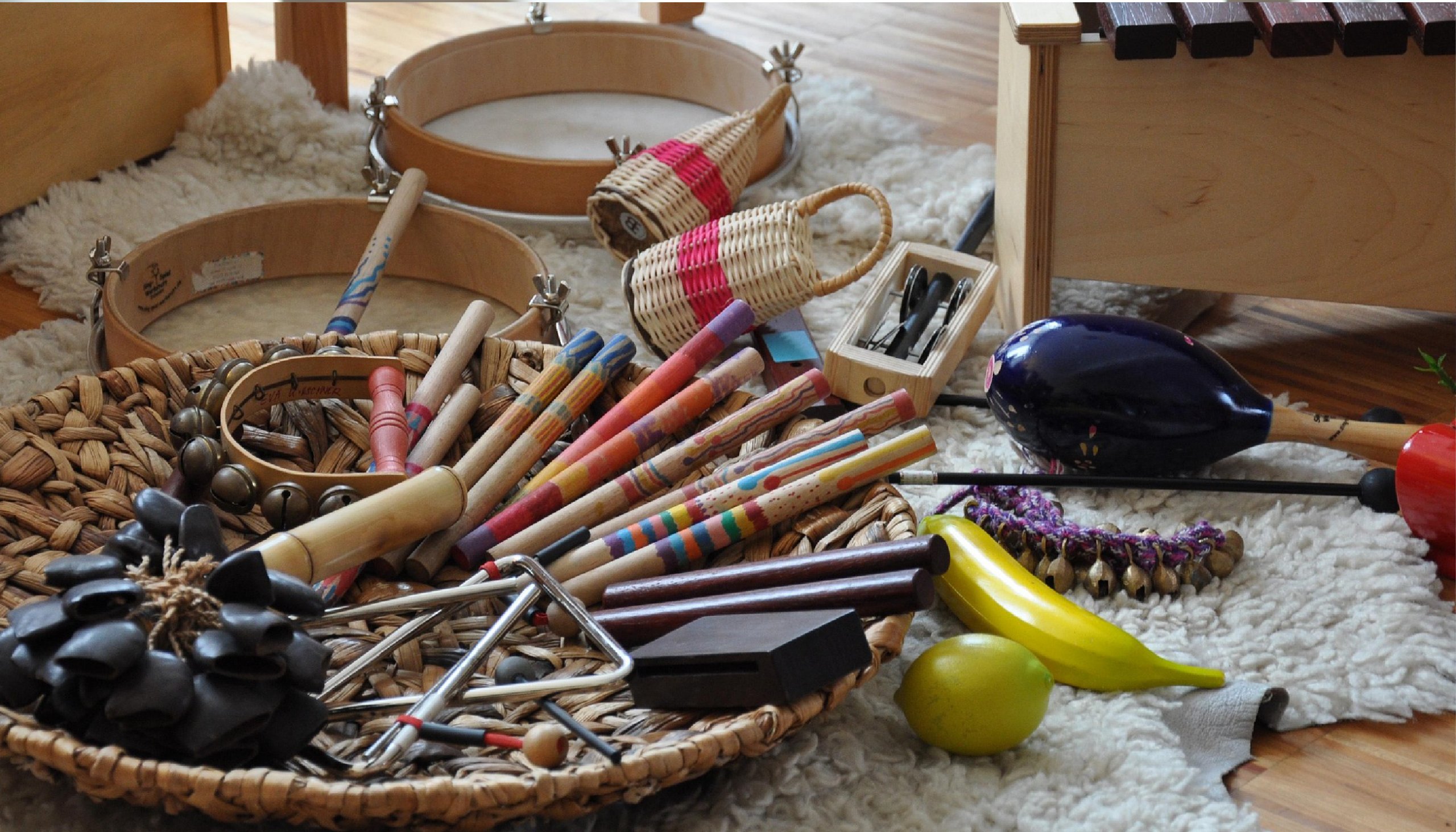
- DIY instrument sensory station – Set up a collection of homemade instruments on a large mat: sealed containers filled with rice or dried beans, an upturned metal bowl with a wooden spoon, a cardboard box drum. Children tap, shake, and explore, experimenting with volume, rhythm, and cause-and-effect. Encourage them to listen carefully to the differences between each sound — this builds auditory discrimination, a foundational skill for both music and language. For toddlers, name each sound as they make it. For preschoolers, introduce simple rhythm patterns to copy.
- Singing and movement sensory circuit – Create a simple circuit of three or four sensory stations (a texture tray, a water pouring station, a playdough mat, a movement station with hoops and ribbons) and play a song with a clear, steady beat in the background. When the music pauses, children freeze or move to the next station. This combines tactile sensory play with auditory tracking, body awareness, and the kind of structured movement that builds focus and self-regulation — skills that directly support school readiness.
At The Music Scientist, music is not just a backdrop to learning — it is the medium through which learning happens. Every programme we offer, from infant classes to preschool readiness, is built on the understanding that music, movement, and sensory play are deeply interconnected pathways to child development. When all three are present in a child’s early years, the results are children who are more confident, more curious, and better equipped for the challenges of formal learning ahead.
Sensory Play Safety Tips for Parents
Sensory play is wonderfully open-ended, but safety must always come first — particularly for babies and younger toddlers who explore primarily through mouthing. Before trying any activity on this list, keep the following principles in mind:
- Always supervise. No sensory activity should ever be unsupervised, regardless of how safe the materials appear. Young children can move quickly and unpredictably.
- Check for choking hazards. Any loose small object poses a potential choking risk for children under three. When in doubt, use the cardboard toilet roll test: if an object fits through the tube, it is not safe for young children without direct, continuous supervision.
- Use taste-safe materials for babies and young toddlers. Babies explore with their mouths. Choose edible or food-safe ingredients whenever possible for children under 18 months, and always for any child who still mouths objects regularly.
- Introduce new sensory experiences gradually. Some children are more sensory-sensitive than others. Start with gentle textures and build up to more intense ones at your child’s pace. There is no rush, and a child who pulls away from an activity is communicating a genuine sensory boundary that should be respected.
- Age-appropriate only. A sensory experience that is ideal for a four-year-old may be genuinely unsafe for a nine-month-old. Use the age guidelines in this article as a starting point, and always factor in your individual child’s development and abilities.
- Test materials beforehand. If you are using any dye, paint, or substance that will contact your child’s skin, patch-test on a small area first to check for sensitivity or allergic reaction.
Frequently Asked Questions
How early can I start sensory play with my baby?
Sensory play can begin from birth. For newborns, it looks like gentle singing, soft touch, black-and-white visual contrasts, and skin-to-skin contact. The key at this stage is following your baby’s cues — if they turn away or become fussy, they are signalling that they have had enough stimulation and need a break. As your baby develops through the first year, you can gradually introduce more varied textures, sounds, and visual experiences.
How often should we do sensory play?
Short, regular sensory experiences are more effective than occasional long sessions. Even ten to fifteen minutes of focused sensory play a day, woven into your existing routine (bath time, mealtimes, outdoor time), provides meaningful developmental input. You do not need elaborate setups or expensive materials — many of the most powerful sensory activities use everyday household items.
My child refuses to touch certain textures. Is this normal?
Texture aversion is completely normal, especially in toddlers and younger preschoolers whose sensory processing systems are still maturing. Never force a child to touch something that distresses them — this can create negative associations that make future sensory play harder. Instead, try sensory bags (where the texture is enclosed in plastic), let them observe first, or use tools like spoons and tongs to explore the material indirectly. Gradual, positive exposure at the child’s own pace is always the most effective approach.
Can sensory play support school readiness?
Absolutely. Sensory play builds the foundational skills that underpin formal learning: attention and focus, fine motor control (essential for writing), language development, problem-solving, and emotional self-regulation. Children who have had rich, varied sensory play experiences in their early years tend to transition into formal schooling with greater confidence and adaptability. At The Music Scientist, our structured programmes for preschoolers are specifically designed to bridge this gap, using music and sensory play as the vehicle for building school-ready skills.
Every Messy Moment Is a Learning Moment
Sensory play is not about perfect setups or Pinterest-worthy bins. It is about giving your child’s developing brain the raw material it needs to build, connect, and grow. Whether it is a baby gazing at a swirling glitter bottle, a toddler elbow-deep in rainbow rice, or a preschooler narrating an elaborate story stone adventure, every sensory moment is quietly doing the important work of early childhood development.
The 50 activities in this guide span every stage from birth to four years, covering touch, sight, sound, taste, and movement — and they can all be started today with materials you likely already have at home. Pick one. Try it. Follow your child’s lead. And know that the mess you clean up afterwards is evidence of genuine, meaningful learning taking place.
If you would like your child’s sensory development to be guided by specialists in a structured, musically enriched environment, we would love to welcome your family to The Music Scientist. Our programmes for babies, toddlers, and preschoolers are built around the same developmental principles that underpin everything in this guide — with the added power of music woven through every experience.
Ready to Explore More With Your Little One?
At The Music Scientist, we bring together music, movement, and sensory play into developmentally designed programmes for babies, toddlers, and preschoolers aged 4 to 47 months. From our infant Tenderfeet classes to our preschool-readiness SMART-START programmes, every session is rooted in child development science and delivered with warmth and joy.
The first twelve months of a baby’s life are nothing short of extraordinary. Every touch, sound, smell, and visual contrast is brand new — a piece of a vast, unfolding puzzle that their developing brain is working hard to understand. Sensory play for babies is not just a trendy parenting concept; it is one of the most well-supported approaches in early childhood development, helping to wire neural pathways that support memory, language, motor skills, and emotional regulation.
But for many new parents in Singapore, the question isn’t whether sensory play is valuable — it’s where to begin, what’s actually safe, and how to make it meaningful rather than overwhelming. This guide walks you through developmentally appropriate, safe sensory play activities for every stage of your baby’s first year, from newborn to almost-toddler, with insights rooted in child development science and practical tips you can use today.
Why Sensory Play Matters in the First Year
A baby’s brain develops faster in the first year than at any other point in life. By the time your child turns one, their brain will have formed over one million new neural connections per second since birth — and sensory experiences are the primary fuel for that growth. When a baby feels the texture of a soft cloth, hears a gentle lullaby, or watches a high-contrast mobile spin overhead, they are not simply being entertained. They are building the cognitive architecture they will rely on for the rest of their lives.
Research in early childhood neuroscience consistently shows that rich sensory environments support stronger language development, better attention spans, and more refined motor coordination. Sensory play also nurtures emotional security. When caregivers engage in sensory activities with babies — making eye contact, using expressive voices, responding to cues — they strengthen the attachment bond that underpins a child’s confidence and social development. In short, sensory play is both brain food and heart work.
How Babies Experience the World Through Their Senses
Babies are born with all five senses — sight, hearing, smell, touch, and taste — already functioning, though each develops at its own pace. Newborns can recognise their mother’s voice and smell from birth. Their vision, however, is limited to about 20–30 cm at first, which is precisely why they’re so captivated by a face held close. By around four months, colour vision matures and depth perception begins to emerge. Touch is the most developed sense from the very start, which is why skin-to-skin contact and varied textures have such a profound early impact.
There are also two additional sensory systems that often go unmentioned but are equally important: the vestibular system (sense of balance and movement) and the proprioceptive system (awareness of body position). Activities like rocking, swinging, and gentle bouncing engage these systems and help babies develop body awareness and coordination long before they take their first steps. Understanding this fuller picture of sensory development helps parents design play that goes beyond simple stimulation to truly support whole-body learning.
Sensory Play for Newborns (0–3 Months)
In the earliest weeks, “play” looks very different from what most people imagine. Newborns are most alert in short windows after feeding, and their capacity for stimulation is limited. The goal at this stage is gentle, focused engagement — not overwhelming input. Less is genuinely more.
Safe Activities to Try
- High-contrast visuals: Hold black-and-white patterned cards or books about 25–30 cm from your baby’s face. Their developing visual cortex responds strongly to sharp contrast before colour perception matures.
- Skin-to-skin contact: Lay your baby on your bare chest. The warmth, heartbeat, and scent of a parent provide rich tactile and olfactory stimulation that also regulates stress hormones.
- Gentle singing and talking: Narrate your day in a warm, varied tone. Your voice is the most powerful sensory tool you have — it stimulates auditory pathways and lays the foundation for language.
- Varied textures on hands and feet: Gently stroke different fabrics — velvet, cotton, a soft brush — across your baby’s palms and soles, which are highly sensitive at this age.
- Tummy time on different surfaces: Even a few minutes on a textured mat or a slightly cooler surface like a clean, smooth floor (with supervision) provides proprioceptive input and strengthens neck muscles.
Keep sessions to 5–10 minutes and watch your baby’s cues closely. Looking away, fussing, or turning the head are signals that they need a break — and responding to those cues is itself a form of sensory learning.
Sensory Play for Babies (4–6 Months)
By four months, babies are more visually alert, can track moving objects, and are beginning to reach intentionally. Their hands are becoming tools for exploration rather than just reflexive clenching. This is an exciting leap — suddenly, the baby can participate more actively in play rather than simply receiving it.
Safe Activities to Try
- Sensory bottles: Fill a sealed, clear plastic bottle with water, food colouring, and a few safe objects like sequins or buttons (sealed tightly and never left unattended). Babies love to watch the contents move and will begin to shake them intentionally.
- Mirror play: Place a baby-safe mirror at floor level during tummy time. Babies at this age are fascinated by faces — including their own — and mirror play supports early self-awareness.
- Rattles and grasping toys: Offer toys of different weights, shapes, and textures. The act of grasping, mouthing, and releasing is rich sensory work that develops hand-eye coordination.
- Water play in the bath: Pour water gently over hands and feet, try different temperatures (always safe and tested), and let them splash. Water is one of the most versatile and engaging sensory mediums.
- Supported bouncing: Hold your baby upright on your lap and gently bounce in rhythm to music. This engages the vestibular system and introduces the concept of rhythm — a precursor to musical and mathematical thinking.
Sensory Play for Older Babies (7–9 Months)
Sitting independently (or nearly so), babbling purposefully, and developing a genuine sense of object permanence — babies between seven and nine months are cognitively exploding. Cause-and-effect play becomes deeply satisfying to them, and they begin to show strong preferences, which means they’ll let you know in no uncertain terms what they love and what they don’t.
Safe Activities to Try
- Treasure baskets: Fill a shallow basket with everyday objects of different textures, weights, and shapes — a wooden spoon, a small fabric square, a smooth stone, a metal spoon. Babies at this stage love to examine, mouth, and compare objects.
- Finger foods as sensory play: As solids are introduced, the act of touching, squishing, and eventually eating soft foods like banana or steamed carrot is legitimate sensory exploration. Embrace the mess.
- Crawling on varied surfaces: Set up a small obstacle course of textures — a yoga mat, a carpet square, a wooden floor section. Crawling across different surfaces builds proprioceptive awareness and bilateral coordination.
- Simple cause-and-effect toys: Stacking cups, pop-up toys, or even pots and wooden spoons they can bang satisfy the growing desire to make things happen. Drums and percussion instruments are particularly wonderful here.
Sensory Play for Near-Toddlers (10–12 Months)
As babies approach their first birthday, they are pulling to stand, cruising along furniture, possibly taking early steps, and understanding far more language than they can yet produce. Sensory play becomes more intentional and social — they want to share discoveries with you and imitate what they see. This is prime time for interactive, music-rich, movement-based play.
Safe Activities to Try
- Sensory bins (closely supervised): A shallow container filled with cooked pasta, dried rice, or shredded paper offers rich tactile and visual exploration. Always supervise to prevent mouthing of unsafe quantities.
- Finger painting with edible paint: Mix yoghurt with a little fruit purée for a completely safe, colourful painting medium. The squishing sensation through fingers is deeply satisfying proprioceptive input.
- Dance and movement to music: Hold your baby and sway, dip, and spin gently to music with a clear beat. At this age, many babies will begin to bounce independently when they hear music — a beautiful early sign of rhythmic awareness.
- Stacking and nesting: Cups that stack and nest offer visual, tactile, and spatial learning. Knocking them down (and the satisfying crash) is as educational as building them up.
- Nature walks with sensory narration: Carry or walk your baby through a park and narrate textures — rough bark, smooth leaves, cool grass underfoot. Connecting language to sensory experience accelerates vocabulary development.
Music and Sound: A Powerful Form of Sensory Play
Among all the sensory modalities, music and sound deserve special recognition as uniquely potent developmental tools. Music simultaneously engages auditory, emotional, motor, and cognitive systems in a way that few other experiences can match. Lullabies and rhythmic songs have been used across every human culture throughout history — not by coincidence, but because they work. Rhythm helps babies organise their sensory experience; melody stimulates emotional attunement; and the patterns within music lay early groundwork for mathematical thinking and memory.
From birth, babies respond to the melodic contours of speech and song. By three to four months, many will coo and vocalise in response to a familiar tune. By nine to twelve months, they may rock, bounce, or clap in rhythm. Introducing structured, developmentally appropriate music experiences early in life doesn’t just nurture musical ability — it supports language acquisition, emotional regulation, and cognitive flexibility across the board.
At The Music Scientist, this understanding sits at the heart of everything we do. Our Tenderfeet programme is specifically designed for infants, weaving music, movement, and sensory play into a warm, structured environment that meets babies right where they are developmentally. For slightly older children moving into the toddler stage, our Happyfeet classes continue building on this sensory-musical foundation with age-appropriate activities for 18-month-olds and beyond.
Safety Guidelines Every Parent Should Know
Sensory play is wonderfully open-ended, but safety must always come first — especially with babies who explore primarily through mouthing. A few clear principles will keep your sessions both enriching and safe.
- Always supervise: No sensory activity should ever be left unattended, regardless of how safe the materials seem.
- Check for choking hazards: Any loose object should be larger than a toilet paper tube opening. If it fits through, it’s not safe for babies.
- Use food-safe or non-toxic materials: Assume everything will go in the mouth. Choose edible paints, natural fabrics, and BPA-free plastics.
- Avoid strong scents: Babies’ olfactory systems are sensitive. Skip essential oils and heavy fragrances, which can be irritating or overwhelming.
- Introduce one new sensory input at a time: Overloading multiple new textures, sounds, and visuals at once can overwhelm young babies. Build gradually.
- Follow your baby’s lead: Withdrawal, crying, or turning away are communication. Always respect when a baby signals they’ve had enough.
- Check for allergies: Before using food-based materials like pasta, rice, or fruit, ensure your baby has already been safely exposed to those foods.
How to Get Started at Home
You do not need expensive toys or elaborate setups to provide rich sensory experiences. The most meaningful sensory play happens in the context of everyday life — a bath, a walk, a song sung while folding laundry. Start with what you have, stay present, and let your baby guide the pace. Your engaged, responsive presence is the single most important sensory stimulus your baby will ever encounter.
As your baby grows toward the toddler years, you may find that structured enrichment programmes offer a wonderful complement to home-based play — particularly those that integrate music, movement, and multi-sensory learning in a guided, social setting. Our Groovers programme for toddlers and our Scouts programme, which connects science concepts to music, are natural next steps for families who have built a strong sensory play foundation in the first year. For families thinking ahead to school readiness, our SMART-START English and SMART-START Chinese programmes provide a seamless bridge into formal education, built on the same rich developmental philosophy.
Every Moment of Play Is a Moment of Learning
The beauty of sensory play in the first year is that it doesn’t require perfection — it requires presence. Whether you’re singing softly to a newborn, letting a six-month-old splash in the bath, or watching a ten-month-old squish pasta between curious fingers, you are providing exactly what a developing brain needs: varied, responsive, loving input. These small moments accumulate into something profound: a child who feels safe to explore, confident to learn, and ready to thrive.
As your little one grows, the natural curiosity ignited through sensory play in infancy becomes the engine that drives all future learning. Nurture it now, and you’ll be giving your child one of the greatest gifts a parent can offer.
Ready to Take Sensory Play Further?
At The Music Scientist, we’ve built our infant and toddler programmes around the same principles you’ve read about here — combining music, movement, and sensory exploration in a joyful, developmentally grounded environment. Our Tenderfeet programme is purpose-designed for babies, offering a beautiful first step into structured sensory-musical learning.
We’d love to welcome your family. Get in touch with us today to learn more about our programmes and find the right fit for your child’s age and stage.
There is a moment, somewhere around the middle of pregnancy, when a soft melody drifts through the air and something remarkable happens on the other side of a mother’s belly. The foetus, still months away from meeting the world, has already begun to listen. Music during pregnancy has long been treated as a sentimental ritual — a mother humming a lullaby to her bump, or a family playing classical music through a speaker in the nursery-to-be. But the science behind what the foetus actually hears, how it responds, and what those experiences may mean for development is far more compelling than folklore.
This article explores the growing body of research on prenatal hearing and music, walking you through the developmental timeline of the foetal auditory system, what studies have revealed about foetal memory and brain responses to sound, and the meaningful difference between singing and simply pressing play. It also bridges the journey from the womb to early childhood — because what begins before birth is only the opening note of a much longer, richer musical story.
The Womb Is Not a Silent Place
One of the most surprising things expectant parents learn is just how noisy the womb actually is. Far from being a hushed, padded retreat, the intrauterine environment is filled with a constant, layered soundscape. The primary causes of internal murmurs are cardiovascular, respiratory, and intestinal in origin — produced by the rhythmic beating of the mother’s heart, her breathing movements, and the activity of her digestive system. Together, they create a complex soundscape that surrounds the foetus as part of its ongoing auditory experience. This is the acoustic world a baby is born into, long before it ever hears a voice from outside.
Understanding this baseline is important because it means the foetal auditory system is not passively waiting for birth to begin its work. It is actively processing, filtering, and responding to sound from surprisingly early in pregnancy. The sounds of the mother’s body — particularly her heartbeat and voice — become deeply familiar anchors for the developing baby, and this familiarity carries real significance for bonding, language, and learning after birth.
When Can a Foetus Actually Hear Music?
Hearing does not arrive all at once. The foetal auditory system develops in stages, and each stage opens up a slightly richer world of sound. Around the 18th week of pregnancy, the foetus’s inner ear structures, including the cochlea, begin forming. While the physical anatomy of the ear is developing, true hearing is not yet possible because the auditory pathways in the brain are still forming. These initial structures start preparing the baby’s system to eventually perceive vibrations, primarily from internal sounds such as the mother’s heartbeat and digestion.
External sound begins to reach the foetus meaningfully from around week 23 to 24. At about 24 weeks, the foetus can begin to detect some external sounds, though they are muffled by the amniotic fluid. At this stage, a foetus may startle at loud noises or respond to familiar voices, which could cause changes in movement or heart rate. But for music specifically, the picture becomes clearer later in the second trimester and into the third. At 19 weeks, foetuses first respond to a 500 Hz tone, roughly the pitch of a man speaking in a normal conversational voice. By 27 weeks, 96% of foetuses respond to tones at 250 Hz and 500 Hz, which covers the range of most speech sounds. But at that same age, none respond to 1,000 Hz or 3,000 Hz tones — the higher pitches found in birdsong or the upper range of a woman’s singing voice.
Responsiveness to those higher frequencies fills in later. All foetuses respond to 1,000 Hz tones by 33 weeks and to 3,000 Hz tones by 35 weeks. So while a baby in the womb can hear voices and music well before the third trimester, it takes until the final weeks of pregnancy for the full range of hearing to come together. This is why the third trimester is often considered the richest period for sharing music with your unborn baby — not because earlier moments don’t matter, but because the auditory system is, by that point, most capable of taking it all in.
How the Foetus Responds to Music
Ask any parent who has played music near their pregnant belly and they will likely tell you: the baby moved. What feels like an anecdotal observation turns out to be entirely consistent with what researchers find in controlled studies. Foetuses are not passive audiences. Partial foetal hearing maturity is reached between 24 and 27 weeks of gestational age, and at this stage of foetal development, the foetus is able to perceive the acoustic parameters of speech, such as melody, rhythm, prosody, phonemes, and different tones.
When music filters into the womb, the foetus registers it in measurable ways. Heart rates change, movement patterns shift, and the baby demonstrates responsiveness that scientists can observe and document. Research investigated foetal responses to music played with a headset placed on the maternal abdomen and found an increase in foetal motor activity and in foetal heart rate in the foetus from 28 weeks. Interestingly, researchers studying an entire lullaby — rather than isolated tones — found evidence that babies begin paying noticeably more attention to music at around 33 weeks gestation. By that point, the foetal brain is not simply detecting noise; it appears to be engaging with the contour and pattern of what it hears.
Does the Foetus Remember Music? What the Research Shows
Perhaps the most fascinating question in this field is not whether foetuses can hear music, but whether they can remember it. The evidence strongly suggests they can. In one landmark line of research, babies whose mothers had regularly watched a particular television programme during pregnancy were tested as newborns with the show’s theme song. These babies showed a distinctive calming response — their heart rates slowed and they became more alert — when they heard the familiar tune. Babies who had not been exposed to it in utero showed no such reaction. The response was not present in either group when unfamiliar music was played instead.
In a controlled experimental setting, researchers created a unique piano melody and asked pregnant women to play it twice daily to their foetuses, beginning at 35 weeks. The music stopped before birth and was not played again until four weeks after the babies were born. When the infants heard the melody in a laboratory, their heart rate response was dramatically stronger than that of babies in a control group who had not heard it prenatally. There is converging evidence for foetal retention of auditory experience into early postnatal life, and this particular study illustrated just how lasting that retention can be — a melody heard in the womb, then silenced, was still recognisable a full month after birth.
In another controlled study, pregnant women listened to a keyboard rendition of “Twinkle, Twinkle, Little Star” once a day, five times a week, starting at 29 weeks — with some infants hearing the tune anywhere between 138 and 192 times before birth. When tested as newborns, neurophysiological studies using event-related potentials (ERP) revealed greater neural activation to lullabies heard during pregnancy, confirming that the prenatal brain was not only absorbing the music but encoding it in memory structures that persisted well after birth.
Music, the Brain, and Neural Plasticity Before Birth
One of the reasons prenatal music experiences carry such developmental weight is the extraordinary neural plasticity of the third trimester. During the last trimester of gestation, plasticity shapes the foetal brain, and sound is one of the primary channels through which that shaping occurs. The auditory cortex is not simply waiting for birth; it is being actively sculpted by every sound that enters the womb, and the quality and variety of that sound environment matters.
Research suggests a paramount influence of exposure to sound during prenatal neural plasticity windows, moulding auditory processing and perception since gestation. This growing body of evidence points to a very early form of auditory learning that takes place in utero, shaping the infant’s future neurodevelopment and processing of language. These are not abstract effects — researchers can measure them directly using neuroimaging and brainwave monitoring on newborns within hours of birth, detecting clear differences between babies who had rich prenatal sound environments and those who did not.
Prenatal music stimulation has shown positive effects on foetus, newborn, and pregnant mother, while postnatal exposure affected the neurodevelopment of preterm infants and parental interaction. The implications span beyond music appreciation — they touch on cognition, emotional regulation, and the foundations of social development.
The Surprising Link Between Prenatal Music and Language Development
One of the most exciting and underreported findings in this field is the connection between prenatal music exposure and a baby’s capacity to process language. A 2023 study published in the journal Developmental Science shed new light on this link. The study reveals that daily exposure to music during the last trimester of pregnancy is associated with more robust coding of speech stimuli. Prenatal exposure to music is associated with fine-tuned coding of the fundamental frequency of human speech, which may facilitate processing and early language acquisition.
This is a significant finding because it suggests that music is not operating in a separate developmental lane from language — the two are deeply intertwined. Certain brain regions are already active in the prenatal stage and can react to auditory stimuli, especially speech. This indicates that the brain of the foetus is already prepared for language processing before birth. The development of primordial linguistic networks is a basic element for later language processing, and the prenatal environment and exposure to language play an important role in the development of the brain in relation to language processing. Music, with its patterns of rhythm, pitch, and timing, appears to train the very neural pathways that will later be recruited for understanding and producing speech.
According to research conclusions, daily musical exposure during the last weeks of pregnancy is associated with an improved encoding of low-frequency sound compounds, which could improve the newborn’s perception of tone. For parents thinking about language-rich early childhood environments — whether English, Mandarin, or both — this connection between prenatal music and early language encoding is a compelling reason to make music a natural part of daily life long before a due date arrives.
Singing vs. Recorded Music: Which Is Better for Your Baby?
It is tempting, in an age of curated playlists and smart speakers, to treat prenatal music exposure as simply a matter of hitting play on the right soundtrack. But researchers and clinicians consistently highlight an important distinction: a mother’s own voice, especially when singing, offers something that a recording simply cannot replicate.
Hearing is fully developed around 24 to 26 weeks gestation and the first voice heard by a foetus is usually that of its mother, a voice that becomes a comforting anchor, particularly in times of distress. This innate draw to a mother’s voice is supported by research showing that newborns prefer the sound of their mother’s voice, and more so when that voice is singing. When a mother sings, the foetus receives not only the sound waves transmitted through the air but also the vibrations conducted through her body — a physical, intimate channel of communication that recorded music cannot provide.
There is mounting research showing the health benefits of singing among expectant mothers. Such benefits include improving maternal emotional state, reducing cortisol (the stress hormone), and increasing oxytocin (the bonding hormone). These benefits flow directly to the baby as well, since maternal stress levels during pregnancy are closely linked to foetal wellbeing. Singing appears to outperform simply playing recorded music when it comes to bonding, likely because singing engages the mother emotionally and produces vibrations the foetus feels directly. None of this is to say that recorded music has no value — it clearly does, particularly for its effects on maternal relaxation and as a source of rich, varied musical input. But singing is the more powerful of the two tools, and the good news is that it requires nothing more than a willingness to hum a tune.
Safe and Sensible Practices for Sharing Music During Pregnancy
The evidence in favour of music during pregnancy is encouraging, but it comes with some important caveats that every parent should understand. The goal is to enrich the foetal sound environment — not to overwhelm it. Experts are consistent in their guidance on what to avoid:
- Do not place headphones, earphones, or any sound device directly against the pregnant belly.No headphone or sound device should be applied directly to the abdomen during pregnancy, as this can result in damage to the foetal hearing system (hair cells in the cochlea) and hearing loss.
- Avoid sustained loud, low-frequency sounds.Scientists advise that exposure to intense low-frequency noise above 60 dB should be avoided during pregnancy, especially after 20 weeks.
- Avoid environments where noise levels threaten your own hearing. If a sound environment is too loud for the mother, it is too loud for the foetus.
- Fill the room naturally. The safest and most effective approach is to simply let music fill the space around you — through speakers at comfortable volumes — as part of everyday life.
The overarching principle is this: music during pregnancy should feel natural, enjoyable, and calm. Sing while you cook. Put on a favourite album in the background. Hum while you take a walk. Talking, reading, and singing to the foetus by the mother during pregnancy can help in developing better bonding and attachment, good hearing functions, and possible speech and language development in the coming years. The best prenatal music programme is one that fits seamlessly into a mother’s daily rhythm, rather than feeling like a structured academic exercise.
From the Womb to the World: Continuing the Musical Journey After Birth
Birth is not the end of this story — it is the moment the story truly opens up. Everything the foetus heard and encoded in the womb becomes the foundation from which a newborn begins to engage with the world. During the first months of life, an infant’s brain is absorbing the sounds around them. By the end of the first year, the brain starts to prioritise, building greater sensitivity to familiar sounds and less ability to distinguish unfamiliar ones. Based on phonetic perception and brain development research, regular exposure to a variety of musical sounds is critical during the first year of life.
Listening to music helps babies differentiate between different pitches, rhythms, and tones, which are foundational elements of speech and language. Research highlights that infants who engage with music through activities like singing, listening, and moving to rhythms show advanced abilities in language acquisition and cognitive development compared to those who do not have such musical interactions. This is why the transition from prenatal music appreciation to structured music enrichment in infancy and toddlerhood is such a natural and valuable one.
For families in Singapore looking to continue nurturing their baby’s musical development after birth, The Music Scientist’s programmes are designed around exactly this developmental arc. Tenderfeet supports the earliest stage of infant development through sensory-rich musical experiences that speak directly to what a baby’s brain has been primed for since the womb. As babies grow into toddlers, Happyfeet and Groovers extend that journey through movement, rhythm, and play, building the motor, cognitive, and social skills that early music research consistently points to as outcomes of rich auditory environments. For older toddlers beginning to explore their curiosity about the world, Scouts weaves science and music together in a way that makes learning irresistible. And when school readiness becomes the focus, the SMART-START English and SMART-START Chinese programmes channel music as a powerful medium for early literacy, memory, and confident learning.
The science of prenatal music is ultimately a story about continuity. The baby who responded to a lullaby in the womb and the toddler who lights up during a music class are connected by the same developmental thread. Music, it turns out, has been part of the learning journey from the very beginning.
What the Research Really Tells Us
The science is clear on several points: the foetal auditory system becomes meaningfully active from around 24 weeks, develops rapidly through the third trimester, and is capable of not just detecting but remembering music encountered before birth. Prenatal music exposure has been linked to stronger neural responses to both music and speech in newborns, and there is compelling emerging evidence connecting it to improved language encoding in the earliest days of life. Singing — especially a mother’s own voice — appears to be the most powerful form of prenatal musical engagement, outperforming recorded music on both bonding and physiological grounds.
What the research does not tell us is that prenatal music exposure guarantees smarter or more advanced children. The honest picture is more nuanced and, in some ways, more beautiful: music during pregnancy is less about optimization and more about connection. It is about beginning a conversation with your child before they are born, laying down neural pathways that will serve language, learning, and emotional development, and establishing a musical familiarity that will make the world feel a little more known from the very first breath.
Ready to Continue Your Baby’s Musical Journey?
At The Music Scientist, we believe that every child is born ready to learn through music — and that belief is rooted in science. Whether your little one is still weeks away from arrival or already exploring the world with curious eyes and busy hands, our developmentally focused programmes in Singapore are designed to meet them exactly where they are.
From sensory-rich infant classes to preschool readiness programmes in both English and Chinese, we are here to help your child’s musical story unfold — one note, one beat, one discovery at a time.
Every parent knows the moment: your baby is restless, the hour is late, and almost instinctively, you begin to hum. Something soft. Something gentle. Something that somehow works. That quiet act — singing a lullaby — is one of the oldest parenting practices in human history, and modern science is now confirming what generations of caregivers have always sensed: lullabies are genuinely powerful.
Far more than a bedtime strategy, lullabies are a scientifically validated tool for soothing, bonding, and nurturing young minds. They calm the nervous system, stimulate language acquisition, build emotional intelligence, and lay the neural groundwork for lifelong learning. Whether you have a perfectly pitch-perfect voice or you couldn’t carry a tune to save your life, the lullaby you sing to your child matters deeply — for reasons that go well beyond sleep.
In this complete guide, we explore the fascinating history of lullabies across cultures, unpack the neuroscience and psychology behind why they work, and walk you through exactly how to sing one effectively for your child’s development.
What Is a Lullaby?
A lullaby is a slow, gentle song sung to young children, typically to soothe them or ease them into sleep. The word itself likely derives from the sounds parents make while shushing or calming a child — soft, rhythmic vocalisations that predate formal language. While the defining features of lullabies can vary across cultures, they consistently share a few musical qualities: a slow tempo, a simple and repetitive melodic structure, and lyrics that often speak of comfort, closeness, and rest.
What sets a lullaby apart from other music is not just what it sounds like, but the context in which it is sung. A lullaby is fundamentally an act of connection between caregiver and child. It is music made personal, intimate, and immediate. This is precisely why researchers find that even very young infants respond to it so powerfully — not just to the sounds, but to the presence and emotion behind them.
A Tradition Older Than Written History
Lullabies are among the most ancient forms of human expression. The oldest known written lullaby dates back approximately 4,000 years to ancient Babylonia, and even then, it was clearly a continuation of a much older oral tradition. Harvard evolutionary psychologist Samuel Mehr and his team found in their landmark “Natural History of Song” project that people across wildly different cultures can reliably identify a lullaby just by its sound — even when sung in a language they have never heard. In a study of 29,000 participants listening to 118 songs from diverse cultures, lullabies were the most consistently recognised song type of all.
This near-universal quality speaks to something deeply embedded in our biology. As researchers at Harvard have noted, “there seems to be some kind of parenting-music connection that is both universal around the world but also old, sort of ancient.” Across Africa, Asia, the Americas, and Europe, caregivers have instinctively composed music to soothe their infants using remarkably similar musical tools — a slow, lilting rhythm; a soft, falling melody; and a tone of warmth and reassurance. The lullaby, in its many forms, is genuinely a thread that runs through all of human culture.
The Science Behind Why Lullabies Work
So what is actually happening in your baby’s body and brain when you sing? The effects are more physiological than most parents realise. Research shows that the slow tempo and simple melodic structure of a lullaby directly triggers the infant’s autonomic nervous system to downshift: heart rate slows, breathing becomes more regular, and levels of cortisol — the body’s primary stress hormone — decrease measurably. This is not a placebo effect; it is a documented neurobiological response.
There are several reinforcing reasons that lullabies are so effective at producing this response. First, the slow, rocking rhythm of a typical lullaby mimics the physical sensations a baby experienced in the womb — the gentle sway of movement, the muffled but rhythmic sound of a heartbeat and voice. For a newborn, this familiarity signals safety. Second, when you sing to your baby, your own body vibrates with the sound, and that gentle resonance transfers through your arms and chest in a way that is genuinely soothing — much like the vibration of a swing or a moving car. Third, the predictability of a lullaby matters enormously. Brain imaging research shows that people — including infants — enjoy music more when their brains can anticipate what comes next. Simple, repetitive songs are neurologically satisfying in a way that complex or unpredictable music is not.
A key piece of Harvard research adds another remarkable dimension to this picture. When researchers played lullabies from multiple cultures — including Inuit, Mayan, Scandinavian, and Gaelic traditions — to infants who had never heard those songs before, the babies consistently became calmer. The music had never been part of their experience, yet it worked. This suggests that infants are not just responding to familiarity; they are responding to something inherent in the acoustic structure of lullabies themselves. The human brain, it appears, is primed from birth to respond to this kind of sound.
The physical act of singing also benefits the caregiver. Studies have found that singing a lullaby helps regulate a parent’s own stress response, creating a moment of shared calm between caregiver and child. When you feel relaxed and safe, your baby reads those cues from your voice, your body, and your demeanour — and relaxes in turn. The lullaby, in this sense, is a two-way tool.
The Developmental Benefits of Lullabies
Sleep is only the beginning. When we look at the full body of research on lullabies and infant development, what emerges is a picture of music as a genuine catalyst for growth across multiple developmental domains — exactly the kind of holistic, multi-intelligence development that sits at the heart of music enrichment programmes like those at Tenderfeet, The Music Scientist’s sensory and music programme for infants from four months old.
Language and Early Literacy
Lullabies are one of the earliest language lessons a child receives. The repetitive structure of a lullaby exposes babies to patterns in sound — the rise and fall of syllables, the rhythm of phrases, the relationship between stress and meaning. Research from Cambridge University confirms that babies process rhythmic information before they can process individual sounds, making the melodic cadence of a lullaby one of the earliest pathways into language comprehension. The repetitive lyrics and rhyming structure that characterise many lullabies also help build phonemic awareness — the ability to hear and distinguish individual sounds that is foundational to reading and writing. When a baby hears the same melodic phrase sung again and again, their brain is building the neural connections that will later underpin early literacy.
Cognitive Development
Beyond language, lullabies introduce infants to a range of cognitive skills from a remarkably early age. Remembering the tune of a familiar lullaby exercises memory recall. Focusing on the song builds early attention span. Distinguishing between different melodies develops auditory discrimination. Exposure to music has also been linked to enhanced spatial reasoning abilities, which are a core component of logical problem-solving. In this way, the humble bedtime song is doing genuine cognitive work — scaffolding the kind of early brain development that supports learning across all subjects as a child grows.
Emotional Intelligence and Self-Regulation
When a caregiver sings to a baby, that child is learning something profound about the world: that emotions can be expressed, shared, and soothed. Lullabies help babies practise what developmental psychologists call self-regulation — the ability to manage one’s own emotional and physiological state. Through repeated lullaby experiences, infants begin to internalise the calming signals they associate with that music, gradually developing the capacity to use those associations to settle themselves. Research also suggests that early exposure to music supports the development of emotional intelligence more broadly, helping children learn to read emotional cues in sound, voice, and the faces of those around them.
Bonding and Attachment
Singing to a baby is one of the most powerful bonding acts a parent can perform. The act triggers the release of oxytocin in both caregiver and child — often called the “love hormone” — which promotes a deep sense of safety, well-being, and connection. Research has consistently found that babies show a strong preference for their primary caregiver’s voice, and that voice, heard in the context of a gentle, predictable song, becomes profoundly associated with security and love. Studies have shown that when lullabies are incorporated into regular routines, maternal-child bonding strengthens measurably, and infant crying decreases over time. This attachment foundation is not just emotionally important; it is the bedrock of healthy social and cognitive development.
How to Sing a Lullaby: A Step-by-Step Guide
The most reassuring thing about singing a lullaby is this: your voice does not need to be perfect. In fact, research confirms that the quality of a parent’s voice is far less important than rhythm, repetition, and the emotional presence behind the singing. Your baby has been listening to your voice since before birth, and it is already the most comforting sound they know. Here is how to make the most of it.
- Find a calm, settled environment. Before you begin, create the right conditions. Dim the lights, reduce background noise, and settle into a comfortable position — whether that is a rocking chair, a glider, or simply sitting on the floor with your baby in your arms. The environment signals to your child that it is time to wind down, reinforcing the lullaby’s effect.
- Choose a song with a simple, repetitive structure. The most effective lullabies are not complex. Look for songs with a slow tempo, a melody that rises and falls gently, and lyrics that repeat. Many of the world’s most beloved lullabies use a 3/4 or 6/8 time signature — the familiar “waltz” feel — because it creates a natural rolling, swaying quality that mirrors the experience of being rocked. Classics like Brahms’ Lullaby (Wiegenlied), Twinkle Twinkle Little Star, or even a simple melody you hum yourself all work beautifully.
- Keep your voice soft and your pace slow. Lower the volume of your voice to a gentle, near-whisper level and resist the urge to perform. The goal is not musical perfection; it is presence and consistency. Slow your tempo down to something that feels almost too slow — around 60–80 beats per minute is ideal. Your baby’s nervous system will begin to entrain to this rhythm.
- Add gentle movement. Pair your singing with slow, rhythmic rocking or swaying. The combination of auditory and vestibular (movement-based) stimulation significantly amplifies the calming effect. You can rock in a chair, sway while standing, or simply move your arms gently if your baby is lying down. The rhythm of the movement should match the rhythm of the song.
- Make eye contact. Hold your baby close and look into their eyes as you sing. This simple act amplifies the emotional connection, reinforces the feeling of safety, and supports the development of social cognition. Your baby is learning to read your face and your emotions, and the warmth in your eyes while you sing is communicating something words alone never could.
- Sing until drowsy, not until asleep. As a practical sleep tip, aim to finish your lullaby while your baby is calm and drowsy but not yet fully asleep. This helps prevent a sleep association where your baby requires the sound of your voice to fall asleep every time they rouse in the night. The lullaby is the wind-down, not the sleep trigger itself.
- Be consistent. The power of a lullaby grows with repetition. Babies as young as six weeks begin recognising patterns, so singing the same song (or small repertoire of songs) at the same point in your bedtime or naptime routine will build a powerful sleep cue over time.
Practical Tips for Making Lullabies Part of Your Routine
The best lullaby practice is one that works sustainably for your family. A few principles to keep in mind:
- You do not have to stick to classic lullabies. Any song sung slowly and gently can function as a lullaby. Some parents find that adapting a favourite song — slowing it down, softening it — works just as well as a traditional nursery rhyme. What matters most is consistency and your voice.
- Personalise the lyrics. Singing your child’s name into a lullaby, or weaving in small details about their day, deepens the intimacy of the experience. Research suggests that personalised lullabies can strengthen parent-child bonding even further.
- Use different songs for different routines. If bedtime and naptime are separate routines, consider using different songs for each. This helps your baby build distinct associations and avoids one song becoming tied to a particularly difficult time of day.
- Do not worry about your voice. Babies are not critics. Your child has loved your voice since they first heard it in the womb, and that bond means your imperfect rendition of Brahms will always outperform a recording by a professional singer. Sing anyway.
- Lullabies are not only for bedtime. Singing a gentle song during a nappy change, after a fall, during a stressful moment, or simply as a quiet pause in the day can provide comfort and regulation whenever it is needed.
The habits built through daily musical interaction in infancy lay the groundwork for richer engagement with music and learning later. At The Music Scientist, programmes like Happyfeet for toddlers from 18 months build naturally on those early musical foundations, expanding from the intimate one-to-one bond of a lullaby into a structured environment of movement, rhythm, and group musical play.
Beyond Bedtime: Music as a Lifelong Learning Tool
The lullaby is where music begins for most children — but it is far from where the story ends. The neural pathways opened by early musical experience continue to support learning throughout childhood and beyond. Music develops the brain in ways that directly support the skills children need for formal education: focus, memory, pattern recognition, sequencing, listening, and the ability to work with and respond to others.
At The Music Scientist, this developmental philosophy is woven into every programme. The Groovers programme for toddlers, for example, combines music and dance to build motor skills, rhythm, and physical confidence — the natural next step after the sensory awakening of early lullaby experiences. For older preschoolers ready to deepen their relationship with the world through song, the Scouts programme uses catchy, original melodies to foster a love for science and discovery. And for families thinking ahead to kindergarten readiness, the SMART-START English and SMART-START Chinese programmes leverage the power of music to build the literacy, numeracy, and social skills that prepare children for seamless transitions into formal schooling.
The lullaby your baby hears tonight is not just a bedtime ritual. It is the first page of a much longer story — one about music, learning, confidence, and the extraordinary capacity of the young mind to grow when it is nurtured with intention and love.
The Lullaby You Sing Tonight Matters More Than You Think
Lullabies are one of the most accessible and powerful developmental tools available to any parent. They require no equipment, no special talent, and no training — only your voice, your presence, and a little consistency. Yet the effects ripple outward in ways that science is only beginning to fully map: calmer babies, stronger bonds, richer language, greater emotional resilience, and a brain that is better prepared to learn.
Singing to your child is an act of love with measurable developmental consequences. And it is also, as countless parents discover, one of the most tender and memorable parts of early parenthood. So tonight, when the room is dim and the day has been long, trust your instincts. Lean in close. And sing.
Ready to Take Your Child’s Musical Journey Further?
At The Music Scientist, we believe that every child is born ready to learn through music. From our sensory-rich infant classes to our preschool readiness programmes, our curriculum is designed to harness the developmental power of music at every stage — from first lullabies to first classrooms.
Explore our programmes for babies, toddlers, and preschoolers, or get in touch to find the right fit for your child.
Picture this: your child sits down at the table to do homework or work through an activity book, and within minutes they’re fidgeting, distracted, or staring into the distance. Sound familiar? Many parents in Singapore and around the world have discovered that a little background music can make a surprisingly big difference — but only if you choose the right kind.
Study music for kids is a topic that sits right at the intersection of neuroscience, child development, and everyday parenting. The good news is that research increasingly supports what many parents instinctively sense: the right background music can genuinely help children settle into focused learning. The important caveat is that not all music is created equal when it comes to concentration. Pop songs with catchy lyrics, fast-paced beats, and high-energy rhythms can work against focus just as easily as silence or noise can.
In this guide, we’ll break down the science behind music and children’s attention, walk you through the best genres and types of study music for different ages, and share practical tips for making background music a helpful part of your child’s learning routine. We’ll also explore how early music enrichment goes far beyond playlists — and why the habits you build now lay the groundwork for lifelong learning.
Does Study Music Actually Work for Kids?
The short answer is: yes — with the right conditions. Research has consistently shown that background music can support children’s learning, but the effect is highly dependent on the type of music, the type of task, and the individual child. Classical music and instrumental music have been shown in multiple studies to positively affect concentration and academic performance, while music with lyrics or complex rhythmic sequences can distract — particularly during reading and writing tasks that engage the same verbal processing channels as song lyrics.
One study conducted at the Eastman School of Music found that children who listened to classical music for 20 minutes a day showed improved speech and language skills, stronger memory, and greater organization of the brain. Meanwhile, broader research into early childhood confirms that music plays a multifaceted role in development — not just as a mood-lifter, but as a genuine cognitive tool. The key is understanding how music interacts with a developing brain so that parents can make informed choices, rather than defaulting to whatever happens to be playing.
It’s also worth noting that 40% of parents in a recent survey of over 1,000 American families reported that their child performs better academically when studying with music, and the most common benefit observed was reduced stress or anxiety. For young learners who may feel overwhelmed by structured activities, that calming effect alone can be genuinely transformative.
How Background Music Supports the Learning Brain
To understand why music helps some children focus, it helps to understand a little about how the brain handles attention. Our brains operate with two simultaneous attention systems: a conscious, directed system (which focuses on the task at hand) and an unconscious, ambient system (which constantly scans the environment for other stimuli — a door creaking, a sibling’s voice, a car horn outside). When the environment is completely silent, that ambient attention system tends to go hunting for things to latch onto, often pulling focus away from the task.
When we play gentle background music, we give that ambient attention system something steady and predictable to anchor to. This allows the conscious, task-focused part of the brain to work more freely. Essentially, the music acts as an auditory anchor — not demanding active listening, but keeping the background-monitoring part of the brain quietly occupied. The result is that children can often sustain focus for longer and feel less mentally restless during study time.
Beyond attention, calming music has been shown to lower physiological stress responses, including the production of stress hormones. For children who feel anxious about homework, tests, or structured learning, this is particularly meaningful. When the body settles into a more relaxed state, the brain is better able to absorb, process, and retain new information. Music and movement also promote physical, social, emotional, and cognitive development in young children — which is why at The Music Scientist, we integrate music across all dimensions of early learning rather than treating it as a simple add-on.
The Best Types of Study Music for Kids
Not all genres are equally effective for concentration. The following categories of music have the strongest research backing and practical track record as study aids for children:
Classical and Baroque Music
Classical compositions — particularly pieces with slow to moderate tempos from composers like Bach, Handel, or Mozart — are among the most studied and recommended for focus. Research by Dr. Georgi Lozanov showed that some classical pieces shift the brain’s electromagnetic frequency to what is called the Alpha Mode, a state in which the brain focuses optimally. This is ideal for steady, concentrated tasks like reading comprehension, maths, or writing exercises. Baroque compositions in particular tend to have a consistent, predictable structure that the brain finds calming without being boring.
Nature Sounds and Ambient Music
Recordings of rain, flowing water, birdsong, or ocean waves can be especially effective for young children who find full silence unsettling but find melodic music too engaging. Nature sounds and ambient music work in a similar way to classical music — they occupy the background-monitoring brain without triggering active listening. They’re also excellent for masking household noise, which can be a significant challenge in busy Singapore homes.
Lo-Fi and Instrumental Chill Music
For older primary-school children who find classical music too formal or unfamiliar, lo-fi music (downtempo, instrumental tracks without distracting vocals) has become increasingly popular precisely because it maintains a consistent, mellow atmosphere without demanding attention. Lo-fi beats have grown in popularity because many students find they enhance mood and maintain focus without being engaging in a way that steals attention. The key characteristic these tracks share with classical music is the absence of lyrics — which brings us to the single most important rule of study music selection.
Gentle Soundtracks and Film Scores
Orchestral soundtracks from animated films or nature documentaries can be a wonderful bridge for children who aren’t yet familiar with classical music. These pieces are professionally composed to evoke emotion without demanding cognitive attention — which is exactly what good study music does. Many children already have positive associations with familiar soundtracks, making them feel comfortable and settled rather than restless.
Music to Avoid During Study Time
Choosing the wrong background music can actually make concentration harder than silence. Here are the key types to steer clear of when children are doing focused learning activities:
- Music with lyrics: The research is fairly clear that when there is music in the background with vocals, working memory performance tends to decrease. Lyrics engage the brain’s language processing centres — the same systems your child is using to read, write, or follow instructions. The result is cognitive interference, not support.
- High-energy, fast-tempo music: Pop, hip-hop, EDM, or anything designed to energise and excite will activate arousal systems in the brain that are counterproductive to sustained, quiet focus.
- Music the child loves intensely: Paradoxically, a child’s absolute favourite songs can be more distracting than unfamiliar music. Beloved tracks trigger emotional responses and associations that pull the child’s mind away from their work.
- Music played at high volume: Even beneficial genres become distracting when played too loudly. Study music should always serve as background — audible, but never demanding to be heard over everything else.
- Music with sudden tempo or volume changes: Abrupt shifts in a piece will trigger the brain’s alert response, interrupting focus just as effectively as an external distraction.
It is also worth noting that music is not universally helpful for every child or every task. Some children are highly sensitive to auditory input and genuinely concentrate better in silence. If you notice that your child seems more distracted, more fidgety, or less productive with music playing — even calm, instrumental music — trust that observation. The goal is to serve your child’s focus, not to follow a formula.
Practical Tips for Setting Up a Study Music Routine
Getting the most out of study music is about more than picking the right playlist. How you introduce and manage music during learning time matters just as much as what’s actually playing.
- Start before the task begins – It takes roughly 15 to 20 minutes of listening for background music to shift the brain into a more focused state. Consider putting on calming instrumental music a few minutes before your child starts their activity, rather than switching it on mid-task.
- Keep the volume low and consistent – The music should be audible but never the loudest thing in the room. If your child has to concentrate to hear the music, it’s become a task in itself rather than a background aid.
- Build a dedicated playlist – Having a consistent, familiar playlist that is only used during study or focused activity time can help signal to your child’s brain that it’s time to settle in and concentrate. Over time, the music itself becomes a focus cue.
- Match the music to the task – Quieter, slower pieces work well for reading and writing. Slightly more rhythmic instrumental tracks can support repetitive tasks like practising handwriting or memorising facts.
- Observe and adjust – Check in on your child after 10 to 15 minutes. Are they more settled, or are they humming along, tapping their feet, or looking distracted? Their response is your best data point.
- Use music as a transition signal – A specific piece of calming music can also signal to young children that it’s time to shift from play to a quieter activity. This kind of musical routine is something we use intentionally in structured early childhood programmes — and it works remarkably well at home too.
Age-Specific Guidance: From Toddlers to Primary Schoolers
Children at different developmental stages relate to music differently, and what works beautifully for a seven-year-old may not suit a three-year-old at all. Understanding where your child is developmentally helps you make smarter choices about how music fits into their learning environment.
Toddlers and Preschoolers (Ages 1–4)
For very young children, passive background listening is a starting point, not the whole story. Between the ages of one and three, children respond best to music when they are actively experiencing it — rocking, marching, clapping, and moving to the beat. While gentle instrumental music can certainly create a calming atmosphere during quiet play or reading time, the most developmental benefit at this stage comes from active engagement rather than background listening. Nursery rhymes, simple melodies, and songs built around patterns and repetition help build language skills, memory, and attention span simultaneously. This is precisely the philosophy behind programmes like Tenderfeet and Happyfeet at The Music Scientist, which use carefully composed music alongside sensory and movement activities to build the very cognitive foundations that later support focused learning.
Kindergarten-Age Children (Ages 4–6)
As children move into the preschool and kindergarten years, their capacity for sustained attention begins to grow. This is an excellent time to begin introducing gentle background music during quieter activities like drawing, colouring, puzzle-solving, or working through early literacy exercises. Simple, soothing instrumental music — whether classical, nature-inspired, or gentle piano — can help a child settle into a focused state more reliably. At this age, the connection between music, memory, and language is also particularly strong: how well preschool-aged children can detect rhythms correlates with their future reading abilities, and engagement with music strengthens the same areas of the brain associated with reading and language skills. For families looking to build these skills intentionally, programmes like Scouts and the SMART-START English and SMART-START Chinese programmes weave music directly into early academic readiness.
Early Primary School Children (Ages 6–9)
By the time children reach primary school, they are ready to use background music more deliberately as a study tool. The early elementary years are an ideal time to expose children to a wide variety of musical styles, and most are genuinely open to exploring different genres before personal taste becomes more fixed. Classical music, gentle film scores, and instrumental lo-fi tracks all work well at this stage. A consistent study playlist — one that signals “focus time” rather than free time — can become a powerful habit. Research involving children aged six to nine has also demonstrated that music intervention can have measurable effects on attention, a key ingredient for academic performance.
Beyond Background Music: Active Music Engagement Builds Even Deeper Focus
While choosing the right background music is a genuinely useful tool for parents, it’s worth zooming out to appreciate a larger truth: the deepest benefits of music for children’s focus come not from listening to music, but from actively making and engaging with it. Learning songs, rhythms, and melodies helps children improve their memory, concentration, and problem-solving abilities in ways that passive listening alone cannot replicate.
Research has shown that musical training can help children develop critical cognitive skills including memory, attention, and spatial reasoning. An 18-month classical music training programme was found to produce significant improvements in general intelligence, processing speed, concentration abilities, and reading precision in young children. These are not small, incidental benefits — they are the very skills that determine whether a child can sit, focus, and learn effectively through their school years and beyond.
At The Music Scientist, this philosophy is at the heart of everything we do. Our programmes for babies, toddlers, and preschoolers — from Groovers for toddlers who love to move and dance, to our school-readiness SMART-START programmes — use originally composed music combined with movement, sensory play, and general knowledge themes to build the precise cognitive foundations children need for focused, joyful learning. Music and movement activities promote physical, social, emotional, and cognitive development simultaneously, helping children build not just a love of music, but the attention, memory, and confidence to thrive in the classroom.
So yes — put on that calming playlist when homework time rolls around. But also consider the bigger picture: the children who find it easiest to focus, retain information, and engage with learning are often those who have grown up with music woven richly into their daily lives, not just playing softly in the background.
Making Study Music Work for Your Child
Choosing the right study music for kids is less complicated than it might seem once you understand a few guiding principles: keep it instrumental, keep it calm, keep it at a gentle volume, and pay attention to your child’s individual response. Genres like classical, ambient, nature sounds, and instrumental lo-fi are your reliable starting points. Lyrics, high energy, and your child’s favourite earworms are the things to save for after the books are put away.
But perhaps the most empowering insight is this: the best investment you can make in your child’s ability to focus isn’t a playlist. It’s a rich, consistent relationship with music from an early age — through singing, moving, playing, and exploring sound together. When music is part of how your child experiences the world, not just a background to it, the cognitive benefits run far deeper and last far longer.
Give Your Child a Musical Head Start
At The Music Scientist, we believe that music is one of the most powerful tools for building a child’s focus, memory, confidence, and love of learning — especially in the early years. Our developmentally designed programmes for babies, toddlers, and preschoolers in Singapore blend music, movement, and sensory play to nurture young minds from the inside out.
Ready to see the difference music-led learning can make for your child? We’d love to hear from you.
Picture this: your toddler is mid-meltdown, you’ve tried every redirection trick in the book, and nothing is working. Then, almost by accident, you put on a soft song — and something shifts. Their breathing slows. Their body unclenches. Within a minute, the storm has passed.
If that sounds familiar, you’re not imagining things. Calming music for kids is one of the most powerful and underused tools in a parent’s toolkit. But here’s the thing — not all music calms children, and some well-intentioned choices can actually make things worse. With so much conflicting advice floating around (should you play classical? white noise? lullabies?), it helps to understand what the research actually says.
In this guide, we break down the science behind why music soothes young children, which musical qualities genuinely work, which ones don’t, and how to build music into your child’s daily routine in a way that truly supports their emotional development.
Why Music Has Such a Powerful Calming Effect on Children
Young children’s nervous systems are still very much a work in progress. Children’s nervous systems are still developing, and they often lack the tools to regulate their emotions and stress responses — which is why toddlers have meltdowns, babies cry inconsolably, and young children can become overwhelmed by seemingly small events. Their nervous systems are simply learning how to process the world. This is not a parenting failure; it’s developmental biology.
Music steps in precisely because it bypasses the need for words. Telling a child to calm down rarely works, especially when they’re overwhelmed. Their nervous system is already on high alert, and words alone can feel impossible to process. That’s where calming music makes a real difference.A steady rhythm offers predictability, and that sense of structure helps the brain shift out of fight-or-flight mode.
The physiological effects of soothing music are well-documented. Music has a profound impact on brain function, affecting emotional regulation, memory, and even physical health — boosting dopamine release, promoting cognitive recovery, and reducing cortisol (the stress hormone).Calming music has been shown to decrease production of the stress hormone cortisol and increase production of the pleasure hormone dopamine. For babies and toddlers especially, this chemical response is one reason music feels almost instinctive as a soothing tool.
There is also a bonding dimension that parents often overlook. When a parent sings or moves in time to the music with a baby, both brains release oxytocin, a bonding hormone that offers a sense of peace and well-being.Researchers have found that singing — more than talking — keeps babies calm and can lead to stronger social bonds with parents, improved health, and even greater language fluency. In other words, the calming effect of music is amplified when it’s shared.
What Actually Works: The Science-Backed Features of Calming Music
Not every gentle-sounding song will calm a child. What matters is a specific combination of musical qualities. Research consistently points to several features that signal safety and stillness to a child’s nervous system.
- Slow tempo (60–80 BPM):Studies have shown that music with a slow rhythm, between 60 and 80 beats per minute, mirrors our resting heart rate — and our bodies are more likely to synchronise with slower, soothing sounds.
- Predictability and repetition:Songs that have predictability and repetition are more likely to promote sleep and relaxation.Research into children with sensory sensitivities found that high-repetition music produced significantly higher interest, involvement, and enjoyment levels alongside calming effects.
- Minimal or no lyrics:Soft, slow-tempo music with minimal lyrics — like classical lullabies, acoustic instrumentals, or nature sounds — helps calm the body and promote deep sleep.
- Simple, gentle instrumentation:Live singing or simple music with only voice, or voice plus piano or guitar, without abrupt changes in tempo or melody, is preferable.
- Consistent dynamics:Physiological research suggests that music should have slow tempo and few dynamic changes to regulate breathing and heart rate.
These qualities work together to create what researchers describe as a predictable auditory environment. Calm music provides a consistent, predictable auditory environment that helps children feel safe and secure — unlike the chaotic sounds of television, traffic, or loud conversations, gentle music with healing frequencies creates a nurturing atmosphere where children can relax, focus, and grow.
The Best Types of Music to Calm Kids by Age
Different developmental stages call for different musical approaches. What soothes a newborn won’t necessarily work for a four-year-old, and understanding this can save parents a lot of trial and error.
Babies (0–12 months)
For very young infants, the most calming sounds echo the environment they knew in the womb. The concept behind some of the most effective infant calming music is to blend heartbeat sounds, which are known to be calming to infants, with children’s music — incorporating simplicity, repetition, predictability, and simple symmetry (short repeated patterns). Lullabies sung in a parent’s own voice remain the gold standard. Singing a lullaby while rocking a baby stimulates early language development, promotes attachment, and supports an infant’s growing spatial awareness as the child experiences her body moving in space.
Toddlers (1–3 years)
Toddlers respond well to music that combines gentle rhythm with familiar, repetitive melody. The key to toddler music is repetition, which encourages vocabulary growth — and this same quality is what makes a song feel safe and calming. Songs with simple call-and-response structures or recurring choruses work well. Just as repetitive movements and sounds calm babies, they can help ease anxiety in older children. Experts suggest encouraging children to interact with music — toddlers naturally dance or sing along, and encouraging a dance party or letting a child play a small drum or shaker to a song creates repetitive moments that can help calm a worried or stressed child.
Preschoolers (3–5 years)
Preschoolers can handle slightly more musical complexity, and they often respond to songs they already know and love. Different types of music can help relax a child in different ways — lullabies and gentle classical music are great choices for younger children, while for slightly older children, smooth jazz or ambient and nature sounds work well to create a tranquil environment.Classical music, particularly compositions by Mozart and Beethoven, is well known for its positive effects on brain development — the complex structures and soothing melodies promote relaxation, improve concentration, and enhance memory.
Programs like Tenderfeet (for infants) and Happyfeet (for toddlers 18 months and up) at The Music Scientist are designed with exactly these developmental stages in mind — pairing originally composed music with age-appropriate sensory play to build both calm and curiosity in young children.
What Doesn’t Work: Common Mistakes Parents Make
Here’s where many well-meaning parents go wrong. In a rush to soothe a distressed child, it’s easy to reach for whatever music is familiar or convenient — but certain choices can actually ramp up a child’s arousal rather than bring it down.
- Music that’s too loud or rhythmically intense:Music that is loud, has loud drums, or has a loud rhythm (beat) can be overstimulating. Even if a song is technically a “children’s song,” a driving beat or frequent dynamic shifts can keep a child’s nervous system in an alert state.
- Fast-paced or unpredictable music:Children’s nervous systems are highly responsive to sound — fast music, bright electronic textures, and unpredictable rhythms can keep the brain alert. Many popular children’s TV show themes fall into this category.
- Leaving music on continuously during sleep:It’s best to let the music fade out or stop once your child is asleep, as continuous sound can sometimes interrupt natural sleep cycles.Do not leave music on continuously while your baby is sleeping — their still-developing ears need to rest.
- Using unfamiliar music in stressful moments: Research suggests that familiar music produces stronger relaxation responses than unfamiliar music, because the brain processes familiar sounds through memory and emotion rather than attention and novelty.
- Treating music as a passive background fix:It’s not enough to cue up a playlist of lullabies and move on to other tasks — therapeutic music can quickly become intrusive noise if delivered to babies at the wrong time, at the wrong volume, or in the wrong amount.
The core principle to remember is that music is not a guaranteed off switch. Music is not magic — it is environmental design. It works best when paired with the fundamentals: a cool room, predictable timing, limited evening sugar, and no blue-light devices close to bedtime.
When (and How) to Use Calming Music in Your Child’s Day
The most effective use of calming music isn’t reactive (reaching for it only when a child is already distressed) but proactive — woven into the rhythms of the day so that music becomes a consistent emotional cue. Here are the moments where it works best:
- Bedtime wind-down:Rather than using music as background noise all evening, try making calm tracks a deliberate part of the final 15 to 30 minutes before sleep. Play them at a low volume, keep the room dim, and resist pairing them with screens. Over time, the songs themselves can become a conditioned cue: when this music starts, the day is ending, bodies are slowing, and sleep is coming.
- After a big day:Music can help children relax and can be particularly useful after a busy day. Playing soft background music during quiet activities like colouring, puzzles, or light reading gives the nervous system room to decompress.
- During moments of stress or transition:When you want children to calm down, try playing music with a fast rhythm and gradually switching to more and more relaxing tunes — this meets them where they’re at emotionally and gently guides them toward a calmer state.
- Consistency matters more than perfection:Sticking to the same playlist each night or during the same activity builds a comforting sleep or calm association over time. The familiarity itself becomes part of the calming effect.
Beyond Passive Listening: Why Active Music Engagement Goes Further
Here’s something many parents don’t realise: while passive listening to calming music is genuinely beneficial, active musical engagement — singing, clapping, moving, playing instruments — delivers even richer developmental rewards. Music ignites all areas of child development and skills for school readiness, including intellectual, social-emotional, motor, language, and overall literacy.
One study from the Institute of Learning and Brain Sciences detected that after babies listen to music, their auditory and prefrontal cortexes look different — these are the regions of the brain in charge of processing both music and speech.A 2016 study at the University of Southern California’s Brain and Creativity Institute found that musical experiences in childhood can actually accelerate brain development, particularly in the areas of language acquisition and reading skills. This means music isn’t just calming children in the moment — it’s building the brain structures they need for learning.
The experience of being soothed by music also helps babies learn to soothe themselves, supporting the development of self-regulation. Over time, children who are regularly exposed to music in structured, developmentally appropriate settings begin to internalise these calming strategies — which is one of the most important gifts you can give a young child.
This is the philosophy behind programs like Groovers and Scouts at The Music Scientist, where children don’t just listen — they move, explore, and interact with music in ways that nurture focus, memory, and emotional confidence. For older preschoolers preparing for formal schooling, the SMART-START English and SMART-START Chinese programmes take this even further, using originally composed music to build school-readiness skills in a calm, joyful environment.
The Bottom Line
Calming music for kids genuinely works — but only when you understand what to look for. The key is music that is slow (around 60–80 BPM), predictable, repetitive, and played at a gentle volume. Lullabies, soft instrumentals, simple acoustic melodies, and nature sounds all fit the bill. What doesn’t work is loud, fast, or unpredictable music, continuous background sound during sleep, or using music as a passive fix without any intentionality behind it.
More than just a soothing tool, music is one of the most potent supports for your child’s early development. For kids, calming music is more than entertainment — it’s emotional training, a gentle reset, and a way to practice mindfulness without it feeling like “work.” When you pair passive listening with active musical engagement — singing together, moving to a beat, playing simple instruments — you’re not just calming a child in the moment. You’re building their brain, their emotional resilience, and their love of learning.
Start small. Pick two or three gentle songs for bedtime, another for quiet time after school, and let familiarity do the heavy lifting. Over weeks, you’ll likely find that these musical moments become anchors your child looks forward to — and that’s the real magic.
Give Your Child More Than Music — Give Them a Head Start
At The Music Scientist, we believe every child is born ready to learn through music. Our developmentally focused programmes for babies, toddlers, and preschoolers use originally composed music, movement, and sensory play to build calm, confident, curious learners — right here in Singapore.
Whether your little one is 4 months or 47 months old, there’s a programme designed for exactly where they are right now.
For decades, parents around the world have propped up speakers near their babies, pressed play on a Mozart playlist, and hoped for the best. The idea is deeply appealing: a simple, pleasant shortcut to a smarter child. The phrase Mozart Effect for babies became so ingrained in parenting culture that it influenced government policy, spawned entire product lines, and made Wolfgang Amadeus Mozart one of the most heavily marketed composers in history — to an audience that cannot yet talk, let alone appreciate a sonata.
But here is the honest truth: the science does not support the myth. No credible research has ever shown that playing Mozart to a baby produces lasting intelligence gains. That does not mean, however, that music is irrelevant to your child’s development. Far from it. The real story is actually more encouraging than the myth, because what genuinely benefits your baby’s brain is not passive listening to any particular composer. It is something richer, more interactive, and far more enjoyable for everyone involved.
This article untangles what the Mozart Effect really was, how it transformed into a parenting legend, and what the best available evidence tells us about how music can meaningfully support your baby’s cognitive, linguistic, and emotional development in the early years.
What Is the Mozart Effect?
The term Mozart Effect carries two distinct meanings depending on who is using it. In popular culture, it refers to the broad claim that listening to Mozart’s music can increase a child’s general intelligence or IQ. In the scientific literature, it refers to something far narrower: a temporary, modest improvement in visual-spatial reasoning observed in adults immediately after listening to a short passage of Mozart’s music. These two meanings are not the same thing, and the confusion between them is precisely how the legend was born.
The popular version of the Mozart Effect became so pervasive in the 1990s and 2000s that it reshaped parenting norms, drove commercial product launches, and even influenced public policy. Understanding where it came from — and how it was misrepresented — is the first step toward replacing myth with something genuinely useful.
How the Myth Began: The 1993 Study
The entire phenomenon traces back to a single, brief paper. In October 1993, psychologist Frances Rauscher and her colleagues at the University of California, Irvine, published a one-page letter in the journal Nature. The study was remarkably small: 36 college students were asked to listen to either 10 minutes of Mozart’s Sonata for Two Pianos in D Major (K.448), a relaxation tape, or silence. Afterwards, the students who had listened to Mozart performed slightly better on a paper-folding spatial reasoning task from the Stanford-Binet intelligence test.
Critically, the improvement was short-lived, lasting approximately 10 to 15 minutes, and the effect was confined to one narrow type of spatial task. Rauscher herself was explicit that the test measured only a specific kind of spatial intelligence. The study made no claims about babies, made no claims about IQ in any broad sense, and made no claims about lasting cognitive benefits. It was a small, preliminary finding about adults and a temporary shift in attention and alertness. What happened next became a cautionary tale about how science can be distorted as it travels from the laboratory to the public.
From Lab to Lullaby: How the Myth Spread to Babies
Media coverage of the 1993 study was enthusiastic and, unfortunately, inaccurate. Two Stanford researchers who later traced the journalistic history of the story found that in the year following publication, 80% of media coverage at least mentioned that the participants were college students. By the year 2000, that figure had dropped to 30%. From 1997 onwards, more news articles referenced infants than college students when discussing the Mozart study. The participants had been erased from the story, and babies had been written in.
The commercial world moved quickly. Entire product categories were built around the idea — Baby Einstein videos, Mozart for Babies CDs, prenatal speaker systems that wrapped around expectant mothers’ bellies. In 1998, Georgia’s governor launched a programme to distribute classical music CDs to every newborn in the state. The findings of 36 college adults doing a short spatial task had somehow become justification for a global infant intelligence industry. The resulting product category, selling the promise of smarter babies through passive listening, was built on a foundation that the original research had never intended to provide.
What the Research Actually Says About Babies
When researchers have specifically tested whether Mozart’s music delivers cognitive benefits to human infants, the evidence is simply not there. No study has ever provided persuasive, peer-reviewed evidence that passively listening to Mozart or any classical music produces lasting intelligence gains in babies. Later meta-analyses confirmed there was no evidence that passive listening to classical music improves cognitive development in infants. Rauscher herself eventually acknowledged the popular version of the effect to be a myth.
Where the Mozart Effect story takes an interesting turn is in what the research does show. Some studies have found that babies are genuinely soothed by lullabies, that infant-directed singing captures their attention and may help them tune into the rhythmic patterns of language, and that music can calm premature infants in neonatal intensive care settings. These are real, meaningful findings — they just have nothing to do with making babies smarter by pressing play on a playlist.
What researchers increasingly agree on is that the modest, temporary improvement seen in adults was most likely driven by mood and arousal — not by something unique to Mozart. Studies showed that listeners who preferred rock music over classical music showed similar or better results after listening to their preferred music. One study even found that listening to a short story by Stephen King produced comparable improvements for people who preferred it over Mozart. The lesson is that pleasant, energising experiences can temporarily sharpen focus. Mozart has no special monopoly on that.
What Was Real: The Kernel of Truth Worth Keeping
Debunking the Mozart myth does not mean dismissing music’s relationship with the developing mind. The kernel of truth that got lost in translation is this: active engagement with music — learning to play, singing along, moving to rhythm, clapping to a beat — does appear to have genuine, lasting cognitive benefits that passive listening does not. This is a meaningful distinction, and one that should actually excite parents far more than playing a CD in the background.
Researchers who studied the original spatial reasoning effect noted that when children received musical training (learning to play piano, for instance), they did show improvements in their ability to mentally manipulate shapes and spatial information. But they were not infants, and they were not passively listening. They were actively learning. That distinction turns out to be one of the most important findings in the entire field of music and cognition.
Active Engagement vs. Passive Listening: The Key Distinction
Northwestern University neuroscientist Nina Kraus put it plainly when her team found that children who actively participated in music classes showed larger improvements in how the brain processes speech and reading scores compared to less-involved peers. As she noted, the biological changes her team observed were simply not present in people who were only listening to music passively. The body and the attention need to be engaged for the brain to benefit in meaningful, lasting ways.
Structured music interventions that involve singing, dancing, playing simple instruments, and responding to rhythm consistently yield stronger cognitive and social improvements than background music alone. This is good news for parents. It means that the most powerful music experience you can give your child is not expensive or complicated. It is participatory, joyful, and relationship-rich. Singing together, clapping rhythms, bouncing to a beat, and playing with sound are not just enjoyable — they are developmentally significant.
What Actually Works: Evidence-Based Music Benefits for Babies
When we set aside the myth and look at what the research genuinely supports, a compelling picture emerges. Music, used actively and engagingly, offers a wide range of developmental benefits for babies and toddlers. Here is what the science consistently shows:
- Language development: Singing and infant-directed music may help babies tune into the rhythms and sounds of language. Research shows that musical home environments significantly predict outcomes in infants’ receptive vocabulary and gestural communication. Infants who receive musical exposure often demonstrate larger vocabularies when they begin speaking.
- Memory and cognition: The rhythm, repetition, and pattern-based nature of music create powerful memory frameworks for young children. Singing songs with rhymes, numbers, and patterns supports older infants and toddlers’ cognitive development including memory, sequencing, and storytelling.
- Motor skills: Using instruments like shakers and bells helps young children build fine and gross motor skills as they move and make music. Music bolsters motor skills including coordination and rhythm synchronisation by providing a structured, temporally organised context for movement.
- Emotional regulation and social development: Singing to infants reduces distress and increases emotional regulation more effectively than speech alone. Activities involving singing and musical interaction with caregivers enhance attachment and bonding while promoting empathy and social communication.
- Neural pathway development: Music builds neural pathways throughout the brain, strengthening connections that support attention, problem-solving, and even emotional resilience. The neural timing systems activated by musical engagement overlap directly with those involved in reading and language processing.
- Parent-child bonding: When a parent sings or moves in time to the music with a baby, both experience the bonding benefits of shared rhythmic experience, strengthening the emotional connection that underpins all early development.
None of these benefits come from pressing play on a Mozart album and walking away. They come from interaction, responsiveness, and joyful engagement with music as a shared experience between caregiver and child.
Practical Guidance for Parents
If the Mozart Effect myth taught us anything, it is that parents are deeply motivated to give their children the best possible start. That instinct is right — but the method matters. Here are evidence-informed ways to bring meaningful music experiences into your baby’s life:
- Sing directly to your baby. Infant-directed singing, much like infant-directed speech, captures your baby’s attention and helps them process the sounds of language. The genre and composer are irrelevant. Your voice is what matters most.
- Make music a two-way interaction. Respond when your baby vocalises, babbles, or moves to music. Musical turn-taking builds the social and communicative foundations that underpin all later learning.
- Use rhythm and movement together. Bouncing, clapping, and rocking to a beat give your baby a full-body musical experience that simultaneously supports motor development, pattern recognition, and emotional connection.
- Introduce simple instruments early. Shakers, bells, and drums are appropriate from infancy and give babies the chance to actively produce sound rather than simply receive it.
- Create musical routines. Predictable musical routines at wake-up, mealtimes, and bedtime reduce anxiety, signal transitions, and help young children self-regulate throughout the day.
- Enrol in a structured music enrichment programme. For parents who want to provide rich, developmentally calibrated musical experiences, a structured programme delivered by trained educators offers far more than background playlists ever could.
At The Music Scientist, our programmes are built precisely on this evidence base. For the youngest learners from four months, our Tenderfeet infant care and sensory development classes use purposefully composed music, movement, and sensory play to support the developmental milestones of the earliest months. Toddlers aged around 18 months thrive in our Happyfeet enrichment classes, which incorporate songs designed to build phonemic awareness, rhythm recognition, and early vocabulary. For slightly older toddlers who are ready to move, groove, and explore, Groovers music and dance classes combine kinesthetic and musical learning in a joyful environment that children love returning to week after week.
Our Scouts programme takes things further by weaving science concepts into catchy melodies, nurturing curiosity and a love of learning alongside musical development. And for children approaching school age, our SMART-START English and SMART-START Chinese preschool readiness programmes use music as the central medium to prepare children for a seamless, confident transition into formal education.
Every one of these programmes is grounded in the same principle that the science supports: music works best when it is active, interactive, developmentally matched, and delivered with warmth. Not as background noise. Not as a shortcut. But as a rich, living experience shared between children, caregivers, and educators.
The Takeaway: Better Than the Myth
The Mozart Effect, as popularly understood, was a myth built from a misread study. No composer’s music, played passively to a baby, will raise IQ or produce lasting cognitive gains. The original research never claimed that, and decades of follow-up science have confirmed it. What the research does show, however, is something far more actionable and far more exciting: active, engaged, interactive musical experiences genuinely support your baby’s language development, memory, motor skills, emotional regulation, and the neural architecture that underpins lifelong learning.
The best news for parents is that the most effective music experience for your child does not require a particular composer or a special product. It requires you: singing, moving, clapping, responding, and making music a living, shared part of your child’s world. And when you are ready to take that further, the right enrichment programme can deepen those experiences in ways that align precisely with where your child is developmentally.
So put away the myth, and embrace what the science actually offers. Your child does not need Mozart. They need music, movement, and you.
Ready to Give Your Child a Science-Backed Musical Start?
At The Music Scientist, we design every programme around what the research actually shows works for babies and toddlers from 4 to 47 months. Explore our developmentally focused music enrichment classes in Singapore and find the right fit for your child’s age and stage.
Every parent instinctively sings to their newborn, bounces their baby to a rhythm, or lets their toddler splash happily in a tray of water. What feels like simple play is, in fact, one of the most powerful forms of early learning science has ever documented. Baby learning activities built around music, movement, and sensory play are not just enjoyable ways to pass the time — they are among the most evidence-based tools available for shaping a developing brain during its most critical window.
Research confirms that more than one million new neural connections form every second in a young child’s brain during the first few years of life. Every song sung, every rhythm clapped, every textured object explored is quite literally constructing the architecture of your child’s mind. The question is not whether these activities matter — the science is unambiguous on that front. The more useful question is: how do they work, and how can you make the most of them?
In this article, we break down the three pillars of developmentally rich early learning — music, movement, and sensory play — through a scientific lens. You will understand what happens inside your child’s brain during each type of activity, why the combination of all three is especially powerful, and what this means for activities you can try today. Whether your child is 4 months or 4 years, this guide will give you the confidence and knowledge to support their growth in ways that are both joyful and genuinely effective.
Why the Science Behind Early Learning Actually Matters
There is a meaningful difference between knowing that music is “good for babies” and understanding why it works. When parents and caregivers understand the developmental mechanisms at play, they stop treating these activities as optional enrichment and start recognising them as foundational. The first three years of life represent a period of neuroplasticity unmatched at any other point in human development. During this window, a child’s brain contains up to 50% more neural connections than an adult brain, and those connections are being shaped — for better or worse — by every experience the child has.
The three pillars covered in this article — music, movement, and sensory play — are not separate subjects. They are deeply interconnected systems that, when combined thoughtfully, create what neuroscientists call a multisensory learning environment. A 2024 study following 2,400 children across twelve countries confirmed that children experiencing multi-sensory learning demonstrate 34% better engagement and retention compared to single-sense approaches. This is not a niche finding. It is one of the most consistent results in the field of early childhood neuroscience, and it underpins the entire approach at The Music Scientist.
The Music Pillar: How Songs and Rhythm Build Baby Brains
Music is often framed as a creative subject — something children either gravitate toward or do not. But from a neuroscience perspective, music is first and foremost a cognitive tool. When a baby hears a song, their brain does not passively receive sound. Multiple regions activate simultaneously: the auditory cortex processes the melody, the motor cortex responds to rhythm, the limbic system registers emotional tone, and language centres engage with the pattern and cadence of the words. This whole-brain activation is what makes musical experience so uniquely valuable in early childhood.
Research published in the Proceedings of the National Academy of Sciences demonstrated that 9-month-old infants who participated in interactive musical play showed enhanced brain responses to both music and speech sounds compared to control groups. Critically, this was not passive listening — it was interactive play. The implication is clear: singing with your baby, bouncing them to a beat, or playing call-and-response games produces measurably different neural outcomes than simply playing music in the background. Engagement is the operative word.
Music and Language Development
The connection between music and language is one of the most robustly documented findings in early childhood research. Both music and speech rely on the same acoustic features — pitch, timing, and timbre — and are processed in overlapping brain regions. When a baby hears a song, they are not just learning a melody; they are training the neural circuits that will later process words, sentences, and reading. Singing, chanting, and rhythmic repetition activate the left temporal lobe — the brain region associated with phonemic awareness and auditory processing. Melodic contour and musical phrasing help children recognise linguistic patterns, syllable segmentation, and rhyming — all of which are critical pre-literacy skills.
Research further reveals that specific musical attributes play a predictive role in children’s linguistic development. Rhythm influences early linguistic expression, while melody contributes to the complex evolution of language skills over time. This is why the originally composed songs used in programmes like Happyfeet — designed for toddlers from around 18 months — are more than catchy; they are deliberately constructed to match the language milestones children are working through at that exact developmental stage.
Memory, Patterns, and Early Maths
Music is also a remarkable memory system. Singing songs with rhymes, numbers, and patterns supports cognitive development in areas including memory, sequencing, and storytelling. The reason information delivered in song sticks more effectively than spoken instruction is neurological: the melodic structure creates a predictable temporal scaffold that helps the brain encode and retrieve information. Parents who have watched their toddler memorise the words to a song long before they can hold a conversation have witnessed this effect firsthand. The same mechanism that makes a nursery rhyme memorable is the one that will later help a child remember multiplication tables, historical sequences, and vocabulary in a second language.
By the time children reach the Scouts programme age — where music is used to explore science concepts through catchy melodies — the neural pathways built through years of musical engagement mean that new and complex knowledge has a strong memory architecture to attach to. You can explore how Scouts uses this principle to foster a love for science through music.
Music Activities to Try at Home
You do not need instruments or formal training to bring these benefits into your home. The most effective early music experiences are interactive, consistent, and joyful. Here are some science-backed ideas to get started:
- Call-and-response singing: Sing a phrase and pause, encouraging your baby or toddler to respond with a sound, gesture, or word. This builds turn-taking, auditory memory, and early conversational skills.
- Beat-keeping with household objects: Tap wooden spoons on pots, shake containers filled with rice, or clap hands together to a beat. Varying the tempo — faster, slower, stop — teaches anticipation and impulse control.
- Number and alphabet songs with actions: Pair counting songs with finger demonstrations or body movements. The dual encoding (auditory plus kinesthetic) strengthens retention significantly.
- Freeze dancing: Play music and encourage free movement, then stop the music suddenly. This simple activity supports listening skills, self-regulation, and body awareness all at once.
- Lullabies and soothing melodies: Slow-paced, rhythmically consistent songs at sleep time help regulate your baby’s nervous system and reinforce the bond between caregiver and child.
For families looking for structured, developmentally sequenced musical experiences, the Tenderfeet programme for infants and young babies combines live music, movement, and sensory experiences designed around exactly what a young developing brain needs at each stage.
The Movement Pillar: Why Getting Physical Is Getting Smart
There is a common assumption that physical movement and cognitive learning are separate concerns — that running, dancing, and jumping are about the body, while reading, counting, and listening are about the mind. Developmental neuroscience has thoroughly dismantled this idea. Movement is neurological nourishment. When young children move, they are not just exercising muscles; they are building the neural infrastructure that supports attention, memory, language, and executive function. The brain and body develop in concert, not in parallel.
In the first three years of life, babies and toddlers spend enormous amounts of energy learning to use their bodies. This is not incidental to their intellectual development — it is their intellectual development. Every time an infant reaches for an object, pulls to stand, or coordinates their arms and legs in a crawling pattern, they are solving complex spatial and motor problems that strengthen the prefrontal cortex, cerebellum, and motor cortex simultaneously.
Gross and Fine Motor Development
Music is uniquely effective at supporting motor development because rhythm provides the brain with temporal structure that guides movement. Research demonstrates that infants who participate in music and movement activities show accelerated development of both fine and gross motor skills. Rhythm activates the cerebellum, basal ganglia, and motor cortex — the core network responsible for coordinating movement — in ways that unstructured physical play alone does not. When a toddler claps, stomps, or dances to a beat, they are not just having fun; they are refining bilateral coordination, balance, and timing in ways that will later support writing, sport, and self-care tasks.
Combining music and movement also helps develop spatial awareness — a child’s understanding of where their body is in space relative to other people and objects. This proprioceptive awareness is a foundational skill that underpins everything from navigating a classroom to learning to ride a bicycle. The structured, music-led movement sessions in Groovers — designed for toddlers — are built precisely around this principle, channelling natural physical energy into purposeful, brain-building movement.
Movement, Rhythm, and Executive Function
One of the more surprising findings in recent developmental neuroscience is the link between rhythmic movement and executive function — the set of cognitive skills that include attention, impulse control, working memory, and flexible thinking. When children participate in activities that require them to follow rhythmic patterns, areas in the prefrontal cortex responsible for attention and impulse control show increased activation. Longitudinal studies indicate that regular engagement with rhythmic musical activities during early childhood correlates with better self-regulation skills during the preschool years.
This explains something parents often observe intuitively: children who regularly engage in music and movement activities tend to be better at waiting their turn, following multi-step instructions, and managing their emotions in group settings. These are not personality traits — they are skills, and they are built in part through the repeated neural activation that rhythmic movement provides. This is precisely why the SMART-START programmes at The Music Scientist, which prepare children for preschool and primary school transitions, integrate music and movement as central pillars rather than add-ons. Explore the SMART-START English and SMART-START Chinese programmes to see how this school-readiness approach works in practice.
Movement Activities to Try at Home
The most effective movement activities for young children combine rhythm, whole-body engagement, and an element of listening or responding. Keep sessions short, energetic, and fun — even five minutes of intentional movement delivers real developmental value.
- Marching and stomping to music: Encourage your toddler to lift their knees high and stamp their feet in time with a rhythmic beat. This supports bilateral coordination and body awareness.
- Musical freeze: Dance freely to music, then freeze when it stops. This builds impulse control, listening skills, and spatial awareness simultaneously.
- Body-part focus dancing: Call out a body part (“just your arms!”) and invite your child to dance using only that part. This develops motor planning and body schema.
- Clapping and tapping patterns: Clap a simple rhythmic pattern and ask your child to copy it. Start simply and build complexity as their listening and motor memory develops.
- Bouncing and rocking with infants: Gentle rhythmic bouncing in a caregiver’s arms is one of the earliest and most powerful movement-music combinations, supporting both vestibular development and emotional regulation.
The Sensory Pillar: How Touch, Sound, and Texture Shape the Mind
Sensory play is the third pillar, and in many ways it is the foundation beneath the other two. Babies experience the world through their senses long before they understand words or intentions. Sound, touch, texture, rhythm, and movement are the raw materials of early learning — the medium through which everything else is understood. Every sensory experience a young child has helps build nerve connections that grow the architecture of their brain. When a child squishes play dough, shakes a rattle, or feels the vibration of a drum, they are not just playing — they are constructing the neural infrastructure that will support learning, language, and emotional intelligence for life.
Jean Piaget proposed that children need environmental stimuli and experiences to guide their cognitive development, suggesting that sensory play allows children to digest new knowledge and store it for later reference. Modern neuroscience has validated and extended this view considerably. We now know that sensory play stimulates multiple areas of the brain simultaneously, strengthening neural connections involved in learning, memory, language, motor skills, and emotional regulation — all at once. Activities that engage multiple senses produce significantly better outcomes than those that engage only one.
Sensory Play and Neural Architecture
During the first three years, a child’s brain is characterised by extraordinary plasticity. This is the window during which sensory experiences have their most lasting structural impact. Research from early childhood development experts consistently shows that multisensory play — activities that involve seeing, touching, and hearing — can boost memory, creativity, and problem-solving skills. The brain regions activated during rich sensory play overlap significantly with those involved in academic tasks later in life. Put simply: the child who spends time exploring textures, sounds, and spatial challenges in early childhood is building the cognitive toolkit they will rely on throughout their education.
Sensory play also stimulates the proprioceptive and vestibular systems, which support body awareness and balance — two capacities that are often overlooked but are critically linked to attention and self-regulation in the classroom. It is no accident that children who have had rich, varied sensory experiences in their early years tend to transition more smoothly into structured learning environments. This is part of the reason why Tenderfeet infant care classes weave carefully crafted sensory experiences into every session from the very beginning — not as supplementary activities, but as core developmental work.
Emotional Regulation Through the Senses
Sensory experiences do not only build cognitive skills — they are also the primary vehicle through which young children learn to regulate their emotional states. Before a baby has language, they rely entirely on sensory input to understand whether they are safe, comfortable, and connected. Rhythmic sensory experiences — a familiar song, a predictable bounce, the texture of a beloved object — help a baby organise their nervous system and develop the capacity for self-soothing that will underpin emotional resilience for years to come. This is not simply comfort; it is the early architecture of emotional intelligence.
Music, in particular, offers a uniquely rich sensory landscape for emotional development. The pitch of a familiar voice, the rhythm of a gentle bounce, and the repetition of a simple song all help babies organise their experiences in relation to others. Through these shared sensory rhythms, babies begin to understand themselves in relation to the world around them — laying the groundwork for empathy, communication, and social connection. The Happyfeet programme for toddlers around 18 months is designed with this emotional scaffolding in mind, weaving music and sensory play into every session to support growing children as they begin to regulate emotions, expand attention spans, and develop their sense of self.
Sensory Activities to Try at Home
The most effective sensory activities are open-ended, safe, and varied across modalities. You do not need specialised equipment — the richest sensory experiences are often the simplest.
- Textured exploration baskets: Fill a shallow basket with objects of different textures — smooth stones, soft fabric, a wooden block, a crinkly wrapper. Supervised exploration builds tactile discrimination and curiosity.
- Homemade shakers: Fill small sealed containers with rice, dried beans, or beads to create instruments that engage both hearing and touch. Shake them to music for a combined sensory-musical experience.
- Sensory bins with a musical backdrop: Provide a tray of sand, water, or kinetic material for tactile exploration while playing calming or upbeat music in the background. The combination of tactile and auditory input reinforces multisensory processing.
- Rhythmic touch during songs: Gently tap your baby’s hands, feet, or tummy in time with a song. This links auditory rhythm to proprioceptive sensation, deepening the neural encoding of both.
- Mirror play with music: Sit your baby in front of a mirror while singing or playing music. The combination of visual, auditory, and social stimulation activates multiple brain regions simultaneously.
When All Three Come Together: The Multiplied Effect
Music, movement, and sensory play are each powerful on their own. But the most compelling finding in developmental neuroscience is what happens when all three are combined deliberately and consistently. Recent studies confirm that patterned auditory input and coordinated movement engage neural circuits for memory, attention, motor planning, and social bonding simultaneously — creating what researchers describe as a high-impact developmental environment. This is not addition; it is multiplication.
Consider a toddler shaking a percussion instrument in time with a song while sitting with other children in a group. In that single moment, they are processing auditory rhythm, coordinating fine motor control, engaging with social cues, experiencing tactile sensation, regulating their body in a shared space, and connecting language patterns to melody. Every domain of early development is active at once. This is why programmes that integrate music, movement, and sensory play — rather than treating them as separate subjects — produce the most robust developmental outcomes. It is also why call-and-response songs, echo clapping, and group percussion activities build auditory memory, turn-taking, and social skills far more effectively than any single-modality activity could.
At The Music Scientist, this integrated philosophy is expressed across every programme level — from the earliest infant sessions in Tenderfeet through to the school-readiness focus of the SMART-START programmes. Music is not a subject to be learned; it is the medium through which all learning happens.
A Quick Age Guide: What to Focus on and When
While all three pillars are valuable at every stage, different developmental windows call for slightly different emphases. Here is a practical overview to guide your choices:
- 4 to 12 months (Tenderfeet stage): Prioritise rhythmic sensory experiences — gentle bouncing, tactile exploration, and live vocal music from caregivers. The focus is on neural entrainment (synchronising brain activity to rhythm), sensory integration, and the emotional security of musical bonding. The Tenderfeet programme is built around exactly this developmental window.
- 12 to 24 months (Happyfeet stage): Introduce more interactive music experiences — call-and-response games, instruments to explore, and movement songs with clear actions. At this stage, language development accelerates rapidly, and music provides the rhythmic scaffolding that supports vocabulary acquisition and early communication. Happyfeet supports toddlers through this critical phase.
- 24 to 36 months (Groovers stage): Expand into more structured movement and dance, group musical play, and activities that build impulse control and listening skills. Executive function development is the key focus. The Groovers music and dance classes are designed to channel toddler energy into purposeful, brain-building movement at this stage.
- 36 to 47 months (SMART-START and Scouts stage): Introduce theme-based musical learning that connects music to broader knowledge domains — science, nature, numbers, and literacy. This is the preschool readiness phase, where the neural foundations built in earlier years are leveraged for structured learning. The Scouts programme and the SMART-START English and Chinese programmes are designed for this transition.
Giving Your Child the Best Developmental Start
The science is clear: music, movement, and sensory play are not extras to be added when time permits — they are the core ingredients of early brain development. Every song, every dance, every textured surface explored is building something real and lasting inside your child’s mind. The neural connections formed during these first few years will shape their capacity for language, memory, attention, emotional regulation, and learning for the rest of their lives.
What this means practically is both empowering and simple. You do not need elaborate equipment or specialist knowledge to give your child a rich early learning environment. You need consistency, presence, and the understanding that joyful play is serious developmental work. Singing a silly song, bouncing to a beat, letting your toddler bang on a pot — these are not distractions from learning. They are learning, in its most biologically appropriate form.
For families who want their child to benefit from a structured, scientifically grounded approach to music, movement, and sensory development, The Music Scientist offers programmes designed around every developmental stage from 4 months to 47 months — right here in Singapore. Each programme is built on the same principles explored in this article: that music is the most powerful early learning medium available, and that when it is combined with movement and sensory play in a developmentally intentional way, the results go far beyond music itself.
Ready to Explore Our Programmes?
Discover how The Music Scientist’s developmentally-focused programmes can support your child’s growth through music, movement, and sensory play — at every stage from 4 to 47 months.
There is a moment most parents notice but rarely know how to interpret: their newborn, just days old, turning their head ever so slightly toward a familiar voice. Or a three-month-old whose legs kick in rhythmic bursts when a song comes on. Or a ten-month-old who reaches — earnestly, deliberately — for a shaker on the floor. These are not random behaviours. To a music educator trained in early childhood development, each of these moments is a milestone speaking loud and clear.
Baby development across the first year is a remarkable, layered process, and music sits at the very centre of it. Long before a child produces their first recognisable word or takes a single step, their brain is absorbing pitch, rhythm, melodic contour, and sound patterns with extraordinary precision. Understanding what is happening neurologically and musically at each stage of that first year does not just satisfy curiosity — it empowers parents and caregivers to respond in ways that genuinely enrich their child’s cognitive, linguistic, and emotional growth.
This article walks through the first twelve months of life through the eyes of a music educator, breaking down what your baby’s musical responses actually reveal at each stage, what the latest research tells us about infant auditory development, and how intentional musical experiences can support everything from language acquisition to sensory integration and motor skills.
Your Baby Is Already Wired for Sound
Long before they understand words, newborns respond to rhythm, tone, pitch, and repetition — skills they have actually been practising in the womb. The auditory system is one of the first sensory systems to mature during foetal development, meaning babies arrive in the world not as blank slates but as experienced listeners. Hearing is one of the first senses to develop, and babies are already listening to and learning from sound before they are born. This is why a familiar lullaby sung during pregnancy can visibly calm a newborn in those early days — the pattern is already etched into their emerging neural architecture.
From a music educator’s perspective, this is a profound starting point. It means that the first year of life is not when musical development begins — it is when it begins to manifest in ways we can observe and intentionally support. The brain during this period is forming neural connections at a staggering pace, and every musical experience — every song sung during bath time, every rhythmic bounce on a knee, every call-and-response sound game — contributes to that foundational architecture. Research consistently shows that early exposure to music and rhythm strengthens neural pathways associated with memory, language, emotional regulation, and even early mathematical reasoning.
Stage One (0–6 Months): The Deep Listener
During the first six months of life, a baby’s primary musical role is that of an absorber. This can be deceptive to parents who are expecting visible reactions, because much of the most important work happening at this stage is invisible — taking place inside a rapidly developing brain. During these months, the brain is forming over one million neural connections every second, creating the architectural foundation for all future learning. Musical and auditory experiences play a central role in this neurological development, even when the baby appears to simply be lying still and listening.
What you can observe, however, is meaningful. Parents and educators typically notice babies making sustained eye contact when sung to, stilling their body in response to a familiar melody, and showing distinct preferences for certain voices or timbres. Smiling in response to music often appears around two to three months. These are not passive reactions — they are early evidence that the auditory cortex is actively processing and assigning emotional significance to sound.
Pitch Awareness Before First Words
One of the most fascinating discoveries from early childhood music research is just how early infants begin processing pitch. Babies can begin experimenting with vocal pitch as early as three months of age, and some research suggests they can imitate and experiment with their vocal instruments even matching pitch at three to four months of age. This might look like a baby producing a sustained vowel sound that rises or falls in pitch, almost as if they are exploring the edges of their own voice. From a music educator’s standpoint, this is not babbling in the casual sense — it is the very first iteration of vocal musicality.
Equally significant is the way adults naturally support this development through what researchers call infant-directed speech — sometimes known as “motherese.” This richly intonated, higher-pitched, melodically exaggerated way of speaking that caregivers instinctively use with babies is characterised by wide pitch variability and exaggerated rhythmic and melodic patterns. Research has found that this style of singing and speaking is associated with optimal sensorimotor, language-vocalisation, and socio-emotional skills at six months. In other words, when parents sing and speak expressively to their babies, they are not simply being affectionate — they are actively shaping the neural circuits that underpin future language and musical development.
Sensory Engagement and Early Social Bonding
Music at this stage is also a powerfully social and sensory experience. When a caregiver sings to a young baby, music activates multiple areas of the brain at once, engaging not only auditory processing but also emotional and social cognition. When a parent sings or plays rhythmically with their baby, it strengthens neural pathways that support both sensory integration and communication skills. This is one reason why gentle, rhythmically consistent songs are so effective for soothing infants — the predictable pattern engages the baby’s natural drive to detect and process structure, while the caregiver’s voice simultaneously activates the bonding circuitry.
There is also a compelling hormonal dimension to this: when a parent sings or moves in time to the music with a baby, both brains release oxytocin, reinforcing the parent-child bond while simultaneously creating a positive emotional association with musical experience. For a music educator, this dual function — developmental stimulus and relational anchor — is exactly why early music engagement matters so much. The goal at this stage is not musical performance; it is building the emotional and sensory foundations that all later learning will sit upon. The Tenderfeet programme at The Music Scientist is designed precisely around this principle, pairing infant sensory development with carefully selected music to gently stimulate auditory processing, bonding, and early neural pathway formation in a nurturing environment.
Stage Two (6–12 Months): The Active Participant
As babies cross the six-month mark, something shifts. The quiet absorber becomes a much more active, physical responder to music. By 6 to 12 months, babies begin clapping, bouncing, and reaching for sound-producing objects, demonstrating that they are now physically connecting to music in new and deliberate ways. The baby who was previously a passive listener is now an enthusiastic participant, reaching for anything that makes noise, experimenting with their own voice, and beginning to synchronise their body to rhythmic cues. From an educator’s perspective, this transition is enormously significant — it represents the merging of auditory processing with motor intention.
Babies at this stage are also babbling with increasing complexity, experimenting with vowel-consonant combinations and beginning to understand the rhythm and cadence of speech. Research on nine-month-old babies found that those exposed to music during social play showed enhanced pattern recognition and could better predict rhythm patterns — skills that are directly transferable to learning language and eventually reading. This is not a coincidence: the same neural networks that process musical rhythm also underpin the ability to parse the cadence and timing of spoken language.
When Rhythm Meets Motor Development
One of the most exciting findings from recent neuroscience sheds light on exactly when and how the physical response to music develops. Research published in the journal eLife, which recorded neural activity and spontaneous body movement in 79 infants aged 3, 6, and 12 months, found that while the infant brain processes musical structure from as early as three months old, spontaneous physical movement to music emerges only toward the end of the first year of life. This milestone is tied to the biological maturation of the dorsal auditory stream — the neural pathway that links sound perception to motor action. In simpler terms: the brain learns to hear music long before the body learns to dance to it.
By around 12 months, a baby who has been regularly immersed in musical play begins to move their body in response to rhythm, with rocking, swaying, and clapping-like movements appearing with greater intention. It is important for parents to understand, however, that these movements will not yet be synchronised to the beat of the music — and that is completely developmentally appropriate. The rhythmic precision required to truly coordinate movement with music continues to develop beyond the first birthday. What we are observing at 12 months is the seed of the dance, not its full flower. Rhythmic play — singing, clapping, bouncing, and listening to music — plays a powerful role in supporting this motor development process, while simultaneously benefiting speech, communication, and cognitive growth.
At this stage, introducing simple percussion instruments and sound-making toys becomes especially valuable. Each time a baby shakes a maraca and hears the sound they caused, they are practising cause-and-effect reasoning, strengthening wrist and finger coordination, and building a direct experiential link between movement and sound. This is the foundation that more complex musical and fine motor skills will build upon in the toddler years. The Happyfeet programme at The Music Scientist builds on exactly this developmental moment, designed for babies and toddlers approaching the 18-month mark, where music, movement, and sensory play intersect with the child’s growing physical agency.
Musical Babbling and the Language Connection
Between six and twelve months, babbling takes on an increasingly musical character. Babbling incorporates typically musical qualities such as pitch and rhythmic patterns — repeating one syllable, then varied syllables — and the extent and quality of this babbling is closely linked to musical exposure. Research shows that the more a caregiver sings, the greater the likelihood of earlier onset of babbling, and that rich prenatal and neonatal musical experiences result in vocalizations that appear more quickly, in greater quantity, and with greater musical value in infants aged two to eight months compared to those without that musical foundation.
The home musical environment predicts gesture development and word comprehension by 12 months, and for infants under 12 months, both parental singing and the overall richness of the home musical environment significantly predict word comprehension. This connection operates even before a child produces their first recognisable word — gestures are among the earliest building blocks of language, and the music-language link is already active at this stage. From a music educator’s perspective, singing to your baby is not merely entertainment. It is one of the most direct investments a parent can make in their child’s early language development. Infants’ neural coordination with songs at 7 months has even been found to predict vocabulary size at 20 months — a remarkable window into the long reach of early musical experience.
Crossing Into Year Two: What Changes at 12 Months
The twelve-month mark brings a convergence of developmental leaps that transform a baby’s relationship with music almost overnight. With emerging walking ability, the rapid growth of early language, and a longer attention span, one-year-olds engage with music in ways that are physically far more visible and expressive. Where an infant’s musicality was largely internal — absorptive, perceptual, neurological — a twelve-month-old’s musicality begins to externalise with purpose and personality.
In terms of vocal development, purposeful singing can begin at around twelve months, and adults can begin to recognise snippets of familiar songs in a child’s vocalizations. The pitch of their vocal expressions starts to reflect the melodic contour of songs they have been regularly exposed to, shifting from largely monotone vocalisations to patterns that rise and fall with intention. By 12 to 15 months, many children will begin to imitate the melodic contour of songs sung to them by caregivers, even if the specific pitches are not yet accurate. This is a critically important distinction for parents to hold onto: the goal at this age is not pitch accuracy but melodic shaping — the child is learning the architecture of music before they master its details.
Musical memory also becomes more visible at this stage. Mothers of infants in this period often report that children quickly learn new songs and recognise them by responding with smiles, vocalizations, or movement, and that an experiment presenting infants with the same musical pieces over two weeks showed they were able to detect melodic and rhythmic changes — demonstrating genuine musical memory. For a music educator, this means that the songs you repeat consistently with your child at this age are not just background noise. They are being encoded, remembered, and actively used to build musical comprehension.
Why Pitch and Rhythm Develop on Separate Timelines
One insight that music educators consistently find surprises parents is this: pitch and rhythm are two entirely separate skills, and they often develop at markedly different rates in the same child. A baby who appears to be responding physically and rhythmically to music may be far behind in their pitch awareness — or vice versa. Neither pattern indicates a problem. It reflects the way the brain’s auditory and motor systems develop along distinct, sometimes asynchronous, trajectories.
Research confirms this divergence clearly. The brain’s sensory component — the ability to perceive and recognise musical structure — is active from around three months, while the motor component — the ability to coordinate physical movement with musical rhythms — emerges only toward the end of the first year. Even then, true beat synchronisation, the capacity that underlies dancing, is still developing past the first birthday and into the toddler years. Understanding this distinction helps parents observe their child’s development with more nuance and less anxiety: a one-year-old who does not yet clap in time with a song is not behind — they are precisely on schedule for where that particular pathway should be.
Music aptitude itself, according to music researcher Edwin Gordon, can increase or decrease between birth and age 7 based on musical exposure and experience. This means the environment a child grows up in during the early years has a genuine, measurable impact on the ceiling of their musical potential — making consistent, varied, joyful musical engagement during the first year one of the most meaningful things a caregiver can offer.
What Parents and Caregivers Can Do Right Now
The most powerful tool available to any parent is also the simplest: their own voice. Singing to your baby — whether you consider yourself musical or not — is consistently one of the highest-impact activities research identifies for early auditory and language development. You do not need to be in tune. You need to be present, expressive, and consistent. Here are some approaches worth building into daily life during the first year:
- Sing expressively, not just correctly. Wide pitch variation, gentle exaggeration of melodic contour, and varied dynamics all stimulate auditory processing far more effectively than flat, pitch-accurate singing. Lean into the drama of a lullaby.
- Use repetition deliberately. Repeated songs build musical memory, pattern recognition, and early language comprehension. A baby who hears the same song daily is not bored — they are deepening neural pathways.
- Introduce simple sound-making objects from around 6 months. Rattles, soft shakers, and objects that respond to touch give babies the critical experience of connecting their own movement to sound — a foundational step in both musical and cognitive development.
- Move together, rhythmically. Bouncing, rocking, swaying, and gently clapping your baby’s hands together all support the developing motor-auditory connection. The goal is not synchronised dancing; it is joyful rhythmic experience shared between two people.
- Vary the music your baby hears. Research based on phonetic perception and brain development underscores that during the first year, regular exposure to a variety of musical sounds is critical. Expose your child to different tempos, timbres, melodic styles, and genres — including music from your own cultural heritage.
- Respond to your baby’s vocalisations musically. When your baby coos or babbles, echo it back with slight melodic variation. This call-and-response interaction is one of the earliest forms of musical dialogue, and it powerfully reinforces the connection between vocalisation and social engagement.
The guiding principle across all of these approaches is the same: quality of musical experience matters more than technical perfection. The goal is joyful, responsive interaction — not a performance, not a curriculum, and not a checklist. The richness of the musical environment you create for your baby during this first year will shape not just their musical development but their cognitive, linguistic, and emotional development in ways that researchers are only beginning to fully quantify.
When Structured Musical Learning Makes a Difference
While the home environment is irreplaceable as a foundation for early musical development, there comes a point — often around three to six months — when many parents begin wondering whether a more structured environment might add another meaningful layer. The answer, grounded in both research and developmental practice, is yes: when that structure is genuinely developmentally designed and not simply adult music instruction scaled down for small bodies.
Thoughtfully planned music experiences can support and nurture every major developmental domain — social-emotional, physical (motor), cognitive, and language and literacy. The key phrase is “thoughtfully planned.” A programme built around a baby’s actual neurological stage will look very different from one built around the convenience of a schedule. It will address the fact that pitch and rhythm develop on separate timelines. It will integrate sensory play, not simply listening. It will position the caregiver not as an observer but as an active musical partner. And it will be structured around originally composed, developmentally calibrated music rather than repurposed adult songs with simpler words.
At The Music Scientist, the Tenderfeet programme is built precisely for this stage of baby development, combining music, movement, and sensory play tailored to what the infant brain actually needs. As children grow through the first year and into toddlerhood, the Happyfeet programme continues that developmental thread for 18-month-olds, while Groovers supports the toddler who is now ready to channel that growing rhythmic awareness into music and dance. For families thinking ahead to the preschool years, the SMART-START English and SMART-START Chinese programmes offer a music-integrated pathway into formal education readiness.
The first year of a child’s life does not ask for perfection from parents or educators. It asks for presence, for music, for warmth, and for the kind of consistent, joyful engagement that turns every lullaby, every bounce, and every shaker rattle into a building block of a developing mind.
The First Year Is a Musical Education in Itself
What the science and the educator’s eye both confirm is that a baby’s first year is far more musically sophisticated than it appears on the surface. From the newborn who calms at a familiar melody, to the three-month-old experimenting with pitch in their coos, to the ten-month-old shaking a rattle with purposeful delight — each of these moments represents a neurological milestone, a step in the intertwined development of music, language, motor ability, and cognition.
Understanding baby development through a music educator’s lens changes how you see these moments. It transforms a bouncing lap game from a simple distraction into an auditory-motor integration exercise. It reframes your off-key lullaby as one of the most powerful language-development tools available. And it reveals the first year for what it truly is: a critical musical window that shapes everything that follows.
Ready to Support Your Baby’s Musical Development?
At The Music Scientist, our developmentally designed programmes meet your baby exactly where they are — building the cognitive, linguistic, and emotional foundations that will carry them through every stage of learning. Whether your little one is a wide-eyed newborn or a curious one-year-old, there is a programme designed for this precise moment in their development.
From the very first lullaby sung in a darkened nursery to the moment a toddler gleefully stomps to a beat, music is woven into the earliest chapters of a child’s life. But music is far more than a soothing backdrop — it is one of the most powerful tools available for shaping a young mind. Research consistently shows that early exposure to music and rhythm strengthens neural pathways associated with memory, language, emotional regulation, and even early mathematical reasoning. For parents and educators in Singapore and beyond, understanding exactly how music supports baby cognitive development at each milestone stage is the first step to giving children the richest possible start.
This guide walks through the key cognitive milestones from birth to 47 months, explaining what is happening inside your child’s brain at each stage and, crucially, how intentional musical experiences can accelerate and enrich that development. Whether your little one is a wide-eyed newborn or a curious two-year-old with an opinion about every song, there is a science-backed reason to turn up the music — and a joyful way to do it.
Why Music Matters for the Developing Brain
In the first years of life, your baby’s brain is developing at an extraordinary rate. Every sound, movement, and interaction builds neural connections that form the foundation for all future learning. Music is uniquely positioned to accelerate this process because it engages multiple regions of the brain simultaneously. Research from the Institute of Learning and Brain Sciences found that after babies listen to music, their auditory and prefrontal cortexes — the regions responsible for processing both music and speech — show measurable differences in activity. In other words, music does not just entertain; it physically reshapes the architecture of a growing brain.
What makes music particularly powerful is that it demands more than passive listening. When children move to a beat, grip a shaker, or babble along to a melody, they are activating fine motor systems, language circuits, memory networks, and social-emotional pathways all at once. As music therapist Harry Kappen notes, “music helps stimulate the auditory cortex, a brain area involved in processing sound and speech.” This multi-sensory engagement is why developmentally-focused music programs consistently show benefits that extend far beyond the music itself — into literacy, numeracy, focus, and emotional intelligence.
Stage 1 (0–6 Months): Sensory Awakening and Sound Recognition
What Is Happening Cognitively
Babies arrive in the world already wired for sound. Long before they understand words, newborns respond to rhythm, tone, pitch, and repetition — skills they have actually been practising in the womb. In these first six months, the brain is rapidly forming synaptic connections, and every sensory experience matters. Key cognitive milestones at this stage include the ability to distinguish familiar voices from unfamiliar ones, to track moving objects with the eyes, to show preference for certain sounds, and to begin building the earliest traces of memory. Researchers have found that babies as young as three months old can recognise classical music selections they have heard before — a remarkable early sign of memory formation.
Emotionally, this is also the stage where the foundations of trust and security are laid. Predictable, repeated sensory experiences — including musical ones — signal safety to a newborn’s nervous system, creating the calm, regulated state that is most conducive to learning. Every gentle hum and repeated lullaby is, in neurological terms, a lesson in pattern recognition and emotional security.
How Music Supports This Stage
Consistent musical routines are especially powerful in these early months. A particular song for wake-up time, a specific melody for diaper changes, or a special lullaby for bedtime creates comforting predictability while actively strengthening early memory formation. Your baby will gradually begin anticipating these musical moments — a sign that their brain is already making meaningful connections. Singing directly to your baby, maintaining eye contact, and using gentle rhythmic movement during music all reinforce the parent-child bond while simultaneously stimulating auditory and social-emotional development.
At The Music Scientist, the Tenderfeet programme is designed specifically for this critical window. Through structured sensory play, live music, and guided movement, Tenderfeet creates rich multi-sensory experiences that honour exactly what a 4-to-6-month-old’s brain needs most — safe, stimulating, and rhythmically consistent interaction.
Stage 2 (6–12 Months): Rhythm, Cause and Effect, and Early Memory
What Is Happening Cognitively
The second half of the first year brings a remarkable burst of cognitive growth. Babies at this stage are learning one of the most fundamental concepts in thinking: cause and effect. They discover that shaking a rattle produces a sound, that pressing a toy produces a response, and that their own actions have predictable outcomes. Object permanence — understanding that things continue to exist even when out of sight — begins to develop around 8 to 9 months. Babies also show increasingly intentional behaviour, reaching for specific objects and turning towards familiar sounds with clear purpose.
Language development is accelerating too. Babies at this stage are babbling with increasing complexity, experimenting with vowel-consonant combinations and beginning to understand the rhythm and cadence of speech. Research on 9-month-old babies found that those exposed to music during social play showed enhanced pattern recognition and could better predict rhythm patterns — skills that are directly transferable to learning language and eventually reading.
How Music Supports This Stage
At 6 to 12 months, babies begin clapping, bouncing, and reaching for sound-producing instruments — demonstrating that they are physically connecting to music in new ways. This is the ideal time to introduce simple percussion toys, call-and-response songs, and action rhymes that pair words with movement. Each time a baby shakes a maraca and hears the sound they caused, they are practising cause-and-effect reasoning. Songs with repetitive, predictable structures help sharpen early memory, while varied tempos and pitches continue to develop the auditory processing channels that underpin language acquisition.
The Happyfeet programme at The Music Scientist is tailored for babies and young toddlers in this developmental sweet spot, using movement, rhythm, and originally composed music to turn each class into a whole-brain learning experience. The structured interaction is playful and joyful — but it is also purposefully designed around what science tells us the 6-to-18-month brain needs to thrive.
Stage 3 (12–24 Months): Language Explosion and Movement Intelligence
What Is Happening Cognitively
The toddler stage between 12 and 24 months is often called the “language explosion” — and for good reason. Vocabulary can grow from just a handful of words at 12 months to 50 or more by 18 months, and by 24 months most toddlers are combining words into simple two-word phrases. But cognition at this stage encompasses far more than words. Toddlers are also developing symbolic thinking (using one object to represent another), sorting objects by category, exploring cause and effect with new enthusiasm, and beginning to engage in simple pretend play. Physically, gross motor skills are advancing rapidly, with most children walking steadily by 14 to 15 months and beginning to run, jump, and climb with increasing confidence.
This is also a critical period for executive function — the cluster of mental skills that includes working memory, attention control, and cognitive flexibility. Research shows that these functions develop most rapidly between the ages of 2 and 5, and that the foundations laid during the toddler years have a direct impact on a child’s readiness for school.
How Music Supports This Stage
Music is a natural engine for language development at this age. Setting words to music helps the brain learn and retain them more efficiently — which is precisely why we remember nursery rhymes decades after first learning them. Songs with built-in actions, animal sounds, or thematic content (colours, numbers, nature) give toddlers a structured, memorable context in which to absorb new vocabulary. Between 12 and 24 months, children begin clapping in rhythm, singing snippets of favourite songs, and showing clear song preferences — all signs that their brains are processing music with increasing sophistication.
Movement is equally essential here. Dancing, stomping, spinning, and marching to music all build gross motor coordination, spatial awareness, and the kind of kinesthetic intelligence that supports physical confidence. For toddlers at this stage, The Music Scientist offers two complementary programmes. The Happyfeet programme continues to support development through music and sensory play, while the Groovers programme introduces more dynamic music and dance elements that channel a toddler’s natural energy into structured, developmentally meaningful movement experiences.
Stage 4 (24–47 Months): Symbolic Thinking, Focus, and School Readiness
What Is Happening Cognitively
The years between two and four are a period of astonishing cognitive sophistication. Children at this stage are mastering more complex language, engaging in rich imaginative play, developing the ability to follow multi-step instructions, and beginning to grasp abstract concepts like time, quantity, and categorisation. Executive functions — including inhibitory control, working memory, and cognitive flexibility — are at a critical point of development, and research shows that the quality of enrichment activities during this window has a measurable impact on school readiness and long-term academic achievement.
A 2025 meta-analysis examining the effects of music training on executive functions in preschool children aged 3 to 6 found that children in music training groups showed significantly improved inhibitory control, working memory, and cognitive flexibility compared to control groups. These are not incidental benefits — they are the precise cognitive tools children need to sit, listen, focus, and learn in a formal educational setting. Early exposure to music has also been shown to improve school readiness skills including mathematical reasoning, language, and attention span.
How Music Supports This Stage
At this stage, the way music is used matters as much as the fact that it is used at all. Purposeful, curriculum-aligned music education — where songs are composed around general knowledge themes, where rhythm patterns map to early mathematical concepts, and where lyrics build vocabulary in both English and Chinese — is far more effective than background music alone. Songs that tell stories, explore science concepts, or introduce new words give children a memorable framework for knowledge that purely verbal instruction cannot match.
The Scouts programme at The Music Scientist does exactly this, using catchy, originally composed melodies to introduce science and general knowledge themes in a way that lodges firmly in a young child’s memory. For children approaching the transition to formal school, The Music Scientist’s SMART-START English and SMART-START Chinese preschool readiness programmes integrate music with structured early literacy and numeracy frameworks — building the cognitive, linguistic, and social foundations children need for a seamless, confident transition into primary education.
Music and Multiple Intelligences: A Holistic Framework
One reason music-based learning is so effective across all developmental stages is that it targets multiple intelligences simultaneously. A single well-designed music session can develop musical intelligence (through rhythm and melody), kinesthetic intelligence (through movement and dance), verbal-linguistic intelligence (through songs and rhymes), logical-mathematical intelligence (through patterns and sequences), and interpersonal intelligence (through shared musical experiences). This multi-channel approach to learning means children are not just absorbing information through one pathway — they are encoding it across several, making it far more likely to stick.
This is the philosophy at the heart of The Music Scientist’s entire curriculum. Rather than treating music as a supplementary add-on to “real” learning, The Music Scientist positions music as the primary medium through which young minds explore the world. The result is a programme that feels joyful and play-based from a child’s perspective, while being strategically designed around developmental science from an educator’s perspective.
Everyday Ways to Use Music at Home
Formal music classes are invaluable, but the musical environment you create at home plays an equally important role. The good news is that effective musical stimulation does not require instruments, training, or even a good singing voice. Your voice — familiar, warm, and emotionally resonant — is the most powerful musical tool your child will ever encounter. Here are some simple, stage-appropriate practices to weave music into your daily routine:
- 0–6 months: Sing the same lullaby at bedtime every night. Hum gently during feeding. Use different vocal tones and notice how your baby responds to changes in pitch.
- 6–12 months: Play call-and-response games using sounds and claps. Introduce simple rattles and shakers and let your baby explore cause and effect through sound.
- 12–24 months: Sing action songs like “Wheels on the Bus” or “Head, Shoulders, Knees and Toes” that pair words with movement. Let your toddler bang on pots and pans — it counts as percussion.
- 24–47 months: Use songs to teach routines (a clean-up song, a goodbye song). Introduce simple themed playlists that match what your child is learning — animals, colours, the weather.
Consistency and joy matter far more than perfection. When music is a natural, everyday presence in your child’s life, its cognitive and emotional benefits accumulate quietly but powerfully over time.
Building Bright Futures, One Beat at a Time
Baby cognitive development is a breathtaking journey — and music is one of the most reliable companions along the way. From the very first weeks of life, when a newborn turns towards a familiar melody, to the preschool years, when a child uses a song to recall the name of a planet or practise counting, music meets children exactly where they are. It supports memory, language, motor skills, attention, emotional intelligence, and the executive functions that form the bedrock of lifelong learning.
Understanding the science behind each developmental stage empowers parents and educators to use music with intention — not just as entertainment, but as a genuine learning tool. The milestones are the map; music is the engine. When the two are combined thoughtfully, the journey from curious infant to confident, school-ready child becomes richer, more joyful, and more effective than either could achieve alone.
Ready to Give Your Child the Gift of Music-Powered Learning?
The Music Scientist offers developmentally-aligned music enrichment programmes for babies, toddlers, and preschoolers aged 4 to 47 months right here in Singapore. From our sensory-rich Tenderfeet infant classes to our school-readiness SMART-START programmes, every class is designed around your child’s unique stage of development.